Published
Cesar Chavez
Cesar Chavez: The Grape Boycott That Built a Farmworkers' Union
Born March 31, 1927. Died April 23, 1993
Cesar Chavez turned a Filipino-led 1965 grape strike he was not ready for into a nationwide boycott that forced growers to sign real contracts by 1970.
The story
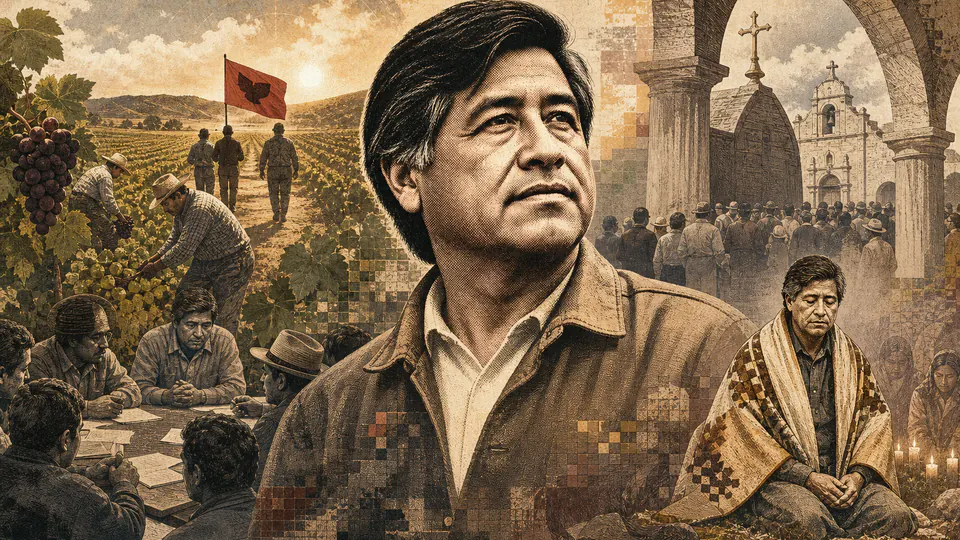
#storyOn September 16, 1965, Mexican Independence Day, the members of the National Farm Workers Association packed Our Lady of Guadalupe Church in Delano, California to vote on a strike Cesar Chavez had not planned and did not think his young union was ready for. Eight days earlier, Filipino grape pickers organized by the Agricultural Workers Organizing Committee had walked off the vines demanding a raise to $1.40 an hour. The NFWA’s own membership voted overwhelmingly to join them anyway, outvoting the man who ran it. Five years later the union that grew out of that vote put its name on the first real contracts California grape growers had ever signed.
Yuma, and the farm the county took
Chavez was born on March 31, 1927, on a small farm his family worked near Yuma, Arizona. In 1939, in the middle of the Depression, Yuma County sold the farm at auction to cover back taxes, and the Chavez family joined the migrant stream moving through California’s fields. In 1942 his father was injured in a car accident, and Cesar left school after the eighth grade rather than let his mother take his father’s place in the rows. He served in the U.S. Navy from 1944 to 1946, then came home to the same fields.
Fred Ross comes looking for him
In 1952, an organizer named Fred Ross came to Chavez’s door in San Jose. Ross ran the Community Service Organization, a Mexican American civil rights group founded in Los Angeles in 1947 that registered voters and challenged police abuse and school discrimination, and he hired Chavez to organize for it. Over the next decade Chavez rose to the CSO’s national directorship and trained two organizers of his own in Ross’s methods, Dolores Huerta and Gilbert Padilla. When he asked the CSO’s board to start organizing farmworkers directly, the board said no.
A union with no name recognition
Chavez resigned from the CSO on his 35th birthday, March 31, 1962, and moved his wife Helen and their eight children to Delano to organize farmworkers on his own. The National Farm Workers Association held its founding convention in a converted Fresno movie theater on September 30, 1962. By August 1965 it had signed up 1,700 dues-paying members and a symbol to go with them: a black Aztec eagle on a white circle and red field.
Delano, September 1965
The AWOC’s Filipino organizers, led by Larry Itliong, had already walked off ten Delano vineyards when the NFWA voted to join them. Neither union could have won alone. The AWOC had the numbers on the picket lines the growers could otherwise fill with NFWA members, and the NFWA had numbers the AWOC lacked. In 1966 the two merged into the United Farm Workers Organizing Committee. The Filipino side of that strike, and how its role later got written out of the popular version of the story, is its own article, at /causes/delano-grape-strike.
Federal labor law excluded farmworkers from its protections, so the union’s real strength turned out to be consumer boycotts, not the picket line. A national boycott of Schenley Industries, a distiller with vineyard holdings, brought the company to the table for the first genuine farm labor contract in the continental United States, signed in April 1966. That same spring Chavez led nearly a hundred strikers on a roughly 300-mile march from Delano to the state capitol, arriving in Sacramento on Easter Sunday, April 10, in front of a crowd of thousands.
Twenty-five days on water
By early 1968 some union members were talking about sabotage against strikebreakers, and Chavez, worried the movement would lose its nonviolent footing, stopped eating. Starting in mid-February he kept to water only for twenty-five days at the union’s Forty Acres complex outside Delano. Doctors warned his kidneys were failing, and he lost 35 pounds. He broke the fast on March 10, 1968, at an outdoor mass in a Delano park, too weak to speak, so Rev. James Drake read his statement to the crowd while Senator Robert F. Kennedy sat beside him. The statement said what the fast had been for:
It is my deepest belief that only by giving our lives do we find life … To be a man is to suffer for others.
Contracts, and a law behind them
The strike ran five years before it produced what a union actually needs, which is a signature on paper. On July 29, 1970, twenty-six Delano-area grape growers signed agreements covering wages, health coverage, and pesticide limits, a kind of contract American agriculture had never before put its name to. California followed in 1975 with the Agricultural Labor Relations Act, the first law in the country giving farmworkers the right to hold union elections. The state Supreme Court cleared the way that same year, ruling on January 13 in Carmona v. Division of Industrial Safety that regulators could treat the short-handled hoe, a twelve-inch tool that had caused lasting back injuries across generations of California field workers, as an unsafe hand tool, and the state’s regulators went on to ban it outright.
The union turns on itself
The union that had out-organized California’s growers spent much of the next decade organizing against its own people. In 1977 Chavez visited Synanon, the California drug-rehabilitation commune turned closed community, and brought back its confrontation exercise, called the Game, to root out anyone at the union’s La Paz headquarters he decided was disloyal. That same year he accepted an invitation from Philippine dictator Ferdinand Marcos over the objection of the union’s own Filipino vice president, Philip Vera Cruz, who had organized the original 1965 AWOC walkout. Vera Cruz later wrote that Chavez had toasted Marcos’s own hand-picked labor leaders while the country’s real union leaders sat in prison, and called the visit plainly: “What Cesar did there in the Philippines is the saddest day in the history of the farm workers movement in this country.” He resigned that year. Organizing director Marshall Ganz left in 1981, alongside other resigning members of the executive board. Dolores Huerta, Chavez’s cofounder, did not leave in the 1970s purge. What she said about her own years in the union decades later is a different, harder story, below.
San Luis, 1993
Chavez was in Yuma County, near where he was born, testifying in a lawsuit a lettuce grower had brought against the union when he died in his sleep on April 23, 1993, at 66. Six days later, mourners walked for miles behind a plain pine casket to the old Forty Acres headquarters; the union put the crowd at 30,000, and grower publications insisted it was under 10,000, a dispute that says its own thing about how the fight never ended. At the funeral mass, Chavez’s grandchildren carried a UFW eagle flag and a short-handled hoe to the altar.
What Dolores Huerta said in 2026
Thirty-three years after Chavez died, the record changed again. In March 2026 a New York Times investigation reported that Chavez had sexually abused minors during the years he led the union, and Dolores Huerta, then 95, said publicly that he had assaulted her twice, in 1960 and 1966. In her own statement, she said:
I have never identified myself as a victim, but I now understand that I am a survivor,of violence, of sexual abuse, of domineering men who saw me, and other women, as property, or things to control.
The full account of what Huerta said, and when, belongs to her own biography.
The institutional response was immediate. The United Farm Workers canceled its Cesar Chavez Day events, and within the week California’s legislature, which had marked his birthday as a state holiday since 1995, voted 37-0 in the Senate to rename the day Farmworkers Day. Los Angeles and Phoenix renamed their own local observances. Texas directed its state agencies to stop commemorating him.
What’s left
Clinton awarded Chavez the Presidential Medal of Freedom posthumously in 1994. The union itself never fully recovered from the 1970s purges and is smaller today than it was at its peak, and as of 2026 its founder’s name is coming off the streets and buildings that carried it. What is not in dispute is the paper: the 1966 Schenley contract, the 1970 Delano contracts, the 1975 Agricultural Labor Relations Act, and the ban on the short-handled hoe that had bent generations of California field workers over the rows.
In their own words
#wordsWhat Cesar Chavez actually said, where, and when. Each one links to the page it was checked against.
-
It is my deepest belief that only by giving our lives do we find life ... To be a man is to suffer for others.
Read by Rev. James Drake to the crowd at an outdoor mass in Delano, California, March 10, 1968, the statement Chavez wrote to mark the end of his twenty-five day fast for nonviolence. Cesar Chavez, statement at the end of his 1968 fast for nonviolence, Delano (March 10, 1968) -
The truest act of courage, the strongest act of manliness is to sacrifice ourselves for others in a totally non-violent struggle for justice.
The same March 10, 1968 fasting statement, on why he chose to stop eating rather than let the movement drift toward violence. Cesar Chavez, statement at the end of his 1968 fast for nonviolence, Delano (March 10, 1968) -
All my life, I have been driven by one dream, one goal, one vision: To overthrow a farm labor system in this nation which treats farm workers as if they were not important human beings.
Address to the Commonwealth Club of California, San Francisco, November 9, 1984. Cesar Chavez, Address to the Commonwealth Club of California (November 9, 1984) -
Once social change begins, it cannot be reversed. You cannot uneducate the person who has learned to read. You cannot humiliate the person who feels pride. You cannot oppress the people who are not afraid anymore.
The same November 9, 1984 Commonwealth Club address, near its close. Cesar Chavez, Address to the Commonwealth Club of California (November 9, 1984) -
The worth of humans is involved here. I see us as one family. We cannot turn our backs on each other and our future.
The Wrath of Grapes boycott speech, which Chavez delivered at rallies around the country starting in 1986. Cesar Chavez, "Wrath of Grapes" boycott speech (1986)
What people get wrong
#wrong- The myth
Cesar Chavez started the Delano grape strike. - The record
The strike began on September 8, 1965, when Filipino members of the Agricultural Workers Organizing Committee, led by Larry Itliong, walked out of Delano vineyards. Chavez's National Farm Workers Association voted to join them eight days later, on September 16, 1965, over Chavez's own doubts about whether his young union was ready.
- The myth
The grape boycott won because the picket lines shut the fields down. - The record
Federal labor law excluded farmworkers from the National Labor Relations Act, so a picket line carried none of the legal protection a factory strike had. What moved the growers was a national consumer boycott: Schenley Industries signed the first contract in April 1966 after that boycott, not after picketing alone.
- The myth
The 2026 sexual abuse allegations against Chavez were an outside attack on his legacy. - The record
The New York Times reported the allegations after roughly five years of reporting, more than sixty interviews, and hundreds of pages of union records, and Dolores Huerta, his own cofounder, corroborated the pattern the same day in a signed statement describing two assaults she said happened in 1960 and 1966.
The dates that matter
#dates- March 31, 1927 Born on his family's small farm near Yuma, Arizona.
- 1939 Yuma County sells the family farm at auction for unpaid back taxes; the Chavez family becomes migrant farm labor.
- 1942 Leaves school after the eighth grade when his father is injured in a car accident, to work the fields full time.
- 1944-1946 Serves in the U.S. Navy.
- 1952 Meets organizer Fred Ross in San Jose and joins the Community Service Organization.
- March 31, 1962 Resigns from the CSO, which had turned down his plan to organize farmworkers, on his 35th birthday, and moves his family to Delano.
- September 30, 1962 Founding convention of the National Farm Workers Association in Fresno.
- September 16, 1965 The NFWA votes, over Chavez's own doubts, to join the Filipino-led AWOC strike against Delano grape growers.
- April 1966 Schenley Industries signs the strikers' first contract after a national boycott.
- March 17 to April 10, 1966 Leads a roughly 300-mile march from Delano to the state capitol in Sacramento.
- Mid-February to March 10, 1968 Fasts on water only for twenty-five days; breaks it at a Delano mass with Robert Kennedy present.
- July 29, 1970 Twenty-six Delano-area growers sign United Farm Workers contracts, ending the strike.
- 1977 Brings Synanon's confrontation exercise, the Game, into the union, and visits Philippine dictator Ferdinand Marcos; cofounder Philip Vera Cruz resigns in protest.
- April 23, 1993 Dies in his sleep near San Luis, Arizona, at 66.
- March 18, 2026 A New York Times investigation reports Chavez sexually abused minors while leading the union; Dolores Huerta says publicly he assaulted her in 1960 and 1966.
- March 2026 The UFW cancels its Cesar Chavez Day events, and within the week California's legislature votes to rename the day Farmworkers Day.
Questions people ask
#faqsWho was Cesar Chavez?
Cesar Chavez (1927-1993) was a farmworker from Yuma, Arizona who trained as an organizer with the Community Service Organization in the 1950s, then co-founded the National Farm Workers Association in 1962. That union joined the Filipino-led Delano grape strike in 1965 and, after a five-year national boycott, forced California grape growers to sign the first real farm labor contracts in the country.
What did Cesar Chavez actually do for farmworkers?
His union won contracts covering wages, health plans, and pesticide limits, starting with Schenley Industries in 1966 and twenty-six Delano growers in 1970, and it pushed California to pass the 1975 Agricultural Labor Relations Act, the first law in the country giving farmworkers the right to hold union elections. The state also banned the short-handled hoe that had crippled generations of field workers, after a 1975 court ruling the union's lawyers won.
Why did Cesar Chavez go on a hunger strike?
In February 1968, with some union members talking about violence against strikebreakers, Chavez stopped eating to hold the movement to nonviolence. He kept to water only for twenty-five days, lost 35 pounds, and broke the fast on March 10, 1968, at an outdoor mass in Delano, too weak to speak; Senator Robert F. Kennedy sat beside him.
Did the Delano grape strike actually work?
Yes. The strike and the boycott that grew out of it ran from September 1965 to July 29, 1970, when twenty-six Delano-area grape growers signed union contracts. The union's later history was rockier: internal purges through the late 1970s and early 1980s drove out much of its original leadership, and membership fell from its peak.
How did Cesar Chavez die?
He died in his sleep on April 23, 1993, near San Luis, Arizona, close to where he was born, while in the area for a lawsuit a lettuce grower had brought against the union. He was 66. President Clinton awarded him the Presidential Medal of Freedom posthumously in 1994.
Did Cesar Chavez sexually abuse Dolores Huerta?
In March 2026, a New York Times investigation reported that Chavez had sexually abused minors during his years leading the union, and Dolores Huerta, then 95, said publicly that he had assaulted her twice, in 1960 and 1966. California's legislature voted 37-0 the same week to rename Cesar Chavez Day, which the state had observed since 1995, as Farmworkers Day.
The bookshelf
#bookshelfWhere to go next. Buy from an independent bookstore, or find it at your library for nothing.
-
An Organizer's Tale: Speeches Cesar Chavez, 2008 primary
His own speeches, collected, from the Delano strike years to his congressional testimony on pesticides.
-
Cesar Chavez: Autobiography of La Causa Jacques E. Levy, 1975 primary
Chavez's own account of the union's founding and the strike years, told across six years of interviews with Levy.
-
The Crusades of Cesar Chavez: A Biography Miriam Pawel, 2014 secondary
The fullest biography, including the Synanon-era purges and the union's decline, built from union archives Pawel was the first historian to use.
Wear it: Cesar Chavez
#merchEvery design here links back to this page.
Sources
#sourcesPrimary sources
The documents themselves: laws, court opinions, speeches, letters, and the numbers from the agencies that count them.
- Cesar Chavez, statement at the end of his 1968 fast for nonviolence, Delano (March 10, 1968) (read by Rev. James Drake; source of the closing quote)
- Philip Vera Cruz, quoted in "When Cesar Chavez embraced a dictator, a Fil-Am hero said, 'No se puede'", Inquirer.net
- Carmona v. Division of Industrial Safety, 13 Cal.3d 303 (Cal. Supreme Court, January 13, 1975)
- Cesar Chavez, Address to the Commonwealth Club of California (November 9, 1984)
- Cesar Chavez, "Wrath of Grapes" boycott speech (1986) (his own speech text, reproduced)
- Voices of Monterey Bay, "A statement from Dolores Huerta" (March 18, 2026)
Secondary sources
Written afterward, about the story.
- Wikipedia, "Cesar Chavez"
- Wikipedia, "United Farm Workers" (source for Philip Vera Cruz's 1977 departure and the union's leadership losses through the 1980s)
- Wikipedia, "Community Service Organization" (source for the CSO board rejecting Chavez's farmworker-organizing proposal)
- San Jose State University, "Before Silicon Valley" digital exhibit, entry on Chavez's early life (source for the 1939 farm auction)
- Latin American Studies, "Cesar Chavez Chronology" (source for the March 31, 1962 CSO resignation and September 30, 1962 NFWA convention)
- Latin American Studies, "The Story of Cesar Chavez" (source for the 1942 eighth-grade departure and Navy service dates)
- Encyclopedia.com, "César Chávez" (source for the 1,700 dues-paying NFWA members by August 1965 and the twenty-six 1970 contracts)
- National Park Service, "Workers United: The Delano Grape Strike and Boycott"
- National Park Service, "The Road to Sacramento: Marching for Justice in the Fields"
- Farmworker Movement Documentation Project (CSUN), "[25] Cesar Chavez's fasting"
- Labor Notes, "Review: Cesar Chavez Remembered, Warts and All" (2014) (on Miriam Pawel's biography and the Synanon-era purges)
- History News Network, "The Last Time I Saw César" (source for the funeral procession, the crowd-count dispute, and the hoe placed on the altar)
- Wikipedia, "Cesar Chavez Day" (source for the 1995-2025 California holiday and its March 2026 renaming to Farmworkers Day)
- Wikipedia, "Dolores Huerta" (source for Huerta's March 18, 2026 statement, citing the New York Times investigation)
- Nadia Lathan, "California moves to erase César Chávez's name after sex abuse allegations surface," CalMatters (March 26, 2026)
- PBS NewsHour, "Labor rights leader Dolores Huerta says she was sexually abused by Cesar Chavez" (March 18, 2026)