Published
Dolores Huerta
Dolores Huerta Coined "Sí Se Puede," Then a Presidential Campaign Borrowed It
Born April 10, 1930
Dolores Huerta co-founded the farmworkers' union in 1962, negotiated its contracts, and answered no se puede with sí se puede in Phoenix in 1972.
The story
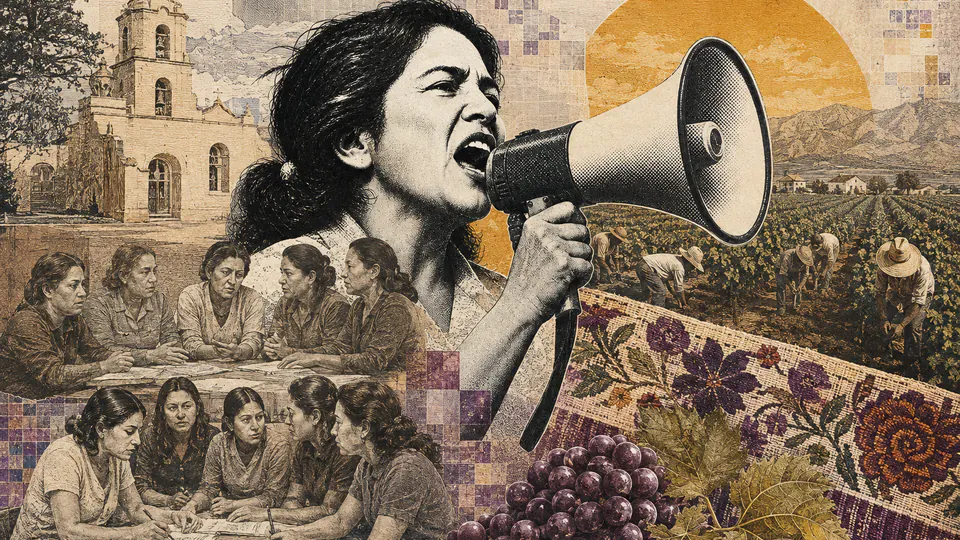
#storyArizona House Bill 2134 cleared the state Senate on May 11, 1972, and Governor Jack Williams signed it forty-five minutes later. The law outlawed secondary boycotts and banned farmworkers from striking at harvest, the only weeks of the year when unpicked fruit costs a grower anything. Cesar Chavez began a water-only fast at Santa Rita Hall in Phoenix that same day. Local Latino political and labor figures came to the hall to explain to the organizers that the growers’ lobby in Arizona could not be beaten: no se puede. Dolores Huerta’s answer was sí se puede. The room stood up clapping it, and thirty-six years later a senator from Illinois ran a presidential campaign on the English translation.
Huerta co-founded that union with Chavez in Delano in 1962, wrote its first contract with a grower in 1966, and was its lead negotiator when twenty-six Delano growers signed in July 1970 and the five-year grape strike ended. She is 96 years old. By her foundation’s count she has been arrested more than twenty-five times, and she raised eleven children in the middle of all of it. The three words are the part of her record everyone can recite, and the part whose authorship kept getting handed to somebody else.
Stockton, and the kids without shoes
Dolores Clara Fernández was born on April 10, 1930 in Dawson, New Mexico, a coal camp. Her father, Juan Fernández, mined coal, carried a union card, and later won a seat in the New Mexico legislature. Her parents divorced when she was three, and her mother, Alicia Chávez, raised her in Stockton, California while running a hotel and restaurant that housed and fed farmworkers cheaply or for nothing.
She earned a teaching credential and lasted about a year in a classroom. The National Archives quotes her explanation for leaving:
I couldn’t tolerate seeing kids come to class hungry and needing shoes,” she said. “I thought I could do more by organizing farm workers than by trying to teach their hungry children.
In 1955 she met the organizer Fred Ross and joined the Community Service Organization, which ran voter registration drives and pushed for Spanish language ballots and driver’s tests. The CSO sent her to Sacramento to lobby, and in 1963 that work extended Aid to Families with Dependent Children and disability insurance to California farmworkers. It also introduced her to a CSO staffer named Cesar Chavez.
The union, 1962
Huerta, Chavez, and Gilbert Padilla founded the National Farm Workers Association in Delano in 1962. Congress had written agricultural workers out of the National Labor Relations Act in 1935, so none of the machinery a union normally uses existed for them: no protected right to organize, no election procedure, no board to complain to. What farmworkers had instead was the crop, which rots, and the consumer, who can be asked to stop buying.
On September 8, 1965, the Filipino members of the Agricultural Workers Organizing Committee walked out of the Delano grape fields, and Huerta’s union joined the strike that month. Huerta ran the boycott operation, organizing a wine boycott across California and then directing the grape boycott out of New York and New Jersey, which is the work that carried a strike in the San Joaquin Valley into supermarkets in cities that had never seen a grape field.
What she got in writing
The negotiating is the part of Huerta’s record that exists as paper with signatures on it. In 1966, with no legal training and no experience of ever having drafted a contract, she negotiated the union’s agreement with the Schenley wine company, the first contract between an American grower and a farmworkers’ union.
On July 29, 1970, twenty-six Delano growers signed and the strike ended. The contracts set an hourly wage of $1.76 with fifteen-cent annual raises, added a twenty-five-cent bonus per box, funded health and welfare plans, and banned DDT in the fields those growers farmed. A union that federal labor law did not cover had put a pesticide ban into a commercial contract and gotten twenty-six companies to sign it.
California passed the Agricultural Labor Relations Act five years later, in 1975, giving the state’s farmworkers a legal right to bargain collectively for the first time. Huerta lobbied it through.
Phoenix, 1972
Arizona moved in the other direction. HB 2134 was written to keep the union out of the state, and Chavez answered it with a fast at Santa Rita Hall that ran 24 days and ended on June 4, 1972. Huerta was in the hall for the meetings with the political and community leaders who came. Fifty years later she told the Phoenix public radio station KJZZ what those meetings had sounded like:
And they said to me, ‘No, aqui en Arizona, no se puede.’
My answer to them was, ‘Si se puede en Arizona.’
The Arizona campaign turned into a recall drive against Governor Williams. Organizers filed 176,152 signatures; enough of them were struck as invalid that the recall never reached a ballot. The chant did better than the petition.
Who owns three words
Sí se puede is a federally registered trademark of the United Farm Workers. When the Mexican airline AeroMexico applied to register the phrase with the US Trademark Office, the union went after the application; AeroMexico dropped it and agreed to stop using the line.
The chant went national in 2006, on signs at the immigration marches in American cities. Barack Obama began using the English version in his 2004 Illinois Senate primary campaign and built the 2008 presidential run around it after his second-place finish in New Hampshire. On May 29, 2012, at the Medal of Freedom ceremony in the East Room of the White House, he said this with her standing there:
And on a personal note, Dolores was very gracious when I told her I had stolen her slogan, “Si, se puede.” Yes, we can.
The attribution is worth stating precisely, because it has never been tidy. Huerta says she coined the phrase in Phoenix. The rhetoric scholars John Hammerback and Richard Jensen attributed it to Chavez, as Stacey Sowards documents in her 2019 study of Huerta’s speeches and letters. Chavez credited Huerta. So did the president who borrowed it.
September 14, 1988
Huerta was 58 and standing outside the St. Francis Hotel in San Francisco, handing out a press release criticizing Vice President George H. W. Bush, who opposed the union’s grape boycott over pesticide use. Police moved into the crowd with batons. An officer’s baton broke her ribs and ruptured her spleen. She was bleeding internally and went into emergency surgery.
San Francisco settled for $825,000. The police department rewrote its rules on crowd control and discipline. Huerta stepped down as vice president of the UFW in 1999 and started the Dolores Huerta Foundation in 2003 with a $100,000 Puffin Prize she had been awarded the year before.
March 18, 2026
The New York Times published an investigation by Manny Fernandez and Sarah Hurtes on March 18, 2026, reported over roughly five years, drawing on more than sixty interviews and hundreds of pages of union records, describing accusations that Cesar Chavez sexually abused girls and women in the farmworker movement. Huerta released a written statement the same day. She said Chavez sexually assaulted her twice in the 1960s, that both assaults resulted in pregnancies, and that she had arranged for other families to raise those children. She said she had held it for about sixty years to protect the farmworker movement she had spent her life building.
I have kept this secret long enough. My silence ends here.
She was 95 when she published that. The statement also separates the man from the work:
Cesar’s actions do not reflect the values of our community and our movement.
The Cesar Chavez Foundation said it was “deeply shocked and saddened by what we are hearing.” The UFW declined to take part in Cesar Chavez Day on March 31. Marches carrying his name in San Antonio, Corpus Christi, Tucson, and San Francisco were called off.
What the record holds
Huerta is still working, running the foundation she started in 2003. Everything else in this article is documentation: contracts with twenty-six signatures on them, a settlement paid out by the City of San Francisco, a trademark registration, a stack of recall petitions ruled invalid, a statement published in March under her own name. At the White House in 2012, before he got to the part about stealing her slogan, Obama read out the answer she gives people who ask how to start. “Don’t wait to be invited,” she says, “Step in there.”
In their own words
#wordsWhat Dolores Huerta actually said, where, and when. Each one links to the page it was checked against.
-
I couldn't tolerate seeing kids come to class hungry and needing shoes. I thought I could do more by organizing farm workers than by trying to teach their hungry children.
Her own explanation, recorded by the National Archives, for why she left a teaching job to join the Community Service Organization in the 1950s. National Archives, Prologue blog, "Dolores Huerta: Sí, se puede" (October 11, 2023) -
And they said to me, 'No, aqui en Arizona, no se puede.' My answer to them was, 'Si se puede en Arizona.'
Telling Phoenix public radio station KJZZ, fifty years later, what she heard and said at Santa Rita Hall in Phoenix in 1972. KJZZ, "Dolores Huerta tells the story of 'Si se puede' at Santa Rita Hall in Phoenix" (May 13, 2022) -
Don't wait to be invited. Step in there.
Her own answer to people asking how to get started organizing, quoted by Barack Obama at her Presidential Medal of Freedom ceremony, White House, May 29, 2012. Barack Obama, "Remarks by the President at Presidential Medal of Freedom Ceremony" (May 29, 2012) -
I have kept this secret long enough. My silence ends here.
Her written statement published March 18, 2026, the day the New York Times reported the investigation into Cesar Chavez. Voices of Monterey Bay, "A statement from Dolores Huerta" (March 18, 2026) -
Cesar's actions do not reflect the values of our community and our movement.
The same March 18, 2026 written statement, separating the union's work from Chavez's own conduct. Voices of Monterey Bay, "A statement from Dolores Huerta" (March 18, 2026)
What people get wrong
#wrong- The myth
Dolores Huerta was Cesar Chavez's assistant, a junior partner in a union he ran. - The record
She co-founded the National Farm Workers Association with Chavez and Gilbert Padilla in 1962, negotiated the union's first grower contract with the Schenley wine company in 1966 with no legal training and no experience writing a contract, and was its lead negotiator on the twenty-six Delano contracts signed July 29, 1970.
- The myth
Sí se puede was Cesar Chavez's line, and crediting Huerta rewrites the record. - The record
Huerta says she coined it answering local political and labor figures at Santa Rita Hall in Phoenix in 1972, an account Chavez himself credited to her and that Obama repeated at her 2012 Medal of Freedom ceremony. The rhetoric scholars John Hammerback and Richard Jensen attributed the phrase to Chavez instead, so the record holds two competing attributions rather than one settled answer.
- KJZZ, "Dolores Huerta tells the story of 'Si se puede' at Santa Rita Hall in Phoenix" (May 13, 2022)
- Stacey K. Sowards, Sí, Ella Puede: The Rhetorical Legacy of Dolores Huerta and the United Farm Workers (University of Texas Press, 2019)
- The myth
The 1988 police beating was a minor incident, or Huerta exaggerated her injuries. - The record
A San Francisco police officer's baton broke her ribs and ruptured her spleen outside the St. Francis Hotel on September 14, 1988, requiring emergency surgery. The city paid an $825,000 settlement and rewrote its police department's crowd control and discipline rules afterward.
The dates that matter
#dates- April 10, 1930 Born Dolores Clara Fernández in Dawson, New Mexico, a coal camp. Her father mines coal, belongs to the union, and later sits in the New Mexico legislature.
- 1955 Meets the organizer Fred Ross and joins the Community Service Organization in Stockton, California, where she also meets Cesar Chavez.
- 1962 Co-founds the National Farm Workers Association in Delano with Cesar Chavez and Gilbert Padilla.
- 1963 Her lobbying in Sacramento extends Aid to Families with Dependent Children and disability insurance to California farmworkers.
- September 1965 Joins the Delano grape strike begun by the Filipino members of the Agricultural Workers Organizing Committee.
- 1966 Negotiates the first contract between an American grower and a farmworkers' union, with the Schenley wine company, having never drafted a contract before.
- July 29, 1970 Twenty-six Delano growers sign the contracts she negotiated, ending the five-year strike.
- May 11, 1972 Arizona passes House Bill 2134; Governor Jack Williams signs it forty-five minutes later, and Cesar Chavez begins a fast at Santa Rita Hall in Phoenix.
- 1972 Answers no se puede with sí se puede at Santa Rita Hall. The union takes it as the chant of the Arizona campaign.
- 1975 California passes the Agricultural Labor Relations Act, the first state law giving farmworkers the right to bargain collectively.
- September 14, 1988 Beaten by a San Francisco police officer outside the St. Francis Hotel; emergency surgery for a ruptured spleen and broken ribs.
- 1999 Steps down as vice president of the United Farm Workers.
- 2003 Founds the Dolores Huerta Foundation with a $100,000 Puffin Prize awarded the previous year.
- May 29, 2012 Receives the Presidential Medal of Freedom in the East Room, where Obama says he stole her slogan.
- March 18, 2026 Publishes a statement saying Cesar Chavez sexually assaulted her twice in the 1960s, the day the New York Times publishes its investigation.
Questions people ask
#faqsWho is Dolores Huerta?
Dolores Huerta (born April 10, 1930) is an American labor organizer who co-founded the National Farm Workers Association, the union that became the United Farm Workers, with Cesar Chavez and Gilbert Padilla in Delano, California in 1962. She negotiated the union's contracts, helped push California's 1975 Agricultural Labor Relations Act into law, and has led the Dolores Huerta Foundation since 2003.
Who came up with sí se puede?
Dolores Huerta, at Santa Rita Hall in Phoenix in 1972. Arizona had just passed a law banning farmworker strikes at harvest, and local political and labor figures told her the growers' lobby could not be beaten there: no se puede. Her answer, sí se puede, became the union's chant. Cesar Chavez credited her with it, and so did Barack Obama at the 2012 Medal of Freedom ceremony, though the scholars John Hammerback and Richard Jensen attributed the phrase to Chavez.
What did Dolores Huerta actually do for farm workers?
She negotiated the union's contracts. In 1966 she made the first agreement between an American grower and a farmworkers' union, with the Schenley wine company. The contracts twenty-six Delano growers signed on July 29, 1970 set an hourly wage of $1.76 with fifteen-cent annual raises, a twenty-five-cent bonus per box, health and welfare funds, and a ban on DDT in those fields. Her earlier lobbying in Sacramento extended Aid to Families with Dependent Children and disability insurance to California farmworkers in 1963.
What happened to Dolores Huerta in 1988?
On September 14, 1988, San Francisco police broke up a demonstration outside the St. Francis Hotel where Huerta, then 58, was handing out a press release criticizing Vice President George H. W. Bush over the union's grape boycott. An officer struck her with a baton, breaking ribs and rupturing her spleen, and she needed emergency surgery. San Francisco settled for $825,000, and the police department changed its crowd control and discipline policies.
What did Dolores Huerta say about Cesar Chavez in 2026?
On March 18, 2026, the day the New York Times published an investigation into accusations of sexual abuse by Cesar Chavez, Huerta released a written statement saying he sexually assaulted her twice in the 1960s, that both assaults resulted in pregnancies, and that she had kept it private for about sixty years to protect the farmworker movement. She wrote that she had kept the secret long enough and that her silence ended there.
The bookshelf
#bookshelfWhere to go next. Buy from an independent bookstore, or find it at your library for nothing.
-
A Dolores Huerta Reader Mario T. García, editor, 2008 primary
Her own letters to Chavez, her 1969 Senate testimony, speeches, and interviews, collected in one volume.
-
Sí, Ella Puede!: The Rhetorical Legacy of Dolores Huerta and the United Farm Workers Stacey K. Sowards, 2019 secondary
The fullest academic treatment of her speeches and the sí se puede attribution question.
-
Dolores Huerta: A Life in American History April Tellez, Peg A. Lamphier, and Rosanne Welch, 2025 secondary
A general-audience biography placing her organizing inside the broader civil rights era.
Wear it: Dolores Huerta
#merchEvery design here links back to this page.
Sources
#sourcesPrimary sources
The documents themselves: laws, court opinions, speeches, letters, and the numbers from the agencies that count them.
- Barack Obama, "Remarks by the President at Presidential Medal of Freedom Ceremony" (May 29, 2012) (official transcript; source of the stolen-slogan line and the Don't wait to be invited quotation)
- KJZZ, "Dolores Huerta tells the story of 'Si se puede' at Santa Rita Hall in Phoenix" (May 13, 2022) (her own account of the exchange, in her words)
- Voices of Monterey Bay, "A statement from Dolores Huerta" (March 18, 2026) (her statement, reprinted with permission from her Medium post; source of the quoted lines)
Secondary sources
Written afterward, about the story.
- National Archives, Prologue blog, "Dolores Huerta: Sí, se puede" (October 11, 2023) (source of the classroom quotation and her role as lead negotiator on the final contracts)
- Barriozona Magazine, "Cesar E. Chavez in Phoenix: 1972 fast at the Santa Rita Hall" (HB 2134, the forty-five-minute signature, and the fast's dates)
- Wikipedia, "Jack Williams (American politician)" (the bill's provisions and the recall petitions filed against Williams)
- Wikipedia, "Sí se puede" (the UFW trademark, the AeroMexico application, and Obama's use of the English translation)
- EBSCO Research Starters, "Dolores Huerta" (the 1966 Schenley contract, the terms signed on July 29, 1970, and her eleven children)
- Dolores Huerta Foundation, "Dolores Huerta" biography and FAQ (arrest count, the 1988 injuries, the foundation's founding, and her awards)
- HISTORY, "Dolores Huerta beaten by police while peacefully protesting" (September 14, 1988) (the St. Francis Hotel protest, the injuries, and the $825,000 settlement)
- Smithsonian Magazine, "Why 'Sí, Se Puede' Was the Winning Motto for the United Farm Workers" (the 1935 exclusion of farmworkers from the NLRA and the 1965 walkout)
- PBS NewsHour, "Labor rights leader Dolores Huerta says she was sexually abused by Cesar Chavez" (March 18, 2026)
- TIME, "Dolores Huerta Breaks Silence on Cesar Chavez Allegations" (March 18, 2026)
- Texas Public Radio, "Dolores Huerta comes forward as sexual abuse allegations against Cesar Chavez emerge" (March 18, 2026) (the Cesar Chavez Foundation statement and the canceled marches)
- Wikipedia, "Cesar Chavez sexual abuse allegations" (the New York Times investigation's reporters, span, and reporting base)
- Stacey K. Sowards, Sí, Ella Puede: The Rhetorical Legacy of Dolores Huerta and the United Farm Workers (University of Texas Press, 2019) (traces the competing attributions of the slogan to Huerta and to Chavez)