Published
Larry Itliong
Larry Itliong Called the Delano Grape Strike Before the Famous Version Starts
Born October 25, 1913. Died February 8, 1977
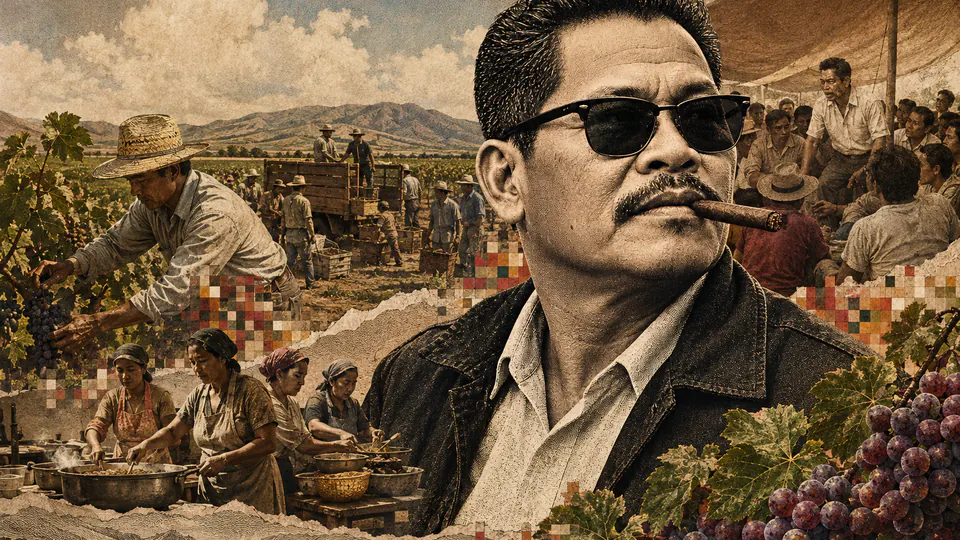
Larry Itliong organized Filipino farmworkers for decades and led the September 8, 1965 walkout that began the Delano grape strike.
The story
#storyThe Delano grape strike began on September 8, 1965, when Filipino farmworkers in the Agricultural Workers Organizing Committee voted to walk out. Larry Itliong was one of the leaders who called it. The better-known organization led by Cesar Chavez and Dolores Huerta joined one week later.
Starting with that order does not shrink anybody else’s work. It restores the workers who took the first risk.
A manong on the labor circuit
Itliong was born in Pangasinan, Philippines in 1913 and came to the United States as a teenager. Like many Filipino migrants of his generation, he moved with harvests and cannery seasons through Alaska, Washington, and California. Racist immigration and marriage laws left many of these men, known respectfully as manongs, without families in the United States.
Itliong organized from the 1930s onward. He worked with the cannery union and the ILWU, helped lead a 1948 asparagus strike in Stockton, and founded the Filipino Farm Labor Union there in 1956. By 1959 he was organizing for AWOC, an AFL-CIO project with a strong Filipino membership.
September 8 in Delano
Grape growers had long used ethnic divisions to defeat farm strikes. AWOC members voted to stop work after growers refused wage demands that followed a successful strike in Coachella. Itliong asked the National Farm Workers Association to join. Chavez believed his younger organization was not ready, but its members voted to walk out on September 16.
Filipino and Mexican workers built the Delano grape strike and national boycott together. AWOC and the NFWA merged in 1966 as the United Farm Workers Organizing Committee. Itliong became assistant director and later national boycott coordinator. Five years of strike and boycott produced contracts in 1970.
Leaving the union, keeping the work
Itliong resigned from the union in October 1971 after disputes over leadership and the place of Filipino workers in the organization. Philip Vera Cruz remained a vice president longer, then left after another internal dispute.
Itliong worked on Agbayani Village, housing for retired Filipino farmworkers, and on Filipino political and community projects. He died in Delano in 1977.
The popular grape-strike story once began on September 16. The archive says September 8. Eight days contain an entire politics of memory: who gets named, who becomes a supporting character, and how easily the person who called the strike can vanish from the first sentence.
U.S. colonial rule shaped the migration route
Itliong arrived in the United States in 1929 from a Philippines under U.S. colonial rule. Filipinos could migrate as U.S. nationals, yet encountered racial exclusion, anti-miscegenation law, mob violence, and occupational restriction.
Young men followed agricultural seasons and cannery work because stable jobs and land ownership were difficult to obtain. They moved between Alaska, the Pacific Northwest, and California, creating labor and social networks across great distance.
The manong generation was disproportionately male. Immigration and marriage rules restricted family formation, leaving many older workers without children or pensions after decades of labor. That history later made housing at Agbayani Village a union obligation rather than charity.
Earlier strikes supplied the Delano leadership
Itliong organized cannery and farm labor long before 1965. Seasonal industries allowed employers to recruit a divided workforce, wait out a crop, and blacklist leaders who would need a job in the next region.
The 1948 Stockton asparagus strike and Filipino Farm Labor Union developed organizers, relationships, and lessons about timing. AWOC later gave Itliong an AFL-CIO base for agricultural organizing, though farmworkers remained excluded from major federal labor protections.
His missing fingers became the source of the nickname Seven Fingers, but the accident should not become folklore detached from work. Farm and industrial labor routinely placed workers’ bodies at risk without durable compensation.
Coachella set the wage demand before Delano
AWOC had won a wage increase in the Coachella grape harvest earlier in 1965. When the season moved north, Delano growers refused comparable demands. Filipino workers met and voted to strike on September 8.
That chronology explains both confidence and danger. Workers had evidence growers could pay more, but the crop could be harvested with replacement labor if other groups did not join. Itliong approached the National Farm Workers Association because unity was a practical condition of victory.
The NFWA’s members voted to join on September 16. The alliance challenged the growers’ long-standing ability to divide Filipino and Mexican workers.
Merger created strength and unequal memory
AWOC brought experienced organizers, an established strike, and AFL-CIO support. The NFWA brought a growing community base, strong volunteer networks, and leadership including Cesar Chavez and Dolores Huerta. The organizations merged in 1966.
Coalition did not erase language, culture, age, or organizational differences. Filipino leaders could become less visible as Chavez’s national profile grew and public accounts sought one central hero.
Itliong served as assistant director and boycott coordinator. The five-year campaign used pickets, a march to Sacramento, consumer boycotts, religious support, and national organizing to win grape contracts in 1970.
Agbayani Village answered a debt to retired workers
Older Filipino farmworkers had spent their lives in labor camps and fields without secure retirement housing. The union built Agbayani Village in Delano with volunteer labor, and the complex opened in 1974.
Itliong worked on the project after leaving union office. The village gave material form to a historical claim: the men who had sustained agriculture and organized its workers should not be discarded when their labor power ended.
Its name honored Paulo Agbayani, who died during the 1966 march. Memory was attached to rooms and services rather than only a plaque.
Resignation revealed unresolved questions of union power
Itliong resigned in 1971 amid disputes over governance, strategy, and Filipino workers’ place in the union. A merger necessary to defeat growers had not settled how authority would be shared afterward.
He continued Filipino community and political work, including support for younger activists. He died in 1977 at sixty-three, before public institutions widely recognized his role.
Restoring September 8 is more than correcting a calendar. It changes how a movement is understood. Filipino workers did not appear as supporters after a strike began. They evaluated the crop, set the demand, voted, walked out, and asked another organization to join a risk already underway.
In their own words
#wordsWhat Larry Itliong actually said, where, and when. Each one links to the page it was checked against.
-
You go to the United States where they pick money on trees. Did that happen? Hell, no.
A taped classroom talk to Debra Panganiban Louie's Asian American studies class at UC Santa Cruz, 1976, a year before his death. Emil Guillermo, "Restoring Larry Itliong to his rightful place during Filipino American History Month," AALDEF (October 16, 2013) -
I feel we are just as good as any of them. I feel we have the same rights as any of them. Because in that Constitution, it said that everybody has equal rights and justice. You've got to make that come about. They are not going to give it to you.
The same 1976 taped classroom talk. Emil Guillermo, "Restoring Larry Itliong to his rightful place during Filipino American History Month," AALDEF (October 16, 2013) -
Prior to 1936, we were nobody. We're not considered nationals, aliens, not considered citizens, we're nothing. We are nothing in this country. It means you don't have any kind of recognition.
The same 1976 talk, on the legal status of Filipino migrants before he began organizing. Emil Guillermo, "Restoring Larry Itliong to his rightful place during Filipino American History Month," AALDEF (October 16, 2013) -
Lots of Pinoys don't like me because I'm an outspoken person. If I don't like you, I'll tell you, you know. But if I know you're wrong, I'll tell you you're wrong.
The same 1976 talk, on his reputation among fellow Filipino organizers. Emil Guillermo, "Restoring Larry Itliong to his rightful place during Filipino American History Month," AALDEF (October 16, 2013)
What people get wrong
#wrong- The myth
Cesar Chavez started the Delano grape strike. - The record
Filipino members of the Agricultural Workers Organizing Committee, led by Itliong, voted to strike Delano grape growers on September 8, 1965. Chavez's National Farm Workers Association voted to join eight days later, on September 16.
- The myth
Itliong was a minor figure next to Chavez in the union that followed. - The record
He had organized farm and cannery labor since the 1930s, founded the Filipino Farm Labor Union in 1956, and after the 1966 merger became assistant director and national boycott coordinator of the United Farm Workers, a senior officer role, not a supporting one.
- The myth
The manong generation's needs were absorbed into the union without anything specific to show for it. - The record
Discriminatory immigration and anti-miscegenation laws had left many older Filipino farmworkers without spouses, children, or pensions after decades of labor. The union built Agbayani Village in Delano specifically to house them in retirement; it opened in 1974, and Itliong worked on the project after leaving union office.
The dates that matter
#dates- October 25, 1913 Born in San Nicolas, Pangasinan, Philippines.
- 1929 Arrives in the United States and begins farm and cannery work.
- 1948 Takes part in the Stockton asparagus strike with other Filipino organizers.
- 1956 Founds the Filipino Farm Labor Union in Stockton.
- 1959 Begins organizing for the Agricultural Workers Organizing Committee.
- September 8, 1965 AWOC's Filipino grape workers walk out in Delano.
- 1966 AWOC and the NFWA merge into the United Farm Workers Organizing Committee.
- October 15, 1971 Resigns from the UFW.
- February 8, 1977 Dies in Delano, California.
Questions people ask
#faqsWho started the Delano grape strike?
Filipino members of the Agricultural Workers Organizing Committee voted to strike on September 8, 1965. Leaders included Larry Itliong, Philip Vera Cruz, Benjamin Gines, and Pete Velasco.
Who was Larry Itliong?
Larry Itliong was a Filipino American farmworker organizer who helped lead AWOC, began the Delano strike, and became an officer of the merged United Farm Workers.
Why was Larry Itliong called Seven Fingers?
He had lost three fingers in a work accident, leaving seven. The nickname appears throughout accounts of his organizing life.
Why did Larry Itliong leave the UFW?
He resigned in 1971 amid disagreements over union direction, governance, and attention to Filipino workers, then concentrated on Filipino community work.
The bookshelf
#bookshelfWhere to go next. Buy from an independent bookstore, or find it at your library for nothing.
-
Journey for Justice: The Life of Larry Itliong Dawn Bohulano Mabalon and Gayle Romasanta, 2018 secondary
The first book devoted to Itliong, aimed at young readers but sourced from archival research.
-
Little Manila Is in the Heart: The Making of the Filipina/o American Community in Stockton, California Dawn Bohulano Mabalon, 2013 secondary
The scholarly history of the Stockton manong community Itliong organized within for decades before Delano.
-
Philip Vera Cruz: A Personal History of Filipino Immigrants and the Farmworkers Movement Craig Scharlin and Lilia V. Villanueva, 1992 secondary
A fellow AWOC organizer's account of the same strike, from inside the Filipino leadership.
Wear it: Larry Itliong
#merchEvery design here links back to this page.
Sources
#sourcesPrimary sources
The documents themselves: laws, court opinions, speeches, letters, and the numbers from the agencies that count them.
Secondary sources
Written afterward, about the story.