Published
Philip Vera Cruz
Philip Vera Cruz Built a Farmworker Union and Refused to Become Its Footnote
Born December 25, 1904. Died June 12, 1994
Philip Vera Cruz helped launch the Delano strike, became a UFW vice president, built Agbayani Village, and left over union politics.
The story
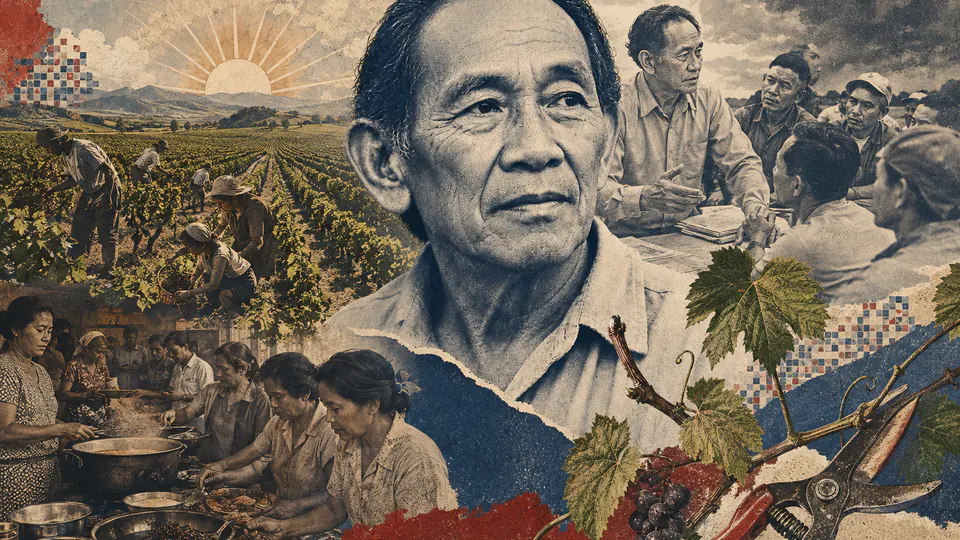
#storyPhilip Vera Cruz arrived in the United States from the Philippines in 1926 with a few dollars and the expectation that work might pay for an education. It took nearly four decades of farms, canneries, restaurants, and factories before he became a vice president of a union known around the world.
His papers fill eight linear feet at Detroit’s Reuther Library. That is useful because farmworker history was often compressed until Filipino organizers fit somewhere after the star’s name.
Twenty years before Delano
Vera Cruz was born in Ilocos Sur in 1904. After migrating, he worked around the Midwest and West and settled into California farm labor in 1943. He joined the 1948 Stockton asparagus strike, part of the long organizing record among Filipino manongs.
By 1965 he was a leader in the Agricultural Workers Organizing Committee. On September 8, AWOC’s Filipino grape workers voted to strike in Delano. Vera Cruz, Larry Itliong, Benjamin Gines, and Pete Velasco were among the leaders. The National Farm Workers Association joined on September 16.
A vice president and a village
The organizations merged in 1966, eventually becoming the United Farm Workers. Vera Cruz became a vice president, the union’s highest-ranking Filipino officer. He worked on bargaining, boycotts, and the Delano strike that ended with contracts in 1970.
He also helped create Agbayani Village, a retirement community for elderly Filipino farmworkers who had spent their lives in the fields and labor camps. Volunteers built the complex in Delano, and it opened in 1974. The name honored Filipino labor leader Paulo Agbayani, who had died on the 1966 march to Sacramento.
The resignation belongs in the story
Vera Cruz criticized centralized control inside the UFW. In 1977 he resigned after Cesar Chavez visited the Philippines and accepted honors from Ferdinand Marcos, whose government ruled under martial law. Vera Cruz saw the visit as a betrayal of Filipino workers and opponents of dictatorship.
He continued speaking, organizing, and documenting the manong generation. With Craig Scharlin and Lilia Villanueva, he produced Philip Vera Cruz: A Personal History of Filipino Immigrants and the Farmworkers Movement. He died in 1994.
Vera Cruz’s record resists the clean commemorative photograph. He helped build the union, held high office in it, created something concrete for retired workers, and left when its politics crossed a line. Loyalty to workers did not require loyalty to every decision made in their name.
The sequence changes the argument
Accounts often compress Philip Vera Cruz into a supporting player in someone else’s farmworker story. The chronology makes a larger claim. Vera Cruz migrated from the Philippines in 1926 and entered a labor market structured by colonial status, racial exclusion, and migratory work. He spent years in farms, canneries, restaurants, and other low-wage jobs before becoming a full-time organizer. Neither fact is background decoration. Together they explain why the conflict took the form it did and why participants did not treat patience as a serious answer.
Filipino workers in the Agricultural Workers Organizing Committee initiated the 1965 Delano grape strike. Their alliance with the National Farm Workers Association created the United Farm Workers and joined workers divided by language and generation. The work depended on meetings, transportation, money, printed material, trusted messengers, and people willing to absorb retaliation. Public memory usually preserves the microphone or the confrontation. Organization lived in the less photogenic decisions that made a crowd, vote, strike, or policy demand possible.
Power worked through institutions
The central dispute concerned whether the workers who built a union could also shape its strategy, memory, and international commitments. That question could not be settled by a good argument alone. Employers, public officials, courts, parties, unions, churches, and newspapers controlled different resources. Organizers had to identify which body could change a rule, which ally could move it, and what pressure could make delay more expensive than action.
Vera Cruz rose to second vice president and worked on pensions, the Agbayani Village retirement community, and the administration of union gains. He argued that elderly Filipino farmworkers deserved more than symbolic praise after decades of labor and bachelor life imposed by exclusion laws. Those outcomes belong in the same account. A movement can gain public sympathy and still lose an immediate demand. It can win a statute while leaving people outside its coverage. It can build an institution that later becomes cautious. Calling one moment a victory or defeat without naming the measure hides more than it explains.
The limits were part of the result
He resigned in 1977 after objecting to the union leadership’s relationship with Ferdinand Marcos’s Philippine dictatorship. His later oral history challenged versions of the movement that made Filipino initiative disappear behind a single charismatic leader. These limits were not footnotes added by later critics. Participants argued about them at the time, often from unequal positions. Race, gender, citizenship, occupation, geography, and access to money affected who took the greatest risk and who received authority after a campaign became respectable.
This is why coalition should be treated as work rather than a photograph. Groups can share an opponent while wanting different remedies. They can cooperate on a march and disagree about a contract, a party, a war, or the pace of change. The useful question concerns the rules that allowed people to decide together, what resources they shared, and whose objections were easier to ignore.
What the record lets us say
The source trail matters because later retellings reward drama and erase maintenance. Government records show what officials claimed and enforced. Organizational papers show plans, budgets, arguments, and revisions. Oral histories recover work that formal minutes often omit, though memory recorded years later has its own limits. Newspapers capture public language while reflecting the interests and racial habits of editors. Reading those records against one another makes uncertainty visible instead of filling it with a convenient quotation.
The durable lesson of Philip Vera Cruz is practical. Rights need procedures, money, institutions, and people able to enforce them after attention moves elsewhere. A law can change the field without ending the contest. A lost campaign can train organizers, expose an alliance, or leave a demand that later movements can use. History becomes more useful when it preserves both the achievement and the bill that remained unpaid.
In their own words
#wordsWhat Philip Vera Cruz actually said, where, and when. Each one links to the page it was checked against.
-
I kept reminding myself of my goal for going to America: to study, get a job, save money, and return to help my family.
On his original motivation for immigrating in 1926, from his oral history as reproduced by the National Park Service. National Park Service, Philip Vera Cruz -
The $2 I paid for membership was probably the most important and expensive $2 I ever spent in my life.
On paying AWOC union dues before the September 8, 1965 strike vote, from his oral history as reproduced by the National Park Service. National Park Service, Philip Vera Cruz -
If somebody is moved by this story to do something to help others, to make a sacrifice, to use [their] intellect for the good of the people, not only people in this country will be affected, but also those in the Philippines. If more young people could just get involved in the important issues of social justice, they would form a golden foundation for the struggle of all people to improve their lives.
Reflecting on his life's work in his later years, from his oral history as reproduced by the National Park Service. National Park Service, Philip Vera Cruz
What people get wrong
#wrong- The myth
Vera Cruz was a minor figure who happened to be present at Delano. - The record
He rose to vice president and later second vice president of the United Farm Workers, the union's highest-ranking Filipino officer, a leadership post he held for more than a decade.
- The myth
The 1965 Delano strike was Cesar Chavez's initiative, which Filipino workers later joined. - The record
Filipino members of the Agricultural Workers Organizing Committee, including Vera Cruz and Larry Itliong, voted to strike Delano grape growers on September 8, 1965. Chavez's National Farm Workers Association voted to join eight days later, on September 16.
- The myth
Vera Cruz resigned from the UFW without stating his reasons publicly. - The record
He laid out his grievances, including the union's inconsistent stance toward the Marcos dictatorship, in a public statement at the UFW's national convention on August 26, 1977, reported at the time in the newspaper Ang Katipunan.
The dates that matter
#dates- December 25, 1904 Born in Saoang, Ilocos Sur, Philippines.
- 1926 Arrives in the United States.
- 1943 Moves to California and becomes a farmworker.
- 1948 Participates in the Stockton asparagus strike.
- September 8, 1965 Joins the AWOC decision to strike Delano grape growers.
- 1966 Becomes an officer in the merged farmworker union.
- 1974 Agbayani Village opens for retired Filipino farmworkers.
- 1977 Resigns as a UFW vice president.
- June 12, 1994 Dies in Bakersfield, California.
Questions people ask
#faqsWho was Philip Vera Cruz?
Philip Vera Cruz was a Filipino American farmworker, AWOC organizer, UFW vice president, and author of a personal history of Filipino farm labor.
What did Philip Vera Cruz do in the Delano strike?
He was among the Filipino AWOC leaders who voted to strike on September 8, 1965 and helped carry the five-year strike and boycott.
What was Agbayani Village?
It was a retirement community built in Delano for elderly Filipino farmworkers. UFW volunteers completed it in 1974.
Why did Philip Vera Cruz leave the UFW?
He resigned in 1977 after conflicts over union democracy and Cesar Chavez's visit to Philippine ruler Ferdinand Marcos.
The bookshelf
#bookshelfWhere to go next. Buy from an independent bookstore, or find it at your library for nothing.
-
Philip Vera Cruz: A Personal History of Filipino Immigrants and the Farmworkers Movement Craig Scharlin and Lilia V. Villanueva, with Philip Vera Cruz, 2000 primary
His own oral account, recorded across years of interviews.
-
Little Manila Is in the Heart: The Making of the Filipina/o American Community in Stockton, California Dawn Bohulano Mabalon, 2013 secondary
The manong generation's world before and around the strike.
Wear it: Philip Vera Cruz
#merchEvery design here links back to this page.
Sources
#sourcesPrimary sources
The documents themselves: laws, court opinions, speeches, letters, and the numbers from the agencies that count them.
Secondary sources
Written afterward, about the story.
- National Park Service, Larry Itliong
- Wikipedia, Philip Vera Cruz
- National Park Service, Philip Vera Cruz
- UCLA Asian American Studies Center, "Untold Civil Rights Stories: UFW Movement, Philip Vera Cruz"
- United Farm Workers, Our History
- Welga Digital Archive, Bulosan Center for Filipino Studies, "Philip Vera Cruz Resigns from UFW"