Published
Emma Goldman
Emma Goldman: Anarchism, Free Speech, and the Deportation of 1919
Born June 27, 1869. Died May 14, 1940
Who Emma Goldman was, why a 24-year-old J. Edgar Hoover took a personal interest in deporting her, and what happened when the government put her on a ship with 248 others.

The story
#storyAt 4:20 in the morning on December 21, 1919, Emma Goldman checked her watch in a locked cabin aboard an aging Army transport ship easing out of New York harbor, the Statue of Liberty sliding past the porthole as the current took hold. She was one of 249 people the United States government put on that ship before dawn: 246 men crammed into the hold and, with her, two other women, Ethel Bernstein and Dora Lipkin. None of them had a return ticket. Goldman had lived in the country for thirty-four years, and no court had ever convicted her of a violent act. What got her deported was three decades of lectures, essays, and organizing as an anarchist, two prison terms for the words alone, and a Justice Department that had just spent months building a legal case to put her on that boat.
Kovno to the Rochester sweatshops
Goldman was born June 27, 1869, in Kovno, then part of the Russian Empire and now Kaunas, Lithuania. She immigrated to the United States in December 1885 at sixteen and found work in a Rochester, New York garment factory. In February 1887 she married a fellow immigrant, Jacob Kershner, which under the marriage law of the period made her an American citizen in her own right without a naturalization hearing of her own. That citizenship would matter more than either of them could have guessed.
Nine months later, on November 11, 1887, Chicago hanged four anarchists convicted in the Haymarket bombing on evidence that never actually tied them to the bomb. Goldman later wrote that the executions were what turned her toward anarchism. In 1889, at twenty, she moved to New York City, met Alexander Berkman in the city’s immigrant radical circles, and the two became lifelong comrades, and for years, lovers.
Homestead, 1892
During the 1892 Homestead steel strike outside Pittsburgh, one of the era’s landmark clashes between organized labor and an armed company, plant manager Henry Clay Frick brought in Pinkerton guards, and the resulting battle left workers and guards dead on both sides. Berkman decided to shoot Frick in retaliation. Goldman, by her own account in Living My Life, agreed with the plan and tried to help pay for it. With no money for a gun or the clothes to pass as a gentleman caller, she went to Fourteenth Street on July 16, 1892 to try streetwalking. An older man approached her, saw through the attempt at once, and handed her ten dollars without any transaction, telling her plainly that she lacked the aptitude for the work and should go home. She kept the money. Seven days later, on July 23, Berkman shot and stabbed Frick, who survived. Berkman was sentenced to twenty-two years in prison.
Arrested for talking
Goldman’s own arrests, over the next three decades, trace almost entirely to free speech rather than violence. In August 1893, addressing a crowd of unemployed New Yorkers during a national depression, she told them what a court would later call incitement to riot:
Well, then, demonstrate before the palaces of the rich; demand work. If they do not give you work, demand bread. If they deny you both, take bread. It is your sacred right
A judge sentenced her on October 18, 1893 to one year on Blackwell’s Island. She served most of it. Eight years later, on September 10, 1901, she was arrested again after President McKinley’s assassin, Leon Czolgosz, turned out to have attended one of her lectures. She was held on twenty-thousand-dollar bail for two weeks; the case against her was dropped for lack of any evidence connecting her to the shooting. Authorities investigated her for other people’s violence, never proved her own, and jailed her anyway for the speaking.
Mother Earth and the birth control fight
In 1906 Goldman founded Mother Earth, a monthly magazine of anarchist and radical writing that she and Berkman kept going for over a decade through subscriptions and lecture-tour receipts. On February 11, 1916, she was arrested again, this time for lecturing publicly on birth control in violation of the Comstock laws. Offered a hundred-dollar fine or fifteen days in a Queens jail, she chose the jail.
Two years for opposing the draft
When the United States entered World War I in 1917, Goldman and Berkman formed the No-Conscription League to organize resistance to the new draft. They were arrested June 15, 1917. The trial opened June 27, her forty-eighth birthday, and on July 9 a jury convicted them of conspiracy against the Draft Act. The judge gave them the legal maximum: two years in federal prison and a $10,000 fine each. Goldman served hers at the federal penitentiary in Jefferson City, Missouri, and Mother Earth did not survive the same wartime crackdown that would send Eugene Debs to prison the following year for a speech in Ohio, and that helped push Helen Keller toward co-founding the American Civil Liberties Union in 1920, the year after Goldman’s boat sailed.
The case a 24-year-old built to deport her
Goldman’s citizenship had rested since 1887 on her marriage to Kershner, and the government found its opening there. Officials reopened his three-decade-old naturalization file, discovered he had been seventeen, and therefore underage, when he was naturalized, and voided it, arguing that his revocation erased her citizenship too, since she had never been naturalized independently. The case drew the personal attention of J. Edgar Hoover, a 24-year-old Justice Department official and the bureau’s rising star. On August 23, 1919, Hoover wrote in a memo:
Emma Goldman and Alexander Berkman are, beyond doubt, two of the most dangerous anarchists in this country and if permitted to return to the community will result in undue harm.
Goldman left the Missouri penitentiary on September 28, 1919, “only technically free,” in her own words: the government held her on a $15,000 bond while the immigration inquiry continued. Her deportation hearing, twice postponed, finally happened October 27. On December 5 she and Berkman surrendered at Ellis Island as ordered, and sixteen days later she was on the Buford, one of 249 people deported that morning under the 1918 Anarchist Exclusion Act, a law built for exactly this: a way to expel an alien radical without ever proving a crime.
Did she really say “if I can’t dance”?
The line “if I can’t dance, I don’t want to be part of your revolution” shows up on t-shirts and tote bags with Goldman’s name attached, and she never wrote or said those words. What she actually recorded, in the 1931 autobiography Living My Life, was a night early in her career as an organizer when a young cousin of Berkman’s pulled her aside and told her, gravely, that her dancing “with such reckless abandon” did not behoove a serious agitator and would hurt the Cause. Furious, she told him to mind his own business, then said what she meant:
I want freedom, the right to self-expression, everybody’s right to beautiful, radiant things.
The four-word bumper-sticker version came later, condensed by admirers into something punchier than anything in the original paragraph. The honest version is longer and, if anything, more useful: a working anarchist’s actual argument for why the movement had no right to demand she stop enjoying her life.
Exile, and the grave she chose
Landing in Finland in January 1920, Goldman went into Soviet Russia hopeful and came out disillusioned within two years, especially after the Red Army crushed the Kronstadt rebellion in March 1921. She left Russia that December and spent the rest of her life in European exile, writing two books on her disillusionment and, in 1936, traveling to support the anarchist militias fighting in Spain. She wrote her two-volume memoir, Living My Life, published in 1931 and 1934, the fullest record of everything above, in her own words, decades before anyone paraphrased her for a t-shirt.
She died of a stroke in Toronto on May 14, 1940, at seventy. The country that deported her let her body back in, and she was buried, at her own request, in Forest Park, Illinois, beside the men hanged over Haymarket in 1887, the event that had started all of it. The stonecutter carved the wrong death year into her marker, 1939 instead of 1940, and it has stood uncorrected for more than eight decades, a small documented error on the grave of a woman the government spent years documenting in order to throw her out.
In their own words
#wordsWhat Emma Goldman actually said, where, and when. Each one links to the page it was checked against.
-
Well, then, demonstrate before the palaces of the rich; demand work. If they do not give you work, demand bread. If they deny you both, take bread. It is your sacred right
Addressing a crowd of the unemployed at Union Square, New York, August 1893, the speech a court called incitement to riot. Emma Goldman, Living My Life, Vol. 1, Chapter 11 (1931) -
I want freedom, the right to self-expression, everybody's right to beautiful, radiant things.
Answering a young comrade who told her that dancing did not behoove a serious agitator, recounted in her 1931 autobiography. Emma Goldman, Living My Life, Vol. 1, Chapter 5 (1931) -
Only technically free, I was taken to the Federal Building to make an affidavit that I possessed no real estate or cash. The Federal agent looked me up and down. "You're dressed so swell, funny you claim to be poor," he commented. "I am a multimillionaire in friends," I replied.
On leaving the federal penitentiary in Jefferson City, Missouri on September 28, 1919, still bound over on bond while the deportation case continued. Emma Goldman, Living My Life, Vol. 2, Chapter 49 (1934) -
I looked at my watch. It was 4:20 A.M. on the day of our Lord, December 21, 1919.
Describing the moment the barge carrying her and the other deportees pulled away from the New York dock toward the Buford. Emma Goldman, Living My Life, Vol. 2, Chapter 51 (1934) -
ANARCHISM:—The philosophy of a new social order based on liberty unrestricted by man-made law; the theory that all forms of government rest on violence, and are therefore wrong and harmful, as well as unnecessary.
The opening definition of her best-known essay, "Anarchism: What It Really Stands For," first published by the Mother Earth Publishing Association in 1910. Emma Goldman, "Anarchism: What It Really Stands For," in Anarchism and Other Essays (Mother Earth Publishing Association, 1910)
What people get wrong
#wrong- The myth
Emma Goldman said, "If I can't dance, I don't want to be part of your revolution." - The record
The line does not appear in any of her writing or recorded speeches. In her 1931 autobiography she describes being told her dancing did not behoove a serious agitator, and answering that she wanted freedom, the right to self-expression, and everybody's right to beautiful, radiant things. The slogan is a later paraphrase of that answer.
- The myth
Emma Goldman personally shot or stabbed Henry Clay Frick. - The record
By her own account, Alexander Berkman shot and stabbed Frick on July 23, 1892, acting alone. Goldman had tried to raise gun money for him on July 16, without success, and took no part in the attack itself. No charge was ever brought against her for it.
- The myth
Emma Goldman was convicted of helping assassinate President McKinley. - The record
She was arrested and held on twenty-thousand-dollar bail for two weeks in September 1901 after McKinley's assassin, Leon Czolgosz, turned out to have attended one of her lectures. Police found nothing connecting her to the shooting, released her, and never filed a charge.
The dates that matter
#dates- June 27, 1869 Born in Kovno, then part of the Russian Empire, now Kaunas, Lithuania.
- December 1885 Immigrates to the United States at sixteen and finds factory work in Rochester, New York.
- February 1887 Marries fellow immigrant Jacob Kershner in Rochester, gaining derivative US citizenship under the marriage law of the time.
- November 11, 1887 Four anarchists are hanged in Chicago over the Haymarket bombing. Goldman later credits the executions with turning her toward anarchism.
- July 16, 1892 Tries and fails to raise gun money by streetwalking on Fourteenth Street, part of funding Alexander Berkman's plan against Henry Clay Frick during the Homestead strike.
- August 1893 Delivers the Union Square speech that leads to a charge of inciting to riot; sentenced October 18 to one year on Blackwell's Island.
- September 10, 1901 Arrested and held two weeks after President McKinley's assassin turns out to have attended one of her lectures. The case is dropped for lack of evidence.
- 1906 Founds the anarchist monthly Mother Earth.
- February 11, 1916 Arrested for lecturing on birth control; chooses fifteen days in a Queens jail over a hundred-dollar fine.
- June 15 to July 9, 1917 Arrested with Berkman for conspiracy against the draft. Convicted and sentenced to the legal maximum: two years and a $10,000 fine each.
- August 23, 1919 24-year-old Justice Department official J. Edgar Hoover writes the memo calling her and Berkman two of the most dangerous anarchists in the country.
- December 21, 1919 Deported aboard the Buford with 248 others, 4:20 in the morning, bound for Soviet Russia.
- March 1921 The Kronstadt rebellion is crushed by the Red Army. Goldman's break with the Bolshevik government becomes final.
- May 14, 1940 Dies in Toronto at seventy. Buried, at her own request, beside the Haymarket anarchists in Forest Park, Illinois.
Questions people ask
#faqsWho was Emma Goldman?
Emma Goldman (1869-1940) was a Russian-born American anarchist writer, lecturer, and editor of the magazine Mother Earth. She was arrested repeatedly between 1893 and 1917 for speeches, essays, and organizing, most often on charges related to free speech rather than any violent act, and was deported from the United States in December 1919.
Why was Emma Goldman deported?
The government stripped her citizenship using a legal technicality: her US citizenship rested on her 1887 marriage to Jacob Kershner, so officials reopened his decades-old naturalization file, found he had been seventeen, and therefore underage, when he was naturalized, voided it, and argued that voided hers too. That made her a deportable alien anarchist under the 1918 Anarchist Exclusion Act. Justice Department official J. Edgar Hoover, then 24, took a personal interest in the case and wrote the memo branding her one of the most dangerous anarchists in the country.
Did Emma Goldman really say 'if I can't dance, I don't want to be part of your revolution'?
No. The line is a later paraphrase that is not in any of her writing or recorded speeches. In her 1931 autobiography Living My Life, she describes being told at a dance that her dancing did not behoove a serious agitator, and writing back that she wanted the right to self-expression and to beautiful, radiant things. The tighter bumper-sticker version came afterward.
Was Emma Goldman involved in the assassination attempt on Henry Clay Frick?
By her own account in Living My Life, she helped plan and tried to help fund it. During the 1892 Homestead steel strike, her partner Alexander Berkman decided to shoot Frick, the plant manager who had sent armed guards against striking workers. Goldman, out of money for a gun, tried streetwalking on July 16, 1892 to raise it; a stranger gave her ten dollars and told her to go home. Berkman shot and stabbed Frick seven days later, on July 23. Frick survived. Berkman was sentenced to twenty-two years in prison.
How did Emma Goldman die?
She died of a stroke in Toronto on May 14, 1940, at age seventy. At her own request, the US government allowed her body back into the country for burial. She is buried in Forest Park, Illinois, beside the anarchists hanged after the 1887 Haymarket affair, the event she said first turned her toward anarchism.
The bookshelf
#bookshelfWhere to go next. Buy from an independent bookstore, or find it at your library for nothing.
-
Living My Life Emma Goldman, 2006 primary
The abridged Penguin Classics edition of her two-volume 1931-1934 autobiography.
-
Anarchism and Other Essays Emma Goldman, 1969 primary
Her 1910 essay collection, opening with "Anarchism: What It Really Stands For."
-
Emma Goldman: Revolution as a Way of Life Vivian Gornick, 2011 secondary
A short, sharp life for readers who do not want two volumes of memoir first.
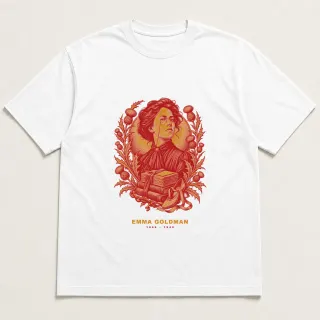
Wear it: Emma Goldman
#merchEvery design here links back to this page.
Sources
#sourcesPrimary sources
The documents themselves: laws, court opinions, speeches, letters, and the numbers from the agencies that count them.
- Emma Goldman, Living My Life, Vol. 1, Chapter 5 (1931) (the dance and the line behind the modern misquote, in her own words)
- Emma Goldman, Living My Life, Vol. 1, Chapter 8 (1931) (the Homestead plan and the ten dollars)
- Emma Goldman, Living My Life, Vol. 1, Chapter 11 (1931) (the Union Square speech, verbatim, and the trial dates)
- Emma Goldman, Living My Life, Vol. 2, Chapter 49 (1934) (the September 28, 1919 release on bond, and the 1889 move to New York)
- Emma Goldman, Living My Life, Vol. 2, Chapter 50 (1934) (the October 27 hearing and the December 5 surrender at Ellis Island)
- Emma Goldman, Living My Life, Vol. 2, Chapter 51 (1934) (the Buford deportation, in her own account)
- Emma Goldman, "Anarchism: What It Really Stands For," in Anarchism and Other Essays (Mother Earth Publishing Association, 1910)
Secondary sources
Written afterward, about the story.
- PBS American Experience, "She Fought the Law" (arrest and sentencing dates, 1893-1917)
- PBS American Experience, "Prelude to the Red Scare: The Espionage and Sedition Acts" (source of the Hoover memo quote, dated August 23, 1919)
- The Foundation for Individual Rights and Expression, "The Deported: Emma Goldman and Activist Persecution Under the 1917 Espionage Act" (trial date, deportation order date, total deportee count)
- The Nation, "How Trump Is Stripping Immigrants of Their Citizenship" (the Kershner denaturalization mechanism)
- Forest Park Historical Society, "Emma Goldman" (burial details and the incorrect death year on the gravestone)
- Wikipedia, "Emma Goldman"