Published
Bread and Roses
Bread and Roses: The 1912 Strike That United 51 Nationalities
The 1912 Lawrence textile strike: a 32-cent pay cut, 20,000 to 30,000 workers from 51 nations, a dead striker, a frame-up, and the settlement that followed.
The story
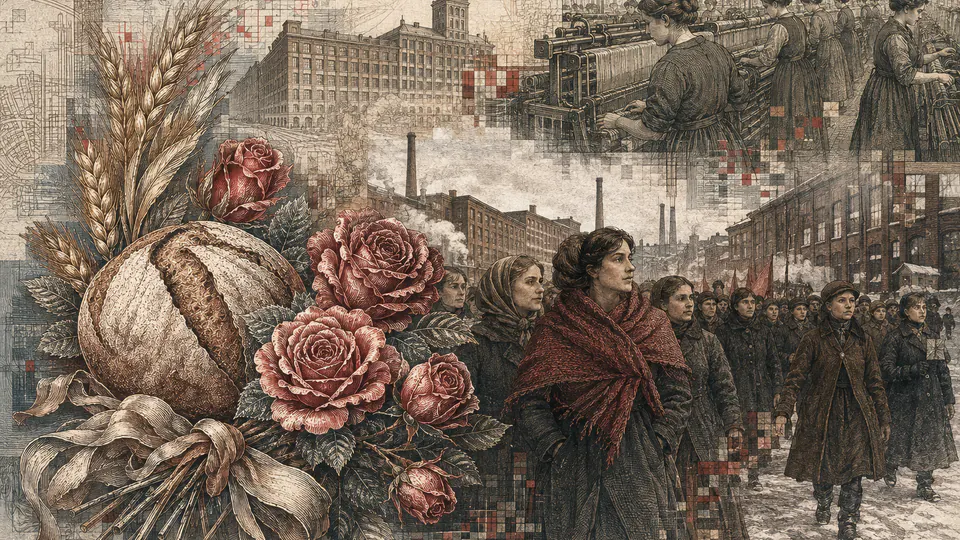
#storyOn January 12, 1912, pay envelopes across Lawrence, Massachusetts came up thirty-two cents short, and by the end of the day the looms had gone silent in mill after mill. Within the week at least 20,000 workers, and by some counts more than 30,000, had walked off the job in a strike that ran nine weeks: a striker shot dead by police, two union organizers charged with a murder they hadn’t committed, dynamite planted in a mill-backed frame-up, and children shipped out of the city to keep them fed while the courts sorted out who had killed whom. It ended on March 12, 1912, with the city’s biggest employer agreeing to raise wages for tens of thousands of workers across New England. This is the strike that’s been called Bread and Roses ever since; the slogan itself has an older and more contested history, told at Symbols of the Left.
Fifty-four hours, thirty-two cents
The spark was almost bureaucratic. Massachusetts had just cut the maximum work week for women and children from 56 to 54 hours, effective January 1, 1912, a real reform meant to ease conditions in the mills. The mill owners’ answer was to cut pay to match the shorter week. On January 11, weavers at the Everett Mill, many of them Polish immigrants, opened pay envelopes thirty-two cents lighter than the week before and walked out on the spot. The walkout reached the Washington Mill the next day and spread through the city’s mills within days, including the plants of the American Woolen Company, Lawrence’s biggest employer. One historical society priced the missing thirty-two cents at about three loaves of bread.
Twenty thousand workers, fifty-one nations
No one ever nailed down an exact strike total. Estimates from the time and since run from about 20,000 to more than 30,000 workers idle at once. What isn’t in dispute is how many different countries they had come from: Bruce Watson’s Bread and Roses, the standard history of the strike, counts workers from as many as fifty-one nations on the picket lines, and organizers translated bulletins and rally speeches into two dozen or more languages so nobody was locked out of a meeting by grammar. The Industrial Workers of the World sent organizer Joseph Ettor to run the walkout, and on his first afternoon in Lawrence he told the crowd exactly how he wanted the strike to go:
All the blood that is spilled in a strike is your blood.
It was an instruction as much as a rallying line: give the mill owners nothing that looked like union violence to photograph. Ettor and fellow organizer Arturo Giovannitti, who came to help him run it, held that line for weeks against state militia sent to guard the mills with bayonets fixed.
A dead striker and a frame-up that failed
On January 29, in a clash between strikers and police at the corner of Union and Garden Streets, a shot killed a striker named Anna LoPizzo. Nineteen witnesses named a Lawrence police officer as the shooter; police countered that the fatal shot had come from an unnamed personal enemy of the officer’s, standing elsewhere in the crowd. No one was ever convicted of firing it. The following day, a soldier’s bayonet killed a second striker, seventeen-year-old John Ramey.
What the state did next was charge Ettor and Giovannitti, who had been speaking at a meeting miles away when LoPizzo died, as accessories before the fact to her murder, and charge a striker named Joseph Caruso as the actual gunman, despite witnesses who placed him at home. All three were held without bail for the better part of a year.
The mills’ other move against the strike leadership backfired. A Lawrence undertaker and school board member, John Breen, planted dynamite at several spots strikers used for meetings, in an apparent attempt to paint the union as a bombing plot. Investigators traced it back to him within days, and he was fined $500. It later surfaced that American Woolen Company president William Wood had paid Breen an unexplained sum shortly before the dynamite turned up. A building contractor, Ernest Pitman, told a district attorney he had sat in on the Boston meeting where mill officials planned the frame-up, then killed himself rather than testify further in court. Wood was indicted, stood trial in 1913, and was found not guilty by a jury.
The children go to New York
Feeding thousands of strikers’ families for weeks strained Lawrence’s relief committees past what they could manage, so organizers, including Elizabeth Gurley Flynn, began sending children to stay with sympathetic families in other cities. On February 10, 119 children reached New York, met at the station by supporters. A second group followed the next week.
On February 24, when strikers tried to send a further group of children to Philadelphia (accounts of the group’s size conflict, from 46 in one count to about 100 in others), city police and state militia moved in at the Lawrence train depot to stop them. Officers clubbed and dragged away mothers who tried to hold onto their children and arrested dozens of them; one pregnant woman in the crowd miscarried afterward. The scene made national newspapers within a day and turned a local strike into a national scandal.
Congress investigated. In March 1912, mill children testified before the U.S. House Committee on Rules in Washington, with the president’s wife, Helen Taft, in the audience. Fourteen-year-old Camella Teoli, who had lost part of her scalp to an unguarded machine at the Washington Mill the year before, described it in her own words:
The machine pulled the scalp off.
Afterward, the Tafts invited the Lawrence children to lunch at the White House and donated $1,000 to the strike relief fund. The hearing produced no new federal law, but it produced headlines the mill owners couldn’t outlast. Within weeks, American Woolen was negotiating.
The settlement, and the trial that followed
American Woolen agreed to terms on March 12, 1912: wage increases of 5 to 20 percent depending on the job, extra pay for overtime, and no retaliation against anyone who had walked out. Two days later, roughly 15,000 workers gathered on Lawrence Common to ratify the deal, and other New England mills raised wages of their own within weeks rather than risk a repeat strike.
Ettor, Giovannitti, and Caruso were still in jail when the mills settled. Their trial finally opened that September in Salem, before Judge Joseph F. Quinn, with all three defendants held in a cage inside the courtroom for its duration. On November 26, 1912, the jury acquitted all three. Ettor and Giovannitti had spent nearly ten months in prison over a shooting that nineteen witnesses said a police officer, not either of them, had fired.
The slogan and the record
The strike’s nickname comes from a poem published a month before the walkout began, and the detail most people know about it, a banner reading “We want bread, and roses too,” has never turned up in any photograph or newspaper account from Lawrence; that history belongs at Symbols of the Left, not here. What Lawrence actually produced needs no banner to carry it: workers who didn’t share a language held a picket line for nine weeks against a company that tried to frame them for a bombing and a murder in the same month, and beat both charges and the pay cut. Ettor and Giovannitti walked out of a Salem courtroom free men that November, and mills across New England raised wages within weeks, strike or no strike.
What people get wrong
#wrong- The myth
Strikers marched under a banner reading "We want bread, and roses too." - The record
No photograph or contemporary newspaper account of the Lawrence strike shows that banner, and the Women's Trade Union League's own post-strike report never mentions the slogan. James Oppenheim's poem "Bread and Roses" ran in The American Magazine in December 1911, a month before the strike began, crediting the line to "a slogan of the women in the West." The banner story was attached to Lawrence only in later retellings.
- The myth
Ettor and Giovannitti were arrested because they shot Anna LoPizzo. - The record
Both men were charged as accessories before the fact to LoPizzo's murder, not as the shooter, and witnesses placed both of them miles away at a rally when she was killed. Nineteen witnesses instead named a Lawrence police officer as the one who fired the fatal shot. A jury acquitted Ettor, Giovannitti, and the striker charged as the actual gunman, Joseph Caruso, on November 26, 1912, after the two organizers had spent nearly ten months in jail.
- The myth
The IWW started the Lawrence strike. - The record
The walkout began on the shop floor, not at IWW headquarters. Weavers at the Everett Mill, most of them Polish immigrants, quit on the spot on January 11, 1912 when they found their pay envelopes thirty-two cents short. The IWW's Joseph Ettor arrived in Lawrence only after the walkout had already spread mill to mill, to help run a strike that was already underway.
The dates that matter
#dates- January 1, 1912 A new Massachusetts law cuts the maximum work week for women and children from 56 to 54 hours.
- January 11, 1912 Weavers at the Everett Mill, many of them Polish immigrants, find their pay cut along with their hours and walk off the job.
- January 12, 1912 The walkout spreads mill to mill across Lawrence; IWW organizer Joseph Ettor arrives and tells the crowd, "All the blood that is spilled in a strike is your blood."
- January 29, 1912 Striker Anna LoPizzo is shot and killed during a clash with police; nineteen witnesses name a Lawrence officer as the shooter.
- January 30, 1912 Seventeen-year-old striker John Ramey dies of a bayonet wound inflicted by a soldier the day before.
- Late January 1912 Authorities charge organizers Joseph Ettor and Arturo Giovannitti as accessories to LoPizzo's murder, though witnesses place both miles away; striker Joseph Caruso is charged as the shooter.
- Late January 1912 A Lawrence undertaker and school board member, John Breen, plants dynamite at strikers' meeting spots in a mill-backed frame-up; investigators trace it to him within days, and he is fined $500.
- February 10, 1912 Strikers send 119 children to stay with sympathizers in New York City.
- February 24, 1912 Police and militia block a further group of children bound for Philadelphia at the Lawrence train depot, clubbing and arresting mothers.
- March 1912 Mill children, including fourteen-year-old Camella Teoli, testify before the U.S. House Committee on Rules in Washington, with Helen Taft in the audience.
- March 12, 1912 American Woolen Company agrees to wage increases of up to 20 percent and the strikers' other core demands.
- March 14, 1912 About 15,000 workers gather on Lawrence Common to ratify the settlement.
- September 1912 Ettor, Giovannitti, and Caruso go on trial in Salem before Judge Joseph F. Quinn, held in a cage in the courtroom.
- November 26, 1912 A jury acquits all three defendants.
Questions people ask
#faqsWhat was the Bread and Roses strike?
A nine-week strike by roughly 20,000 to 30,000 textile workers in Lawrence, Massachusetts, from January 11 to March 14, 1912. Workers from as many as fifty-one nations, led by the Industrial Workers of the World, walked out over a pay cut and won wage increases across New England mills by the strike's end.
Why did the Lawrence mill workers go on strike in 1912?
A new Massachusetts law cut the maximum work week for women and children from 56 to 54 hours starting January 1, 1912. Mill owners cut pay to match the shorter week, and on January 11 weavers at the Everett Mill found their pay envelopes thirty-two cents short and walked out.
Why were Joseph Ettor and Arturo Giovannitti arrested?
After police shot and killed striker Anna LoPizzo on January 29, 1912, authorities charged the two IWW organizers as accessories to her murder, even though witnesses placed both of them miles away giving a speech at the time. They were held without bail for nearly ten months before a jury acquitted them, along with striker Joseph Caruso, on November 26, 1912.
What happened to the children of the Lawrence strikers?
To ease the strain on strike relief funds, organizers sent children to stay with sympathizers in other cities: 119 reached New York on February 10, 1912. When a further group tried to leave for Philadelphia on February 24, police and militia clubbed and arrested the mothers at the train depot, a scene that made national news and led Congress to investigate.
Did the Lawrence textile strikers win?
Yes. On March 12, 1912, the American Woolen Company agreed to wage increases of up to 20 percent and other demands, and roughly 15,000 workers ratified the deal on Lawrence Common two days later. Other New England mills raised wages of their own within weeks.
The bookshelf
#bookshelfWhere to go next. Buy from an independent bookstore, or find it at your library for nothing.
-
The Rebel Girl: An Autobiography, My First Life (1906-1926) Elizabeth Gurley Flynn, 1973 primary
Flynn helped organize the Lawrence relief effort and the children's exodus; her own account of both.
-
Bread and Roses: Mills, Migrants, and the Struggle for the American Dream Bruce Watson, 2005 secondary
The standard narrative history of the strike, and the source for the fifty-one-nations count.
-
Rebel Voices: An IWW Anthology Joyce L. Kornbluh, editor, 2011 primary
Reprints Camella Teoli's congressional testimony and other documents from the strike itself.
-
Radicals of the Worst Sort: Laboring Women in Lawrence, Massachusetts, 1860-1912 Ardis Cameron, 1993 secondary
A social history of the women who ran the picket lines and the neighborhood networks under them.
Wear it: Bread and Roses
#merchEvery design here links back to this page.


Sources
#sourcesPrimary sources
The documents themselves: laws, court opinions, speeches, letters, and the numbers from the agencies that count them.
- Who Built America?, "Camella Teoli Testifies about the 1912 Lawrence Textile Strike" (her verbatim testimony, citing Hearings on the Strike at Lawrence, Massachusetts, House Doc. No. 671, 62nd Cong., reprinted in Joyce Kornbluh, Rebel Voices (1964))
Secondary sources
Written afterward, about the story.
- Wikipedia, "1912 Lawrence textile strike" (general chronology, casualty list, wage settlement terms, trial details)
- Wikipedia, "Anna LoPizzo" (her death and the disputed identity of the shooter)
- Wikipedia, "Joseph James Ettor" (the January 12, 1912 quote, sourced there to Bruce Watson's Bread and Roses, p. 59; trial location and judge)
- Wikipedia, "Carmela Teoli" (her injury, age, and the March 1912 congressional hearing)
- HISTORY, "The Strike That Shook America" (the 54-hour law and pay cut, John Ramey's death, militia deployment, the March 14 ratification vote)
- Zinn Education Project, "Jan. 11, 1912: The Bread and Roses Strike Started"
- Zinn Education Project, "Nov. 26, 1912: Lawrence Textile Strike Acquittal"
- Zinn Education Project, "Bread & Roses: Mills, Migrants, and the Struggle for the American Dream" (the fifty-one-nations figure, drawn from Bruce Watson's standard history of the strike)
- New England Historical Society, "The 1912 Bread and Roses Strike" (the pay cut priced in loaves of bread; the February 24 station incident)
- Spartacus Educational, "Lawrence Textile Strike" (John Breen, Ernest Pitman, and William Wood's dynamite frame-up)
- Bruce Watson, Bread and Roses: Mills, Migrants, and the Struggle for the American Dream (Viking, 2005), p. 59 (the standard history of the strike; source of Ettor's January 12 remark and the fifty-one-nations count)
- Wikipedia, "Bread and Roses" (banner controversy, Oppenheim's December 1911 publication date, and the historians who call the banner account ahistorical)