Published
Poor People's Campaign
The Poor People's Campaign Was King's Unfinished Washington Occupation
The 1968 campaign brought a multiracial coalition to Resurrection City around jobs, income, housing, and economic rights after King's death.
The story
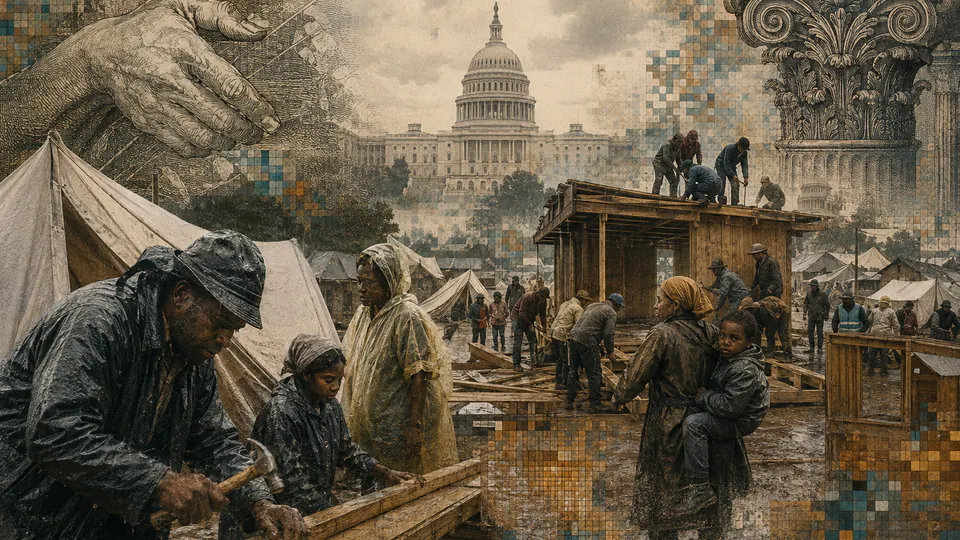
#storyMartin Luther King Jr. planned the Poor People’s Campaign as a multiracial pressure campaign for jobs, income, housing, and economic rights. He was assassinated before the Washington phase began. The organizers continued and built Resurrection City on the National Mall, where thousands lived in plywood shelters through weeks of rain.
A coalition of poor communities
SCLC announced the campaign in November 1967. King and staff met with Mexican American, Puerto Rican, Indigenous, Appalachian, and poor white organizers as well as Black groups. The coalition did not erase different histories or demands. It tried to bring them into sustained federal pressure.
After King’s death in Memphis, Ralph Abernathy led SCLC. Coretta Scott King opened the Washington action with a Mother’s Day march. Caravans arrived, including a mule train from Mississippi. Resurrection City became a temporary community and a daily argument with federal agencies.
An occupation in the mud
Residents lobbied departments and Congress, held meetings, and organized demonstrations. Heavy rain turned the site to mud. Leadership conflict, surveillance, limited resources, and the loss of King weakened coordination. Solidarity Day drew a large crowd on June 19, but Congress did not enact the campaign’s economic bill of rights.
After the permit expired, police cleared the camp on June 24. The civil-rights state had statutes it could pass against explicit discrimination. A guaranteed job or income challenged the distribution of resources more directly. Resurrection City made that next demand visible, then disappeared from the Mall faster than the poverty that built it.
The demand entered federal offices
Caravans reached Washington from several regions, including a mule train from Mississippi. Participants sought jobs, income, housing, food, and access to land as an economic bill of rights. Delegations visited federal departments and congressional offices, turning a national claim into disputes over welfare rules, school support, farm policy, and food assistance.
The coalition was difficult because its members met poverty through different systems. An Appalachian miner, a Black tenant in Chicago, a Chicano farmworker, and an Indigenous family did not need the same agency to change the same rule. Keeping them together required translation, shared leadership, and resources the campaign never had in enough supply. Its clearest policy gain came through pressure for expanded food programs. Its larger proposal remained unmet: treat freedom from poverty as a public obligation rather than a reward delivered through the labor market.
The sequence changes the argument
Accounts often compress the Poor People’s Campaign into an encampment remembered mainly for rain and disorder. The chronology makes a larger claim. King announced the campaign after concluding that formal civil rights could coexist with mass deprivation. SCLC invited Black, Mexican American, Puerto Rican, Indigenous, Appalachian, and poor white organizers without asking them to collapse their demands into one story. Neither fact is background decoration. Together they explain why the conflict took the form it did and why participants did not treat patience as a serious answer.
King’s assassination removed the coalition’s best-known broker before the caravans reached Washington. Residents of Resurrection City ran a kitchen, a school, a cultural program, security, and daily meetings while lobbying federal departments. The work depended on meetings, transportation, money, printed material, trusted messengers, and people willing to absorb retaliation. Public memory usually preserves the microphone or the confrontation. Organization lived in the less photogenic decisions that made a crowd, vote, strike, or policy demand possible.
Power worked through institutions
The central dispute concerned a federal guarantee of jobs, income, food, housing, and land. That question could not be settled by a good argument alone. Employers, public officials, courts, parties, unions, churches, and newspapers controlled different resources. Organizers had to identify which body could change a rule, which ally could move it, and what pressure could make delay more expensive than action.
Rain damaged shelters and made sanitation difficult, but weather did not create the campaign’s political disagreements or the government’s refusal. Solidarity Day drew tens of thousands while the smaller residential occupation struggled to turn visibility into binding legislation. Those outcomes belong in the same account. A movement can gain public sympathy and still lose an immediate demand. It can win a statute while leaving people outside its coverage. It can build an institution that later becomes cautious. Calling one moment a victory or defeat without naming the measure hides more than it explains.
The limits were part of the result
Pressure from the campaign helped move federal food assistance, though it did not win the economic bill of rights organizers sought. The campaign’s unresolved question was whether economic security should depend on a person’s bargaining power in the labor market. These limits were not footnotes added by later critics. Participants argued about them at the time, often from unequal positions. Race, gender, citizenship, occupation, geography, and access to money affected who took the greatest risk and who received authority after a campaign became respectable.
This is why coalition should be treated as work rather than a photograph. Groups can share an opponent while wanting different remedies. They can cooperate on a march and disagree about a contract, a party, a war, or the pace of change. The useful question concerns the rules that allowed people to decide together, what resources they shared, and whose objections were easier to ignore.
What the record lets us say
The source trail matters because later retellings reward drama and erase maintenance. Government records show what officials claimed and enforced. Organizational papers show plans, budgets, arguments, and revisions. Oral histories recover work that formal minutes often omit, though memory recorded years later has its own limits. Newspapers capture public language while reflecting the interests and racial habits of editors. Reading those records against one another makes uncertainty visible instead of filling it with a convenient quotation.
The durable lesson of the Poor People’s Campaign is practical. Rights need procedures, money, institutions, and people able to enforce them after attention moves elsewhere. A law can change the field without ending the contest. A lost campaign can train organizers, expose an alliance, or leave a demand that later movements can use. History becomes more useful when it preserves both the achievement and the bill that remained unpaid.
What people get wrong
#wrong- The myth
The Poor People's Campaign was entirely King's own idea. - The record
Marian Wright, then director of the NAACP Legal Defense and Educational Fund's office in Jackson, Mississippi, proposed the idea to King, who took it to SCLC's staff before announcing the campaign in November 1967.
- The myth
The campaign accomplished nothing because Congress never passed the economic bill of rights. - The record
It produced at least one concrete, if partial, policy result: pressure from the campaign helped qualify roughly 200 counties for free surplus food distribution. Ralph Abernathy called that concession insufficient against the campaign's broader demand, but it was a real change in federal food policy, not nothing.
- The myth
Resurrection City was raided and torn down by force. - The record
The Department of the Interior closed the camp on June 24, 1968 after its National Park Service permit had expired, not through a surprise raid. Residents had already lived there for more than a month under a permit the agency chose not to renew.
The dates that matter
#dates- November 1967 SCLC announces the Poor People's Campaign.
- April 4, 1968 King is assassinated in Memphis.
- May 12, 1968 Coretta Scott King leads a Mother's Day march in Washington.
- May 1968 Resurrection City opens on the National Mall.
- June 19, 1968 The campaign holds Solidarity Day.
- June 24, 1968 Police clear the encampment after its permit expires.
Questions people ask
#faqsWhat was the Poor People's Campaign?
It was SCLC's 1968 campaign to bring poor people of several races to Washington around jobs, income, housing, and economic rights.
Did Martin Luther King Jr. lead it?
King planned and organized the campaign but was assassinated before the Washington phase. Ralph Abernathy led SCLC as it continued.
What was Resurrection City?
It was the campaign's wooden and canvas encampment on the National Mall, occupied for about six weeks in May and June 1968.
How should Poor People's Campaign be evaluated?
Separate the immediate result from the institutions, tactics, exclusions, and enforcement record that followed it.
The bookshelf
#bookshelfWhere to go next. Buy from an independent bookstore, or find it at your library for nothing.
-
And the Walls Came Tumbling Down: An Autobiography Ralph David Abernathy, 1990 primary
The man who led SCLC and Resurrection City after King's death, in his own words.
-
Old News: Resurrection City Jill Freedman, 1970 primary
A photojournalist who lived in the camp, documenting it as it stood, in the mud, before the permit ran out.
-
Power to the Poor: Black-Brown Coalition and the Fight for Economic Justice, 1960-1974 Gordon K. Mantler, 2013 secondary
The fullest account of how the campaign's multiracial coalition came together, and where it strained.
Wear it: Poor People's Campaign
#merchEvery design here links back to this page.

Sources
#sourcesPrimary sources
The documents themselves: laws, court opinions, speeches, letters, and the numbers from the agencies that count them.
Secondary sources
Written afterward, about the story.