Published
Memphis sanitation strike
I Am a Man: The Memphis Sanitation Strike of 1968
Two Memphis sanitation workers died in a garbage truck compactor on February 1, 1968. Eleven days later came the walkout, the I Am A Man signs, and King.
The story
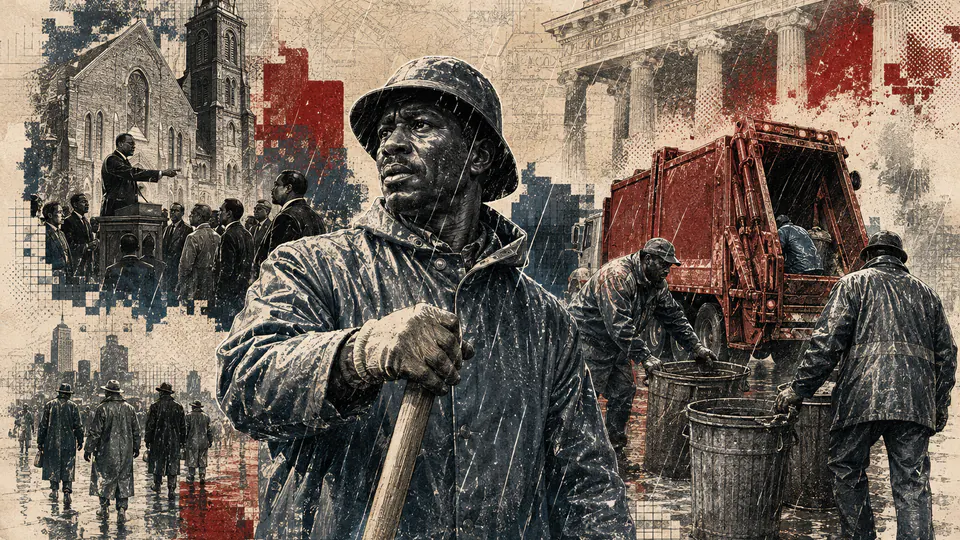
#storyOn February 1, 1968, Memphis sanitation workers Echol Cole and Robert Walker climbed into the back of their garbage truck to get out of the rain, the only shelter the city allowed a Black crew that day. A malfunction set off the compactor, and it crushed them both to death. Eleven days later, on February 12, more than a thousand of the city’s sanitation and sewer workers walked off the job carrying signs that read I AM A MAN. The strike ran sixty-four days, produced Martin Luther King’s last speech, and ended on April 16 with a signed contract for the men who hauled the city’s garbage.
Cole was thirty-six. Walker was thirty. A coworker who watched it happen gave this account of the accident:
The motor started racing and the driver stopped and ran around and smashed that button to stop that thing …
It didn’t stop in time. Two other Memphis sanitation workers had died the identical way in 1964, and the city had never replaced the defective equipment.
Twenty years of asking first
Memphis’s sanitation crews had been organizing since 1959, when a worker named T.O. Jones started signing coworkers up for a union local. In June 1963, Public Works Commissioner William Farris fired Jones and 32 others for attending an organizing meeting. Community pressure got 32 of the 33 rehired, on the condition they drop the union. Jones refused and kept organizing anyway. When AFSCME chartered the group in 1964, the union numbered it Local 1733, after the 33 men who had lost their jobs the year before.
The local tried to strike again in 1966. The city lined up replacement workers and threatened to jail the organizers, and the walkout collapsed before a single truck stopped running. Mayor Henry Loeb cited that year’s court order against a repeat strike when he declared the 1968 walkout illegal on its first morning.
None of the underlying math had moved. Wages for the city’s mostly Black sanitation crews averaged $1.70 an hour in 1968, low enough that 40 percent of the workers qualified for welfare on top of full-time city jobs. The pattern showed itself in miniature the day before Cole and Walker died: 22 Black sewer workers were sent home without pay when it started raining on January 31, while white employees on the same crew kept working through the same rain and were paid for the full day. Labor history runs on this shape more than once: it took 146 dead in a single fire to rewrite New York’s factory safety code in 1911, and it took two men crushed in a truck to turn nine years of asking into a citywide walkout.
The walkout
On February 12, 930 of the city’s 1,100 sanitation workers and 214 of its 230 sewer and drainage workers refused to report for duty, and only 38 of the department’s 108 garbage trucks ran that day. AFSCME’s international president, Jerry Wurf, arrived from Washington on February 18 to back a demand that came down to what a union buys anywhere it wins: recognition, a grievance procedure, dues collected from a paycheck instead of chased down by hand, and enough of a raise that a full-time city job stopped requiring food stamps.
Loeb refused all of it. On February 22, the City Council, facing a sit-in in its own chambers, voted to recommend union recognition and a raise. Loeb rejected the vote, insisting he alone held the authority to recognize a union and would not use it:
This is not New York, and nothing will be gained by ignoring our law.
The next day, marchers who had been promised an eight-abreast permit and a police escort to City Hall were ordered to narrow their line to four abreast instead. When some began rocking the escort cars, officers answered with clubs and mace.
Where the sign came from
On February 24, Rev. James Lawson, the Memphis pastor coordinating support for the strike, told the men gathered at Clayborn Temple what the fight was actually about:
For at the heart of racism is the idea that a man is not a man, that a person is not a person. You are human beings. You are men. You deserve dignity.
Organizers, including AFSCME’s Bill Lucy, settled on four words short enough for a placard and plain enough to need no explanation: I AM A MAN. Rev. Malcolm Blackburn, Clayborn Temple’s pastor and, in his other trade, a journeyman printer, set the type and ran the signs off a press in the church’s own basement, stamped with the union bug of the Allied Printing Trades Council. Decades later, a 1960 Hamilton Wood Type catalog turned up on eBay, and the wood type historian David Shields identified the placard lettering as Gothic No. 6243, a face Hamilton had cut in 1906. The type designer Tré Seals redrew it, added companion weights, pulled the punctuation from Baltimore Afro-American headlines of the era, and released the result as a digital typeface. Four words a Memphis minister set by hand in a church basement now ship as a font file.
The march that broke down
King, invited by Lawson, led a march through downtown Memphis on March 28. It fell apart within blocks: young men at the back of the crowd broke storefront windows on Beale Street, and police answered with tear gas, batons, and mace before the march reached City Hall. An officer named Leslie Dean Jones shot and killed 16-year-old Larry Payne that afternoon, saying Payne emerged from a basement holding a butcher knife; witnesses said Payne had his hands up. A grand jury never indicted Jones, and a Justice Department cold-case review closed the case without charges in 2017. At least 64 other people were hurt.
Memphis photographer Ernest Withers shot the day’s other lasting image: block after block of I AM A MAN placards moving down Beale Street. Decades later, Freedom of Information Act requests revealed that Withers had also been feeding reports on the movement to the FBI since at least 1968. By one researcher’s account, Withers had driven activists to rent the saw that cut the placard sticks that morning, the same sticks youths tore free and swung through storefronts once the march broke down. Withers put it to that researcher plainly:
If anybody is as much responsible for that riot up there, as anybody, I might be responsible.
The mountaintop
King returned to Memphis on April 3 to help repair the movement’s discipline after the March 28 collapse, and that night, at Mason Temple, he gave the speech historians call “I’ve Been to the Mountaintop.” He closed it like this:
Well, I don’t know what will happen now. We’ve got some difficult days ahead, but it really doesn’t matter with me now because I’ve been to the mountaintop. And I don’t mind. Like anybody, I would like to live a long life. Longevity has its place. But I’m not concerned about that now, I just want to do God’s will. And he’s allowed me to go up to the mountain, and I’ve looked over and I’ve seen the Promised Land. I may not get there with you, but I want you to know tonight that we as a people will get to the Promised Land. So I’m happy tonight, I’m not worried about anything. I’m not fearing any man. My eyes have seen the glory of the coming of the Lord.
He was shot on the balcony of the Lorraine Motel at 6:01 the next evening and pronounced dead at St. Joseph’s Hospital just after seven. He was thirty-nine.
What Memphis actually signed
President Johnson sent Under Secretary of Labor James Reynolds to Memphis the day after the assassination to mediate. Reynolds met separately with Loeb and with the union, rarely both at once, starting April 6. On April 8, roughly 42,000 people, led by Coretta Scott King and the city’s union and civil rights leadership, marched in silence from Clayborn Temple through downtown.
The agreement came together on April 16. The City Council adopted it by a vote of 12 to 1, and Loeb signed it; strikers gathered back at Clayborn Temple that night and voted unanimously to accept a fourteen-month contract: recognition by council resolution, a dues checkoff, a grievance procedure, and 15 cents an hour in raises, 10 cents that May 1 and 5 more that September. Weighed against a demand for $2.35 an hour on a base of $1.70, it was a modest raise. Weighed against what Local 1733 had wanted since T.O. Jones started signing up coworkers in 1959, recognition and a grievance procedure that did not depend on Henry Loeb’s opinion of the law, the money mattered less than the signature under it. The city signed one week after the man who had come to help win the fight was buried.
The same wage arithmetic that had put 40 percent of a sanitation department on welfare in 1968 put roughly two hundred fast-food workers on a New York sidewalk in 2012 to start what became the Fight for $15: a job that pays too little to live on eventually produces people willing to walk off it. Memphis proved the other half of that equation first. A walkout alone stops the trucks. It takes a signed contract, and somebody willing to enforce it, to make the raise stick.
What people get wrong
#wrong- The myth
The Memphis strike was a civil-rights protest, not a labor fight over wages and a contract. - The record
It was a union strike first. Sanitation worker T.O. Jones started signing coworkers into a union local in 1959, AFSCME chartered it as Local 1733 in 1964, and the 1968 walkout's core demands were recognition, a dues checkoff, and a grievance procedure. Rev. James Lawson invited King to support a strike that was already nine years and two failed organizing drives old.
- The myth
The officer who killed sixteen-year-old Larry Payne was prosecuted. - The record
A grand jury never indicted the officer, Leslie Dean Jones. Decades later, a Justice Department cold-case review closed the file in 2017 without bringing charges.
- The myth
The strike ended with the workers winning the full raise they demanded. - The record
The April 16, 1968 settlement recognized the union and added a grievance procedure and dues checkoff, but the raise itself was 15 cents an hour, 10 cents that May and 5 more in September, far short of the $2.35 hourly wage demanded on a $1.70 base. The City Council adopted it 12 to 1.
- The myth
I AM A MAN was outside branding, not something Memphis strikers came up with themselves. - The record
Rev. James Lawson, the Memphis pastor coordinating strike support, framed the demand around dignity at a February 24, 1968 meeting at Clayborn Temple. Local organizers, including AFSCME's Bill Lucy, turned it into the four-word slogan, and Clayborn Temple's own pastor, a trained printer named Rev. Malcolm Blackburn, set the type and ran the signs off a press in the church basement.
The dates that matter
#dates- 1959 Sanitation worker T.O. Jones begins signing up coworkers for a union local.
- June 1963 Public Works Commissioner William Farris fires Jones and 32 others for attending an organizing meeting; the city rehires 32 on condition they drop the union, and Jones refuses.
- 1964 AFSCME charters the group as Local 1733, numbered for the 33 men fired the year before.
- 1966 A second strike attempt collapses after the city lines up replacement workers and threatens the organizers with jail.
- January 31, 1968 Twenty-two Black sewer workers are sent home without pay when it starts raining; white coworkers keep working through the same rain and are paid for the full day.
- February 1, 1968 Echol Cole, 36, and Robert Walker, 30, are crushed to death when the compactor on their garbage truck malfunctions while they shelter from rain.
- February 12, 1968 930 of the city's 1,100 sanitation workers and 214 of its 230 sewer and drainage workers walk out; only 38 of the department's 108 trucks run that day.
- February 22, 1968 The City Council votes to recommend union recognition and a raise; Mayor Henry Loeb rejects the vote, insisting only he holds that authority.
- February 23, 1968 Police club and mace marchers headed to City Hall after ordering them to narrow their permitted line.
- February 24, 1968 Rev. James Lawson frames the strike around a man's dignity; I AM A MAN becomes the strike's slogan, printed on a press in the basement of Clayborn Temple.
- March 28, 1968 A march led by King and Lawson turns violent; police shoot and kill 16-year-old Larry Payne and injure at least 64 others.
- April 3, 1968 King delivers "I've Been to the Mountaintop" at Mason Temple.
- April 4, 1968 King is shot on the balcony of the Lorraine Motel and pronounced dead at St. Joseph's Hospital.
- April 16, 1968 The City Council votes 12 to 1 to recognize the union; the settlement adds a dues checkoff, a grievance procedure, and a 15-cent raise.
Questions people ask
#faqsWhat was the Memphis sanitation strike about?
On February 12, 1968, roughly 1,100 Memphis sanitation and sewer workers, almost all Black, walked off the job after two coworkers, Echol Cole and Robert Walker, were crushed to death in a garbage truck compactor eleven days earlier. They were demanding recognition of their union, AFSCME Local 1733, a grievance procedure, a dues checkoff, and a raise from wages that averaged $1.70 an hour. The strike ran until April 16. King was assassinated in Memphis while supporting it, and the workers returned with a signed contract.
What does the I Am a Man sign mean?
Rev. James Lawson told strikers on February 24, 1968 that racism began by denying a man his manhood, and organizers, including AFSCME's Bill Lucy, turned that idea into four words short enough for a placard. Rev. Malcolm Blackburn, a Clayborn Temple pastor who worked as a journeyman printer, set the type and ran the signs off a press in the church's own basement.
Why did Martin Luther King go to Memphis in 1968?
Rev. James Lawson invited him to support the sanitation strike. King led a march on March 28 that turned violent, returned on April 3 to help restore nonviolent discipline and deliver the speech now called "I've Been to the Mountaintop," and was assassinated at the Lorraine Motel the following evening, April 4.
Did the Memphis sanitation workers win their strike?
Yes. On April 16, 1968, the Memphis City Council voted 12 to 1 to recognize AFSCME Local 1733, and the city and union signed a fourteen-month contract adding a dues checkoff and a grievance procedure, plus a 15-cent-an-hour raise, 10 cents that May and 5 more that September.
How did Echol Cole and Robert Walker die?
They were Memphis sanitation workers who took shelter from rain inside the compactor housing of their garbage truck on February 1, 1968, the only shelter the city allowed a Black crew that day. A malfunction set off the compactor and crushed them both. Two other workers had died the identical way in 1964, and the city had never replaced the defective equipment. Their deaths triggered the walkout eleven days later.
The bookshelf
#bookshelfWhere to go next. Buy from an independent bookstore, or find it at your library for nothing.
-
A Testament of Hope: The Essential Writings and Speeches of Martin Luther King, Jr. Martin Luther King Jr., edited by James M. Washington, 1986 primary
King's own words, including the Mountaintop speech he gave in Memphis the night before he died.
-
Going Down Jericho Road: The Memphis Strike, Martin Luther King's Last Campaign Michael K. Honey, 2007 secondary
The definitive labor history of the strike, from T.O. Jones's first organizing to the signed contract.
-
At the River I Stand: Memphis, the 1968 Strike, and Martin Luther King's Last Campaign Joan Turner Beifuss, 1985 secondary
A Memphis journalist's day-by-day account, built from interviews with people on both sides of the table.
Wear it: Memphis sanitation strike
#merchEvery design here links back to this page.
Sources
#sourcesPrimary sources
The documents themselves: laws, court opinions, speeches, letters, and the numbers from the agencies that count them.
- U.S. Department of Justice, "Larry Payne - Notice to Close File" (Payne's age, the officer's and witnesses' conflicting accounts, and the federal cold-case review)
- Martin Luther King Jr., "I've Been to the Mountaintop," Mason Temple, Memphis (April 3, 1968) (transcript, closing passage)
Secondary sources
Written afterward, about the story.
- Wikipedia, "Memphis sanitation strike" (Feb 12 walkout numbers (930 of 1,100 sanitation workers, 214 of 230 sewer workers), truck count, 1963-1966 background, the 1964 compactor precedent)
- Wikipedia, "Death of Echol Cole and Robert Walker" (ages, the compactor accident, the coworker's account)
- Wikipedia, "Assassination of Martin Luther King Jr." (time of the shooting and of death)
- Peter Dreier, "Why He Was In Memphis," The American Prospect (January 15, 2007) (the January 31 rain incident, pre-strike wages and welfare eligibility, and the exact April 16 settlement wage figures)
- APM Reports, "The Sanitation Strike, the Assassination and Memphis in 1968" (King's Last March) (Loeb's quotes, and the March 28 injury count)
- Memphis magazine, "The Life, Death, and Rebirth of Clayborn Temple" (Rev. Malcolm Blackburn's print shop in the church basement)
- Vocal Type, "Martin" typeface history (the identification of the placard type as Hamilton's Gothic No. 6243, credited there to wood type historian David Shields)
- The Intercept, "The Double Life of Civil Rights Photographer and FBI Informant Ernest Withers" (February 28, 2019) (drawing on Preston Lauterbach's Bluff City; Withers's FBI work and his own quote on the March 28 violence)
- The Daily Beast, "The Civil Rights Pastor Who Declared 'I Am a Man'" (Rev. James Lawson's February 24, 1968 remarks)
- Global Nonviolent Action Database (Swarthmore College), "Memphis, Tennessee, sanitation workers strike, 1968" (the February 22-23 council vote and mace incident)
- Walter P. Reuther Library, Wayne State University, "1968 Memphis Sanitation Workers and Dr. Martin Luther King Jr." (T.O. Jones's organizing from 1959, the 1963 firings, and Local 1733's number)
- Wayne State University, "Victory for Local 1733," I Am A Man exhibit (the 12-1 council vote and the total 15-cent raise)