Published
Fight for $15
The Fight for $15: How 200 Fast-Food Workers Changed the Wage Map
On November 29, 2012, about 200 New York fast-food workers walked out for $15 an hour. What that walkout won, state by state, and what it never touched.
The story
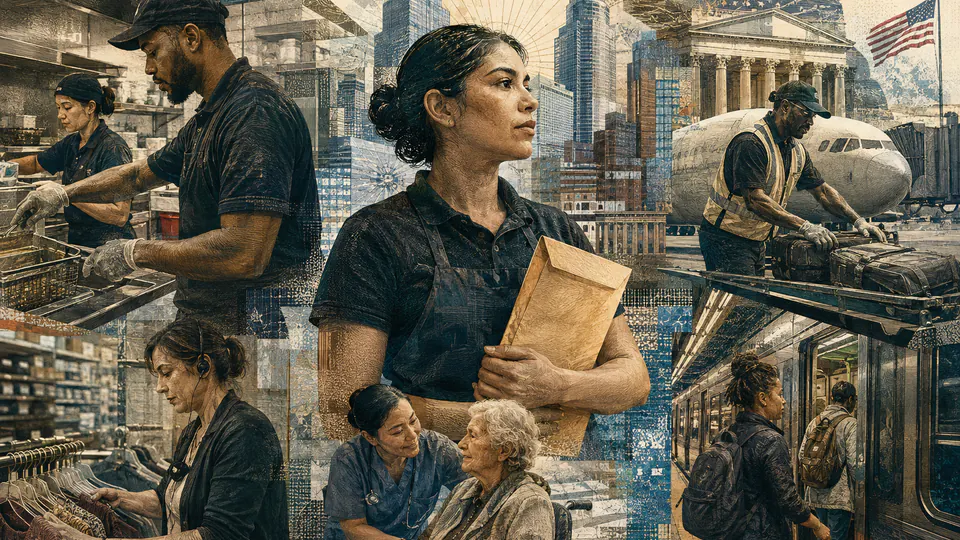
#storyOn the morning of November 29, 2012, about 200 fast-food workers walked off their jobs at McDonald’s, Burger King, KFC, Wendy’s, Domino’s, Taco Bell, and Pizza Hut locations across New York City. It was, by multiple accounts from that day, the largest coordinated strike the American fast-food industry had ever seen. A McDonald’s worker named Darryl Young explained himself that morning:
Good morning I’m on strike Wanna know why? $7.25
Young had worked at McDonald’s for two years and still made the federal minimum wage. A McDonald’s manager named Diego Delgado, three years in and up to $8.50 an hour, put his reason more simply: “I’m here for the union.”
Neither man got $15 that week. Nor did a KFC worker in East Harlem, identified only as Gregory in that day’s coverage, who earned minimum wage, relied on food stamps, and lived in Rockaway, Queens, which Superstorm Sandy’s floodwaters had inundated weeks earlier. New York City employed roughly 50,000 fast-food workers at the time, in an industry whose revenue that year approached $200 billion nationally. What Young, Delgado, and Gregory started is now credited, by the research group that tracks it, with more than 26 million workers sharing a combined $150 billion in raises over the following decade, while the number on their signs became law in dozens of cities and states. The federal minimum wage they were picketing has not moved at all.
Why the number was $15
The number on Young’s sign was not picked at random. Congress last raised the federal minimum wage on July 24, 2009. It has sat at $7.25 an hour ever since, the longest stretch without a raise since the federal minimum wage law took effect in 1938, according to Business for a Fair Minimum Wage’s count. A worker at $7.25 who gets forty hours a week, every week, grosses $15,080 a year before taxes. Workers who depend on tips have it worse: the federal tipped minimum wage has been $2.13 an hour since 1991, on the theory that customers make up the difference. Fifteen dollars an hour was simple math against that baseline: roughly double the wage floor, and a number that fit on a sign.
SEIU, and the union half of the slogan
The walkout did not organize itself. New York Communities for Change built the campaign for months beforehand, canvassing fast-food workers store by store, and the Service Employees International Union backed it with money and meeting space at its Manhattan headquarters. SEIU’s own name for the resulting campaign said exactly what it wanted: Fight for $15 and a Union. The wage number got the headlines. The union half of the slogan was the part SEIU had been chasing since long before 2012, in an industry where almost nobody was organized and almost nobody had bargaining power to show for it. More than a decade of strikes has not changed that in the way a strike usually changes it: no McDonald’s restaurant in the country has a certified union, because the franchise model means each location would have to organize and win its own separate election, one at a time, forever, if it wanted to.
One walkout becomes a hundred cities
New York’s one-day action did not stay a one-day action. Organizing under the name Fast Food Forward, SEIU called a repeat strike on August 29, 2013 that reached workers in about 60 cities, then a second one on December 5, 2013 that reached about 100 cities, the biggest showing the campaign had managed yet. No city had actually raised its minimum wage. What had grown, in the year since Young and Delgado walked out, was the tactic itself: a coordinated one-day strike, repeatable in any city with a franchise and a union organizer willing to knock on doors.
SeaTac gets there first
The first place in the country to actually reach $15 an hour was not a city most Americans could find on a map. SeaTac, Washington, population under thirty thousand, is built around the airport it is named for. On November 5, 2013, its voters narrowly approved Proposition 1, by a margin of 77 votes out of roughly 6,000 cast, setting a $15 minimum wage for hospitality and transportation workers. It took effect January 1, 2014. A King County judge initially ruled the wage could not reach workers at Seattle-Tacoma International Airport itself, on the theory that the Port of Seattle’s exclusive control of airport operations overrode the city’s law. The Washington Supreme Court disagreed, 5 to 4, on August 20, 2015, extending the $15 wage to the roughly 4,700 people working there for airport contractors, concessionaires, and rental car agencies.
Seattle makes it law
Seattle followed its smaller neighbor within months. On June 2, 2014, the Seattle City Council passed, unanimously, an ordinance phasing in a $15 minimum wage citywide: big employers (over 500 employees) first, reaching $15 by 2017, and small businesses given until 2021, with an interim combined wage-and-benefits threshold applying to small employers starting in 2019. The United Steelworkers, among others, called it the highest minimum wage in the country at the time.
California takes it statewide
Sacramento went further than any single city could. On April 4, 2016, Governor Jerry Brown signed SB 3, phasing in a $15 minimum wage across the entire state by 2022, with an extra year, until 2023, for businesses with 25 or fewer employees. Brown had resisted a statewide $15 wage for months, and his own bill moved only once a labor-backed ballot initiative carrying the identical number, the Fair Wage Act of 2016, was working its way toward the November ballot. At the signing, Brown described it plainly: “This is about economic justice, it’s about people.”
The federal number never moved
Congress had its own chance. In 2019, Senator Bernie Sanders and Representative Bobby Scott introduced the Raise the Wage Act, phasing the federal minimum wage up to $15 an hour by 2025. The House passed it on July 18, 2019, by a vote of 231 to 199. The Republican-controlled Senate never scheduled a vote, and the bill died there. The federal minimum wage is $7.25 an hour today, seventeen years after its last increase.
What ten years added up to
None of that federal inaction stopped the state and city laws from compounding. By the ten-year mark, the National Employment Law Project counted 29 states and nearly five dozen cities and counties that had raised their minimum wages since the 2012 walkout, many of them to $15 or higher. NELP put the combined total at more than 26 million workers sharing $150 billion in raises, with workers of color making up 46 percent of the people who got a raise and taking home just over $76 billion of it. Those are the movement’s own numbers, produced by a research group that supports the movement’s goals, and they measure state and local law, not anything Congress did. The same NELP report also tracked wealth, in addition to wages, in the states that raised their minimums between 2013 and 2019: it found Black worker wealth grew 174 percent and Latino worker wealth grew 211 percent in those states, narrowing the Black-white wealth gap there by 40.3 percentage points and the Latino-white gap by 29.4 points, faster narrowing than in states that left their minimums where they were.
The tipped minimum wage Young’s and Delgado’s coworkers lived on is still $2.13 an hour, unchanged since 1991. By 2026, 15 states had adopted a path to at least $15 since the first walkout, and inflation indexing had carried five more above it. Congress never took a single one of those steps.
Argue it
#argue3 claims about Fight for $15 you can make out loud, the best case against each one, and the answer. Every number links to where it came from.
-
Claim 1
Congress never passed the raise. More than 26 million people got one anyway.
The evidence
The National Employment Law Project added up the state and local minimum wage laws passed since the 2012 walkout and counted $150 billion in raises by 2022. NELP backed the campaign and is counting its own side's wins. The laws are on the books in the states and cities that passed them.
Their best case
The Congressional Budget Office's 2021 score of a federal increase to $15 by 2025 put the median estimate at 1.4 million fewer jobs nationally, the number most often cited against taking the fight federal.
The answer
The two numbers measure different things. NELP counted money already paid out under laws already in effect; CBO projected what a bill that never passed might do. Read the rest of that score and it puts 17 million workers in line for a direct federal raise, which is the other half of the same page.
-
Claim 2
McDonald's former CEO blamed the ordering kiosks on the $15 campaign. The job numbers never showed it.
The evidence
Cengiz, Dube, Lindner, and Zipperer studied 138 state minimum wage increases from 1979 to 2016, the span that covers the campaign's first city and state wins. Five years after each increase the total number of low-wage jobs was essentially unchanged, food service included.
Their best case
Ed Rensi, former president of McDonald's USA, wrote in Forbes in April 2016 that a $15 minimum wage "will mean wiping out thousands of entry-level opportunities for people without many other options," because a franchisee can absorb the cost through "the substitution of a self-service computer kiosk for a full-service employee."
The answer
Rensi names two things, cheaper touchscreen technology and the wage floor, and a chain can buy the first without waiting for the second. If the wage laws were doing the cutting, the jobs would be missing from the national count of the increases the campaign won. They are not.
-
Claim 3
The same chains pay union wages in Denmark and still sell burgers at a profit.
The evidence
Denmark's fast-food restaurants run under union contracts that pay far above the U.S. wage floor. McDonald's and Burger King are among them: same chains, same menus, same industry.
Their best case
International Franchise Association president Stephen Caldeira rejected the comparison outright: "trying to compare the business and labor practices in Denmark and the U.S. is like comparing apples to autos."
The answer
John Schmitt of the Center for Economic and Policy Research had made the claim Caldeira was answering: "We see from Denmark that it's possible to run a profitable fast-food business while paying workers these kinds of wages." Caldeira rejects the comparison without naming one part of selling burgers that would break at Danish pay. The Danish restaurants are open.
What people get wrong
#wrong- The myth
The Fight for $15 succeeded because Congress raised the minimum wage. - The record
The federal minimum wage never moved. It has been $7.25 since July 24, 2009, before the movement existed. Every $15 win, SeaTac, Seattle, California, and the states and cities that followed, came through state and local law, not Congress.
- The myth
The Fight for $15 got McDonald's workers a union. - The record
No U.S. McDonald's restaurant has ever certified one. The franchise structure means every location has to run and win its own NLRB election, so a win at one store reaches no other store. The wage half of the demand spread nationwide through state and local law. The union half has not spread at all.
The dates that matter
#dates- 1991 The federal tipped minimum wage is set at $2.13 an hour and has not changed since.
- July 24, 2009 The federal minimum wage reaches $7.25 an hour, the last increase Congress has passed.
- November 29, 2012 About 200 fast-food workers walk out across New York City, organized by New York Communities for Change with SEIU's backing, demanding $15 an hour and the right to unionize.
- August 29, 2013 A follow-up strike under the Fast Food Forward and SEIU banner reaches workers in about 60 cities.
- November 5, 2013 SeaTac, Washington voters approve Proposition 1 by 77 votes, setting a $15 minimum wage for hospitality and transportation workers, the first in the country.
- December 5, 2013 A second follow-up strike reaches about 100 cities, described at the time as the largest fast-food worker protest yet.
- January 1, 2014 SeaTac's $15 minimum wage takes effect.
- June 2, 2014 The Seattle City Council unanimously passes an ordinance phasing in a $15 minimum wage citywide.
- August 20, 2015 The Washington Supreme Court rules 5 to 4 that SeaTac's $15 wage also covers roughly 4,700 workers at Seattle-Tacoma International Airport.
- April 4, 2016 California Governor Jerry Brown signs SB 3, phasing in a statewide $15 minimum wage by 2022.
- July 18, 2019 The U.S. House passes the Raise the Wage Act, 231 to 199, to phase the federal minimum wage up to $15. The Senate never votes on it.
- 2022 The National Employment Law Project marks ten years since the walkout, counting more than 26 million workers and $150 billion in raises tied to the state and local wage increases the movement pushed through.
Questions people ask
#faqsWhat is the Fight for $15?
A campaign for a $15 minimum wage and the right to unionize that began when about 200 fast-food workers walked off the job in New York City on November 29, 2012. Organized by New York Communities for Change with financial backing from the Service Employees International Union, it pushed dozens of cities and states to adopt $15 minimum wages over the following decade.
When did the Fight for $15 start?
November 29, 2012, when fast-food workers at McDonald's, Burger King, KFC, Wendy's, and other chains walked out across New York City. It was described at the time as the largest coordinated strike in the history of the American fast-food industry.
Did the Fight for $15 actually raise wages?
Yes, in the places that adopted it. SeaTac, Washington reached $15 an hour first, in January 2014, followed by Seattle, California, and dozens of other cities and states by 2022. The National Employment Law Project, a group aligned with the movement, credits the resulting wage increases with more than 26 million workers and $150 billion in combined raises. The federal minimum wage itself never moved.
What is the federal minimum wage right now?
$7.25 an hour, unchanged since July 24, 2009. That is the longest stretch without an increase since the federal minimum wage law took effect in 1938. The federal tipped minimum wage is even further behind, at $2.13 an hour since 1991.
Did Congress ever try to raise the minimum wage to $15?
Yes. The House passed the Raise the Wage Act on July 18, 2019 by a vote of 231 to 199, which would have phased the federal minimum up to $15 by 2025. The Republican-controlled Senate never brought it to a vote, and the federal wage stayed at $7.25.
The bookshelf
#bookshelfWhere to go next. Buy from an independent bookstore, or find it at your library for nothing.
-
No Shortcuts: Organizing for Power in the New Gilded Age Jane McAlevey, 2016 secondary
McAlevey on why a one-day strike has to turn into a majority of the workforce before an employer moves.
-
Beaten Down, Worked Up: The Past, Present, and Future of American Labor Steven Greenhouse, 2019 secondary
Puts the 2012 walkout in line with the strikes that came before it, by the reporter who covered it as it happened.
-
Fast Food Nation: The Dark Side of the All-American Meal Eric Schlosser, 2001 secondary
The industry the walkout targeted: how it built low wages and high turnover into the business model from the start.
Wear it: Fight for $15
#merchEvery design here links back to this page.
 Design proof
 Fight for $15 Pixel Tee
$36.00 Design proof
 "$150 billion in raises. No act of Congress." Tee
$36.00 Design proof
 "$150 billion in raises. No act of Congress." Sticker
$5.00 Design proof
 "Kiosks got blamed. The job count never moved." Tee
$36.00 Design proof
 "Kiosks got blamed. The job count never moved." Sticker
$5.00 Design proof
 "Same chains. Danish wages. Still open." Tee
$36.00 Design proof
 "Same chains. Danish wages. Still open." Sticker
$5.00Sources
#sourcesPrimary sources
The documents themselves: laws, court opinions, speeches, letters, and the numbers from the agencies that count them.
- National Employment Law Project, "Ten-Year Legacy of the Fight for $15 and a Union Movement" (the movement's own tally of the original walkout size, total workers, and total raises)
- National Employment Law Project, "Raises From Coast to Coast in 2026" (the current count of states that have adopted a path to $15 or risen above it through indexing)
- Labor Notes, "New York Fast Food Workers Walk Off the Job" (November 29, 2012) (on-the-scene reporting and worker quotes from the original walkout)
- Waging Nonviolence, "Strike Launches Largest Union Drive in U.S. Fast Food History" (November 2012) (organizing detail on NYCC and SEIU's roles in the walkout)
- Business for a Fair Minimum Wage, "July 24 Marks 15 Years With Federal Minimum Wage Stuck at $7.25" (the July 24, 2009 date and the freeze's standing as the longest since 1938)
- Office of Sen. Bernie Sanders, "Bernie Sanders Reminds Americans Tipped Minimum Wage Has Remained $2.13 an Hour for 30 Years" (the federal tipped minimum wage figure and its 1991 origin)
- Cornell Catherwood Library, "Fast-food strikes planned for 100 cities" (December 2013) (the December 5, 2013 strike's scale and the summer 2013 walkout it followed)
- Office of Governor Edmund G. Brown Jr. (archived), "Governor Brown Signs Landmark Legislation to Raise California's Minimum Wage" (April 4, 2016) (the SB 3 signing date and Brown's own words)
- Office of Sen. Bernie Sanders, "Sanders Statement on House Passage of $15 Minimum Wage" (confirms the House passage date and the Senate's inaction)
- Doruk Cengiz, Arindrajit Dube, Attila Lindner, and Ben Zipperer, "The Effect of Minimum Wages on Low-Wage Jobs," NBER Working Paper 25434 (January 2019); Quarterly Journal of Economics 134(3)
- Congressional Budget Office, "The Budgetary Effects of the Raise the Wage Act of 2021" (February 8, 2021)
- Ed Rensi, "The Ugly Truth About A $15 Minimum Wage," Forbes (April 25, 2016) (the former McDonald's USA president's kiosk argument in his own words)
- Liz Alderman and Steven Greenhouse, "Living Wages, Rarity for U.S. Fast-Food Workers, Served Up in Denmark," The New York Times (October 27, 2014) (source of Stephen Caldeira's "apples to autos" line and John Schmitt's Denmark comparison)
Secondary sources
Written afterward, about the story.
- Governing, "Court Extends $15 Minimum Wage to Airport Workers Long After Washington City Raised It" (SeaTac Proposition 1's vote margin, effective date, and the 2015 Washington Supreme Court ruling)
- Davis Wright Tremaine, "Seattle's $15 Minimum Wage Ordinance: How Will it Affect My Business?" (the June 2, 2014 unanimous council vote)
- Fisher Phillips, "California Governor Agrees To Unprecedented $15.00 Minimum Wage" (SB 3's phase-in schedule and the competing ballot initiative)
- Littler Mendelson, "House Passes $15 Minimum Wage; Unlikely to Proceed in Senate" (the July 18, 2019 House vote count of 231 to 199)
- Wikipedia, "McDonald's and unions" (source for the fact that no U.S. McDonald's restaurant has a certified union, and why the franchise structure requires location-by-location votes)
- Occupy.com, "Fast-Food Workers In Denmark Make $20/Hour As U.S. Employees Fight for $15," reproducing the Alderman and Greenhouse report
- Time, "Ex-McDonald's CEO: It's Cheaper to Buy Robots Than Pay $15 Minimum Wage" (May 25, 2016)