Published
Triangle Shirtwaist Fire
The Triangle Shirtwaist Fire: 146 Deaths That Rewrote Labor Law
On March 25, 1911, a factory fire killed 146 New York garment workers after a locked door and collapsing fire escape cut off exits. What the trial found, who went free, and what laws followed.
The story
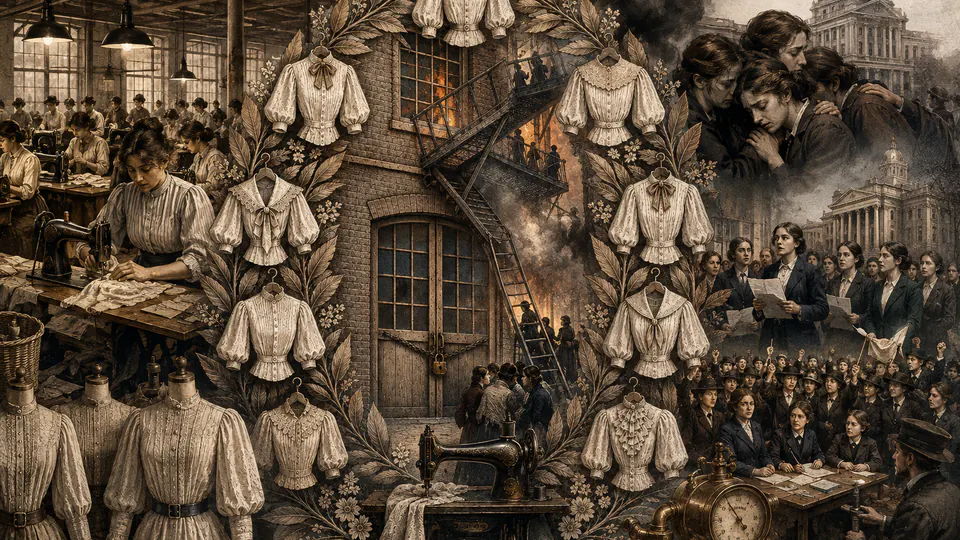
#storyAt 4:40 pm on Saturday, March 25, 1911, the workday was ending on the eighth, ninth, and tenth floors of the Asch Building in Greenwich Village, where the Triangle Shirtwaist Company cut and sewed women’s blouses. A fire flared up in a scrap bin under a cutter’s table at the northeast corner of the eighth floor, most likely from a dropped match or a cigarette butt among two months of accumulated cotton scraps. Smoking was banned on the floor; cutters were known to sneak cigarettes anyway, exhaling through their lapels. Within three minutes the Greene Street stairway was unusable in both directions. On the ninth floor, the other stairway door, the one on Washington Place, was locked, the way it was locked every working day so a foreman could check departing workers’ bags for stolen shirtwaists. The foreman held the only key, and he had already left by another route. The building’s single fire escape, a flimsy iron structure that may already have been damaged, twisted and collapsed under the heat and the crowd’s weight, dropping about twenty of them a hundred feet to the pavement. The fire department’s horse-drawn ladders reached only as high as the seventh floor. When it was over, 146 workers were dead: 123 women and girls and 23 men, ranging from 43-year-old Providenza Panno down to two fourteen-year-olds, Kate Leone and Rosaria Maltese.
The door was locked on purpose
Owners Max Blanck and Isaac Harris said plainly, at trial, exactly why the Washington Place door stayed locked: theft. Shirtwaists were valuable and small enough to roll under a coat, so management staffed one exit to check bags on the way out and shut the other. Survivors at the criminal trial testified they tried that door every way they knew and could not get it open. The building had no sprinklers.
The strike that told them exactly what was wrong
Eighteen months before the fire, Triangle’s own workers had already told Blanck and Harris what was wrong with the shop. In September 1909, Triangle employees walked out on strike. Two months later, on November 22, a mass meeting filled the Great Hall of Cooper Union to debate a general walkout across the shirtwaist trade. After hours of men on the platform urging caution, a 23-year-old striker named Clara Lemlich took the floor and moved, in Yiddish, that the whole industry go out. Within a day 15,000 workers had left their machines; the number climbed past 20,000, and the episode entered union history as the Uprising of the 20,000, the largest strike by women in the country to that point.
It ran until February 1910, when most of the industry settled in what became known as the Protocol of Peace: better pay, shorter hours, equal treatment for union and non-union workers. Blanck and Harris refused to sign. They kept the shop without a union contract and left the specific safety complaints on the table, the locked doors among them. Those were the same doors, thirteen months later.
“We have found you wanting”
The city’s response came fast. On April 2, 1911, a memorial meeting packed the Metropolitan Opera House, drawing much of the Women’s Trade Union League and the allies it had built during the 1909 strike, including the wealthy suffragists who had marched the picket lines alongside garment workers, a pairing this site’s suffrage history covers on its own terms. Rose Schneiderman, an organizer for the League and the ILGWU, told the crowd:
I would be a traitor to these poor burned bodies if I came here to talk good fellowship. We have tried you good people of the public and we have found you wanting.
The trial that let them go
A grand jury indicted Blanck and Harris on first and second degree manslaughter in mid-April 1911, and the trial opened on December 4. Defense attorney Max Steuer built his case on a narrow legal point: New York’s manslaughter statute required proof the owners personally knew the door was locked at the moment of the fire, not merely that it was locked. Steuer also cross-examined survivor Kate Alterman by having her repeat her account of the fire again and again, until he could argue to the jury that her identical wording sounded memorized rather than remembered. On December 27, 1911, the jury acquitted both men. One juror explained the reasoning afterward:
I believed that the door was locked at the time of the fire. But we couldn’t find them guilty unless we believed they knew the door was locked.
A civil suit two years later found the two men liable for wrongful death and set damages at $75 per victim. In the summer of 1913, at the factory they had rebuilt on Fifth Avenue, Blanck was arrested again for locking a door during working hours. He was fined $20, the legal minimum the law allowed.
What Frances Perkins actually saw
Frances Perkins was visiting a friend near Washington Square Park that afternoon when she heard the engines and the screaming and ran toward the building. Speaking at Cornell more than five decades later, in a lecture recorded on September 30, 1964, she recalled workers already jumping by the time she arrived:
They had been holding until that time, standing in the windowsills, being crowded by others behind them, the fire pressing closer and closer, the smoke closer and closer. … They began to jump. The window was too crowded and they would jump and they hit the sidewalk.
The line most often attached to Perkins, that the fire is where “the New Deal began” or “the day the New Deal was born,” is printed on the Frances Perkins Center’s own website and in nearly every retelling of her career since. None of those retellings names a date, a speech, or a document where she actually said it, and her own recorded 1964 account of the day never uses the phrase. What the record shows instead is a job. On the recommendation of Theodore Roosevelt, Perkins left her post at the National Consumers League to become executive secretary of the Committee on Safety of the City of New York, formed to push fire-safety legislation through Albany. That lobbying produced the Factory Investigating Commission, created by the legislature on June 30, 1911 and organized on August 17 under state senator Robert F. Wagner as chairman and assemblyman Al Smith as vice chairman. Perkins ran its field investigations. Over four years the commission interviewed 222 witnesses and filled 3,500 pages of testimony, and its findings fed new laws requiring fire drills, sprinklers, and unlocked, outward-swinging exit doors. The first of them, a 1912 law capping women’s and children’s hours at 54 a week, was the commission’s opening result.
What changed, and what didn’t
Blanck and Harris dissolved the Triangle Waist Company for good in 1918. Harris went back to work as a tailor; Blanck ran other shirtwaist companies under other names. New York’s factory laws became a model other states copied, and the fire helped grow the union that had organized the 1909 strikers. The era’s reform wave reached past garment lofts, too: the Ludlow Massacre three years later showed how far a different set of owners would go when miners tried the same kind of organizing. The Asch Building still stands at the corner of Greene Street and Washington Place, renamed the Brown Building and owned now by New York University. Every March 25, the fire department raises a ladder to the seventh floor outside it, the same height its ladders reached in 1911, and one firefighter climbs up, removes his hat, and bows his head. The ladder still does not reach the ninth floor.
What people get wrong
#wrong- The myth
Frances Perkins said the Triangle fire is 'the day the New Deal began.' - The record
The line is printed on the Frances Perkins Center's own website and repeated in nearly every retelling of her career, but none of those retellings names a date, speech, or document where she said it, and her own recorded 1964 Cornell lecture describing the fire never uses the phrase.
- The myth
Nobody was ever held responsible for the Triangle fire. - The record
Owners Max Blanck and Isaac Harris were acquitted of manslaughter on December 27, 1911, but a civil suit two years later found them liable for wrongful death and set damages at $75 per victim, and Blanck was separately arrested and fined $20 in 1913 for locking a door again at his rebuilt factory.
- The myth
The locked doors that trapped workers were an unknown hazard until the fire exposed them. - The record
Triangle's own employees struck in September 1909 over shop conditions. Most of the industry settled that dispute in February 1910's Protocol of Peace, but Blanck and Harris refused to sign it and left the specific safety complaints, the locked doors among them, unaddressed for another thirteen months.
The dates that matter
#dates- September 1909 Triangle Shirtwaist Company workers walk out on strike.
- November 22, 1909 At a mass meeting in Cooper Union's Great Hall, striker Clara Lemlich moves that the whole shirtwaist trade go on general strike.
- February 1910 The strike ends in the Protocol of Peace for most of the industry. Triangle's owners refuse to sign and leave the shop's locked doors unaddressed.
- March 25, 1911, 4:40 pm Fire breaks out in a scrap bin on the Triangle factory's eighth floor.
- March 25, 1911 146 workers die. The locked Washington Place stairway door and a collapsing fire escape cut off two of the main exits.
- April 2, 1911 Rose Schneiderman speaks at a memorial meeting at the Metropolitan Opera House.
- Mid-April 1911 A grand jury indicts owners Max Blanck and Isaac Harris on manslaughter charges.
- June 30, 1911 New York's legislature creates the Factory Investigating Commission.
- August 17, 1911 The commission organizes, electing Robert F. Wagner chairman and Al Smith vice chairman.
- December 4 to 27, 1911 Blanck and Harris stand trial for manslaughter and are acquitted.
- 1912 New York passes the 54-hour law capping women's and children's work hours, the commission's first major result.
- 1913 A civil suit awards plaintiffs $75 per victim. Blanck is separately arrested and fined $20, the legal minimum, for locking a door at his rebuilt factory.
- 1918 Harris and Blanck dissolve the Triangle Waist Company.
Questions people ask
#faqsHow many people died in the Triangle Shirtwaist fire?
146: 123 women and girls and 23 men, most of them recent Italian and Jewish immigrants. The oldest victim was 43-year-old Providenza Panno; the youngest were two fourteen-year-olds, Kate Leone and Rosaria Maltese.
Why was the door locked at the Triangle Shirtwaist factory?
According to the owners' own trial testimony, to stop theft: shirtwaists were small enough to hide under a coat, so managers kept one exit staffed and the other, on Washington Place, locked and checked bags there. The foreman who held the only key had already left by another route when the fire started.
Were the Triangle Shirtwaist factory owners punished?
Not criminally. Max Blanck and Isaac Harris were acquitted of manslaughter on December 27, 1911, because the judge required proof they personally knew the door was locked at the time of the fire. A 1913 civil suit found them liable for wrongful death and set damages at $75 per victim, and Blanck was separately fined $20 that same year for locking a door at his new factory.
What laws came out of the Triangle Shirtwaist fire?
New York's Factory Investigating Commission, created that June under state senator Robert F. Wagner and assemblyman Al Smith, spent four years interviewing 222 witnesses and produced a wave of new laws: mandatory fire drills, sprinklers, unlocked and outward-swinging exit doors, and, in 1912, the first cap on how many hours women and children could work in a week.
Did Frances Perkins really witness the Triangle fire?
Yes. She was visiting a friend near Washington Square Park, ran to the scene when she heard the fire engines, and watched workers jump from the windows. The line often attributed to her, that the fire is where "the New Deal began," is repeated everywhere but traced to no dated speech or document, and her own recorded 1964 account of the day does not contain it.
The bookshelf
#bookshelfWhere to go next. Buy from an independent bookstore, or find it at your library for nothing.
-
The Roosevelt I Knew Frances Perkins, 1946 primary
Written by the fire's most famous eyewitness, who left the National Consumers League for the Committee on Safety within months of watching it happen.
-
The Triangle Fire Leon Stein, 1962 secondary
The book that rebuilt the case from survivor interviews the papers never printed. Still the source most other histories work from.
-
Triangle: The Fire That Changed America David Von Drehle, 2003 secondary
Places the fire inside the politics around it: the 1909 strike, the trial, and the laws that followed.
Wear it: Triangle Shirtwaist Fire
#merchEvery design here links back to this page.
Sources
#sourcesPrimary sources
The documents themselves: laws, court opinions, speeches, letters, and the numbers from the agencies that count them.
- Lecture by Frances Perkins (September 30, 1964), Kheel Center for Labor-Management Documentation and Archives, Cornell University (her own eyewitness account and description of running the state's investigation, transcribed)
- "Preliminary Report of the New York Factory Investigating Commission" (1912), reprinted at Famous Trials (the commission's founding date, organization date, and leadership)
- Rose Schneiderman, "We Have Found You Wanting" (April 2, 1911), reprinted by Cornell ILR (text of her speech at the Metropolitan Opera House memorial meeting)
Secondary sources
Written afterward, about the story.
- Wikipedia, "Triangle Shirtwaist Factory fire" (the fire's timeline, death toll, trial record, and 1913 civil suit and fine)
- Wikipedia, "New York shirtwaist strike of 1909" (Triangle's own workers striking in 1909 and the owners' refusal to sign the Protocol of Peace)
- Wikipedia, "Frances Perkins" (her role as executive secretary of the Committee on Safety and the 1912 54-hour law)
- "The Triangle Shirtwaist Fire Trial: Building and Safety Laws," Famous Trials (the 1913 statute requiring factory doors to open outward and stay unlocked in working hours)
- "Triangle Shirtwaist Fire Trial: 1911, Blanck and Harris Go Free," JRank Law Library (the judge's jury instructions and a juror's account of the acquittal)
- "December 27, 1911: Owners Acquitted in Triangle Fire," ABA Journal (verdict date and the failed effort to retry the case)
- "110 Years Ago Today: The Triangle Shirtwaist Factory Fire," Teaching American History (corroborates the Factory Investigating Commission's witness count and testimony volume)
- Frances Perkins Center, "Her Life" (source for the widely repeated, undated "New Deal was born" attribution)
- "New York City events honor Triangle fire victims, focus on new activists," Cornell Chronicle (source for the FDNY's annual ladder tribute at the Brown Building)