Published
Ludlow Massacre
The Ludlow Massacre: The Day the Company Burned the Tents
On April 20, 1914, Colorado militia and mine guards attacked a coal strikers' camp at Ludlow. Two women and eleven children suffocated in a pit under one tent.
The story
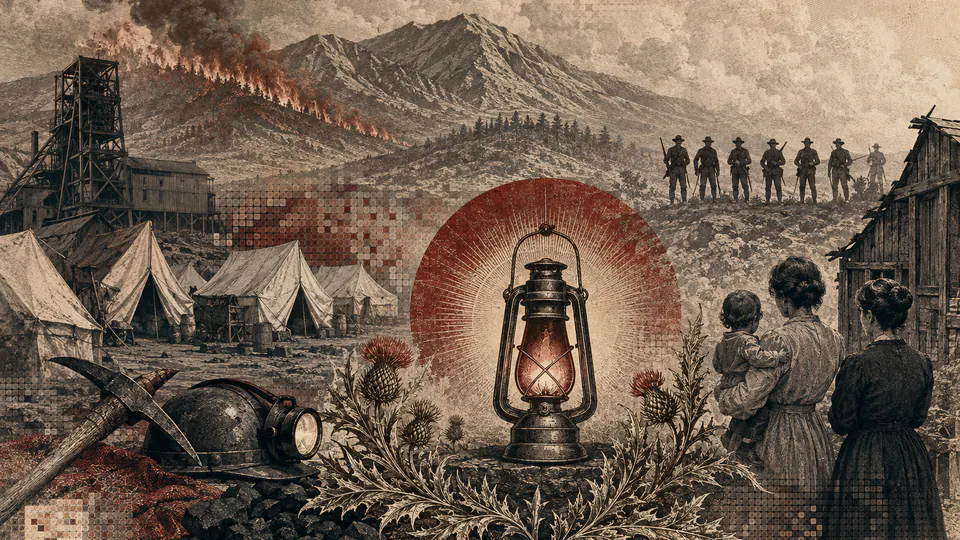
#storyOn the night of April 20, 1914, Colorado National Guardsmen and Colorado Fuel & Iron mine guards set fire to a coal strikers’ tent colony at Ludlow, Colorado, after a full day of gunfire between the camp and machine guns positioned on the ridge above it. The next morning a telephone lineman found two women and eleven children dead in a pit dug beneath one tent, where the family had hidden from the shooting and suffocated when the tent above them burned. The camp’s leader, Louis Tikas, was already dead too: beaten with a rifle butt and then shot three times after militiamen took him the evening before. The mine belonged to the Colorado Fuel & Iron Company, controlled by John D. Rockefeller Jr., who ran it from an office at 26 Broadway in New York City.
A company town with no room for a union
Rockefeller’s father bought a controlling stake in Colorado Fuel & Iron in 1902 and passed it to his son in 1911. In the company’s southern Colorado coal camps, ownership meant more than the mine: the company owned the houses, ran the stores, and hired the doctors. About 10,000 miners struck on September 23, 1913, over six specific demands: union recognition, a ten percent wage increase, checkweighmen to verify what they were paid for the coal they loaded, cash wages instead of company scrip, freedom to buy and sell where they chose, and enforcement of the eight-hour day, a law Colorado voters had already put in its constitution in 1902 and mine operators routinely ignored. Recognition is still the same basic ask behind what a union does today. The company evicted the strikers and their families, up to 20,000 people, from its housing as the strike began, and the United Mine Workers of America leased land at the mouths of the canyons and built tent colonies to hold them. The largest, at Ludlow, held roughly 1,200 people in about 200 tents. Denver’s public library, cataloging the colony’s makeup, counts at least 32 ethnic and national groups among the strikers, including Greek, Italian, and Mexican workers.
Mother Jones, then in her seventies, came to organize the camps and spent the winter in and out of custody: arrested and held nine weeks starting in January 1914, then arrested again that March and locked in an underground Huerfano County jail cell for 26 days.
The day the shooting started
On the morning of April 20, militiamen at Ludlow demanded the release of a man they claimed the strikers were holding. Tikas walked to the rail station to negotiate with the militia’s commander. While he was gone, militia companies set a machine gun on Water Tank Hill above the camp and set off warning charges meant to summon reinforcements. Strikers, reading the explosions and the gun placement as an attack, took defensive positions. Tikas ran back to warn his camp, and gunfire continued for most of the day while women and children sheltered in pits dug beneath the tents for exactly this purpose. By evening a stalled freight train let many families slip east to safety. Around 7 p.m. the camp caught fire. Militiamen moved through the burning tents, looting as they went, and captured Tikas along with two other miners.
The pit, and the death that wasn’t in it
Eleven children, ranging in age from three months to nine years, and two women suffocated in the earthen pit beneath one tent as the canvas above them burned. Their surnames, Costa, Petrucci, Valdez, and Pedregone among them, mark the same mix of nationalities that filled the whole colony. Tikas died a different way, and separately. Lieutenant Karl Linderfelt broke his rifle butt over Tikas’s head after the capture; Tikas was then shot three times, once through the back, and died of the wounds. His body and those of the two other captured miners lay along the Colorado and Southern Railway tracks for three days before anyone retrieved them.
Ten days of war, and a death toll no one fully agrees on
News of the pit deaths reached the union’s district office, and its officers issued a call to arms departing from the strike’s earlier restraint. For the next ten days, hundreds and at times close to a thousand armed strikers attacked mines and militia positions across a front that ran some 225 miles, from Trinidad north to Louisville: the Empire Mine, the Chandler Mine, Walsenburg, the Hecla Mine, and Forbes, where nine men died in a single engagement. President Wilson invoked the Insurrection Act on April 28, the first time since 1894, and federal troops arrived within a day to disarm both sides. Contemporary newspapers counted 20 dead at Ludlow itself: 12 children and 8 adults. Modern historians count it closer to 19 people on the strikers’ side: the 2 women and 11 children who suffocated in the pit, an 11-year-old boy named Frank Snyder shot in his family’s tent, and at least 5 men shot elsewhere, including Tikas, against 1 confirmed National Guard death. Historian Thomas G. Andrews, in a book titled for exactly this argument, estimates 69 to 199 deaths across the entire strike from September 1913 to that December, and calls it the deadliest strike in the history of the United States. The range is wide because the fighting was scattered across months and dozens of camps, and because the only people keeping count had a side in the fight.
Rockefeller testifies, and nobody goes to prison
Rockefeller was summoned to Washington twice. In May 1914 he appeared before the House Committee on Mines and Mining and, by the New York Times account of the hearing, said he could not speak to the specifics of the evictions and that company officials would have the facts; none were ever supplied. In January 1915, called before the federal Commission on Industrial Relations, he held the same position for several days of questioning from the commission’s chairman, Frank Walsh. Asked whether he would keep the camps nonunion even at the cost of the company’s whole property and its workers’ lives, Rockefeller answered that it was “a great principle.” Pressed on whether that meant refusing collective bargaining outright, he explained himself further:
Rather than allow outside people to come in and interfere with employees who are thoroughly satisfied with their labor conditions,it was upon a similar principle that the War of the Revolution was carried on.
Nothing in that exchange acknowledges that a number of those thoroughly satisfied employees were, at that moment, on strike, and eleven of their children were dead. No one paid a criminal price for it. A military court reviewed Linderfelt’s conduct toward Tikas, found him guilty of the assault, ruled the act carried no criminality, and gave him no punishment. Not one militiaman or mine guard was ever criminally convicted for a death at Ludlow.
The company hires a spin doctor
That same year, Rockefeller retained Ivy Lee, a publicist who had worked for the Pennsylvania Railroad, to manage what the fire had done to the family name. Lee’s operation issued 19 numbered bulletins titled “The Struggle in Colorado for Industrial Freedom.” The first 15 went out in the name of Colorado’s mine operators to roughly 11,000 newspaper editors and opinion leaders, and were later compiled into a booklet distributed in 40,000 copies. One bulletin proposed that the tent camp’s own women and children, in the panic of the attack, “probably pulled down a stove” and set the fire themselves, an account that left out the machine gun fire and the kerosene the National Guard’s own men had used. Another bulletin, “How Colorado Editors View the Strike,” presented the coal industry’s side as consensus opinion while leaving out that only 14 of the 331 Colorado newspaper editors it cited had shown up to the meeting it drew from, and only 11 of those had signed the report. The muckraking press nicknamed Lee “poison Ivy”; Carl Sandburg’s own label for him was blunter, “a paid liar.” Lee also coached Rockefeller through a more effective move: an in-person tour of Colorado’s coal camps that fall, meeting miners and their families and touring the mines himself, the kind of visible contrition no bulletin could fake. Historians now point to the whole campaign, bulletins and photo opportunity together, as one of the founding case studies in what became the corporate public relations industry.
What’s left at Ludlow
The United Mine Workers bought 40 acres of the Ludlow site in 1915 and dedicated a granite monument there in 1918, a miner, his wife, and a child cut into stone. In 2003 vandals sawed the heads off both adult figures; no one was ever arrested for it. The union spent more than $77,000 rebuilding the statues and rededicated the memorial on June 5, 2005, with roughly 400 people, including descendants of the survivors, in attendance. The Ludlow Tent Colony Site became a National Historic Landmark on January 16, 2009. The union that buried its dead there still owns the plot, and still pays to fix the monument when someone tries to erase it again.
What people get wrong
#wrong- The myth
The fire at Ludlow started when a stove tipped over in the panic. - The record
That account came from the company's own publicist, Ivy Lee, who wrote in an early bulletin that the tent colony's women and children "probably pulled down a stove in their hysterical flight, and this stove was what set the whole camp in flames." Other contemporary accounts describe the National Guard moving into the camp and setting the tents alight directly, after a full day of gunfire from the ridge above.
- The myth
Someone went to prison for what happened at Ludlow. - The record
Not one militiaman or mine guard was ever criminally indicted for a death at Ludlow. A military court found Lieutenant Karl Linderfelt guilty of assaulting Louis Tikas, ruled the act carried no criminality, and issued no punishment.
- The myth
Rockefeller ran the mine day to day and knew what was happening on the ground. - The record
John D. Rockefeller Jr. controlled Colorado Fuel & Iron from an office at 26 Broadway in New York City, hundreds of miles from the camps. Under questioning from Congress in May 1914, he said he could not speak to the specifics of the evictions that opened the strike and that company officials in Colorado would have those facts. None were ever supplied to the committee.
The dates that matter
#dates- September 23, 1913 About 10,000 Colorado Fuel & Iron miners strike over six demands: union recognition, a ten percent raise, enforcement of the eight-hour day, checkweighmen, cash wages, and freedom to buy and sell. As the strike begins, the company evicts them and their families, up to 20,000 people, from company housing.
- March 22, 1914 Militia arrest Mother Jones again and hold her 26 days in an underground jail cell in Huerfano County. She is 76.
- April 20, 1914 National Guardsmen and mine guards fire on the Ludlow tent colony most of the day, then burn it that evening. Two women and eleven children suffocate in a pit beneath one tent; Louis Tikas is captured, beaten, and shot dead.
- April 20-30, 1914 The Ten Days' War: hundreds of armed strikers attack mines and militia positions across a stretch of southern Colorado.
- April 28-29, 1914 President Wilson invokes the Insurrection Act; federal troops arrive and disarm both sides.
- May 20, 1914 Rockefeller testifies before the U.S. House Committee on Mines and Mining in Washington.
- December 1914 The union, out of strike funds, calls off the action. It wins no recognition and no contract.
- January 1915 Rockefeller testifies for several days before the federal Commission on Industrial Relations, defending the company's nonunion policy as, in his words, a great principle.
- 1915 The United Mine Workers buys 40 acres at the Ludlow site. Rockefeller, on his publicist's advice, tours Colorado's coal camps in person that fall.
- 1918 The union dedicates a granite monument at Ludlow depicting a miner, his wife, and a child.
- 2003 Vandals saw the heads off the monument's two figures. No one is arrested.
- June 5, 2005 The union rededicates the rebuilt monument after a restoration costing more than $77,000.
- January 16, 2009 The Ludlow Tent Colony Site is designated a National Historic Landmark.
Questions people ask
#faqsWhat was the Ludlow Massacre?
On April 20, 1914, Colorado National Guardsmen and Colorado Fuel & Iron mine guards attacked a coal strikers' tent colony at Ludlow, Colorado, firing on it for most of the day and setting it on fire that evening. Two women and eleven children suffocated in a pit dug beneath one tent, and the camp's leader, Louis Tikas, was captured, beaten, and shot dead separately. It came seven months into a strike against the Rockefeller-controlled Colorado Fuel & Iron Company.
How many people died in the Ludlow Massacre?
Contemporary newspapers counted 20 dead at Ludlow on April 20: 12 children and 8 adults. Modern historians put the strikers' side at roughly 19: the 2 women and 11 children who suffocated in the pit, an 11-year-old boy named Frank Snyder shot in his family's tent, and at least 5 men killed by gunfire elsewhere, including Tikas. A single National Guardsman also died. Historian Thomas G. Andrews estimates 69 to 199 deaths across the full strike, from September 1913 to the following December, which he calls the deadliest strike in the history of the United States.
Who was responsible for the Ludlow Massacre?
The Colorado National Guard, its ranks by then including men Colorado Fuel & Iron helped pay, and the company's own mine guards carried out the attack; the company was controlled by John D. Rockefeller Jr. A military court found Lieutenant Karl Linderfelt guilty of assaulting Tikas but ruled the act carried no criminality and issued no punishment. No militiaman or mine guard was ever criminally convicted for a death at Ludlow.
What happened to Louis Tikas?
Tikas, a Greek-born organizer who led the Ludlow camp, went to negotiate with the militia commander the morning of the attack and ran back to warn his camp when the shooting started. That evening, after his capture, a militia lieutenant beat him with a rifle butt and he was then shot three times. He died of the wounds, and his body was left along the railroad tracks for three days.
Is the Ludlow Massacre site still there?
Yes. The United Mine Workers of America bought the land in 1915 and dedicated a granite monument there in 1918. Vandals sawed the heads off its two statues in 2003, and the union rebuilt them for a 2005 rededication. The site became a National Historic Landmark in 2009, and the UMWA still owns and maintains it.
The bookshelf
#bookshelfWhere to go next. Buy from an independent bookstore, or find it at your library for nothing.
-
The Autobiography of Mother Jones Mary Harris "Mother" Jones, 1925 primary
Her own account of organizing the southern Colorado camps and the winter she spent in and out of custody.
-
Buried Unsung: Louis Tikas and the Ludlow Massacre Zeese Papanikolas, 1982 secondary
The fullest account of the Greek-born organizer the militia beat and shot.
-
Blood Passion: The Ludlow Massacre and Class War in the American West Scott Martelle, 2007 secondary
A reporter's narrative of the whole strike, from the tent colonies to the congressional hearing room.
-
Killing for Coal: America's Deadliest Labor War Thomas G. Andrews, 2008 secondary
The environmental and labor history behind the death-toll range already cited on this page.
Wear it: Ludlow Massacre
#merchEvery design here links back to this page.

Sources
#sourcesPrimary sources
The documents themselves: laws, court opinions, speeches, letters, and the numbers from the agencies that count them.
- Testimony of John D. Rockefeller Jr., Final Report and Testimony Submitted to Congress on Industrial Relations, 64th Congress, 1st Session (1916) (reproduced by Who Built America? (American Social History Productions))
Secondary sources
Written afterward, about the story.
- Wikipedia, "Ludlow Massacre"
- Wikipedia, "Colorado Coalfield War"
- Wikipedia, "Louis Tikas"
- Wikipedia, "Karl Linderfelt" (the court-martial finding on the assault of Tikas)
- National Park Service, "War in the Coalfields: The Ludlow Massacre and Its Impact on the Eight-Hour Workday"
- Robert Forrant, "1914 Ludlow Massacre took lives of 25 miners and family members during bitter strike for fair wages and conditions," The Conversation (author is a professor of labor history at UMass Lowell)
- PBS American Experience, "The Rockefellers": the Ludlow feature
- Summit Daily, "Vandalized memorial to Ludlow Massacre victims restored"
- COMM 500 course archive, "The Ludlow Massacres" (case study on Ivy Lee's Colorado bulletins)
- Zinn Education Project, "April 20, 1914: Ludlow Massacre" (source for the National Guard's company-paid wages)
- Denver Public Library Special Collections and Archives, "Diversity Then & Now: The Ludlow Massacre and Western History"
- Thomas G. Andrews, Killing for Coal: America's Deadliest Labor War (Harvard University Press, 2008) (the 69-to-199 death toll estimate across the full strike)