Published
Mother Jones
Mother Jones: The "Most Dangerous Woman in America" at 83
Born 1837. Died November 30, 1930
Mary Harris Jones lost her family to yellow fever, then spent forty years organizing miners. At 83, a military court sentenced her to twenty years.
The story
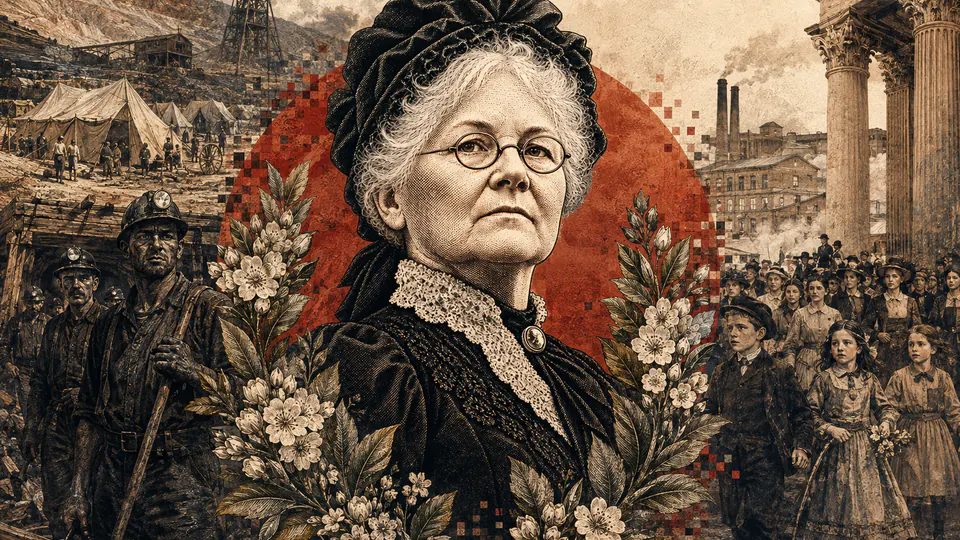
#storyIn her eighty-third year, by the birthday she had given herself. That was Mary Harris Jones in February 1913, under arrest in Charleston, West Virginia, headed for a military court that would sentence her to twenty years in the state penitentiary for conspiracy to murder. She had already survived a yellow fever epidemic that killed her husband and all four of her children inside a week, watched a fire burn down the shop she had rebuilt her life around, and spent four decades talking coal miners into striking against some of the richest companies in the country. A federal prosecutor had handed her a label a decade earlier that she never bothered to correct: the most dangerous woman in America.
The birthday she picked herself
She was baptized Mary G. Harris on August 1, 1837, at the Cathedral of St. Mary and St. Anne in Cork, Ireland, daughter of Richard and Ellen Harris. The Famine years pushed her family across the Atlantic in stages, her father and brother first, her mother and the rest of the children a few years later, all of them eventually settling in Toronto.
None of that made it into her own account of her life. In the autobiography she published in 1925, she gave her birth date as May 1, 1830, a date that put her on the calendar next to the day organized labor around the world celebrates as May Day. She kept the story to the end: on May 1, 1930, well-wishers and reporters marked what she called her hundredth birthday. Historians only confirmed the earlier date using the Cork parish register decades after her death. Whatever her reasons, the seven-year gap is the kind of detail this record keeps rather than smooths over.
What she lost in Memphis and Chicago
Mary Harris moved to Memphis, Tennessee, and in 1861 married George E. Jones, an iron molder and member of the Iron Molders’ Union. Six years later, a yellow fever epidemic swept the city. Her own account of it:
One by one, my four little children sickened and died. I washed their little bodies and got them ready for burial. My husband caught the fever and died.
She moved to Chicago afterward, built a dressmaking business sewing for the city’s wealthier families, and lost that too: “In October, 1871, the great Chicago fire burned up our establishment and everything that we had,” she wrote. Afterward she started attending Knights of Labor meetings at a hall near the ruins.
Becoming Mother Jones
By the mid-1890s she was a paid organizer for the newly formed United Mine Workers of America, sent into coalfields from Pennsylvania to Colorado to sign up miners local by local. Miners’ families started calling her Mother, and the name outlasted every other one she carried; the nickname that came with it, the Miners’ Angel, said what the rank and file thought she was worth. In June 1905 she was named among the contributors to the Chicago convention that founded the Industrial Workers of the World, alongside Eugene Debs and Big Bill Haywood, one of the only women in a hall organizing what its founders called One Big Union. The union work is what she meant when someone once asked where she lived and she said, “Well, wherever there is a fight.”
The most dangerous woman in the country
Her organizing style came with an edge the pamphlets didn’t carry. In one West Virginia coal town during a UMW campaign, she found striking miners paying to hold their meetings in a church, told them a union was a fighting institution rather than a praying one, moved the meeting to the schoolhouse, and gave them the line labor has repeated ever since:
Pray for the dead and fight like hell for the living
The campaign that line came out of got her arrested. On June 21, 1902, deputy marshals took her into custody at Clarksburg, West Virginia for defying a federal injunction against holding union meetings, part of a wider UMW drive in the state’s Fairmont coalfield. At her trial that summer in the federal court at Parkersburg, before Judge John Jay Jackson Jr., the prosecutor offered the judge a deal: go easy on her, but only if she agreed to leave the state for good. Her own account of how he made the case for why she needed watching:
Your honor - there is the most dangerous woman in the Country today.
Later accounts name that prosecutor as Reese Blizzard and give the line a longer, more theatrical shape: she comes into a state, crooks her finger, and twenty thousand contented men lay down their tools and walk out. That’s the version that gave a later biography its title and made “the most dangerous woman in America” stick as a permanent label. It isn’t the version in her own book. Whichever words the prosecutor actually used, the case is forgotten and the label is on shirts. She kept organizing for another three decades and never once denied it fit.
Paint Creek, Cabin Creek, and a twenty-year sentence
Paint Creek’s miners struck in April 1912 over a wage gap of two and a half cents a ton with other union mines nearby. Jones arrived that June to organize, and by July she was warning West Virginia’s governor, William E. Glasscock, in front of a crowd of miners in Charleston:
I warn this little governor that unless he rids Paint Creek of these mineguard thugs, there is going to be one hell of a lot of bloodletting in these hills.
Glasscock declared martial law on September 2 and sent in twelve hundred state troops. Martial law didn’t stop the violence: in February 1913, gunmen firing from an armored train nicknamed the Bull Moose Special raked a miners’ tent colony at Holly Grove, killing a striker. Within days, deputies arrested Jones in Charleston and moved her under guard to a makeshift military prison at Pratt, where a court tried her, along with dozens of others, on charges that ran up to conspiracy to murder. She refused to recognize the court’s authority to try a civilian at all. It convicted her anyway:
I was tried for murder. Along with the others I was sentenced to serve twenty years in the state penitentiary.
She was in her eighty-third year, by the birthday she had given herself.
She didn’t serve it. Word of her sentence reached Senator John W. Kern of Indiana, who read her smuggled telegram into the Congressional Record and used it to push through a resolution sending the Senate Committee on Education and Labor to investigate West Virginia’s coalfields. The state’s new governor, Henry Hatfield, would not let the military court’s sentence stand: he set the convictions aside and released Jones along with most of the other prisoners. She had served roughly eighty-five days.
Colorado and the last strike
Within months she was in Colorado, working the United Mine Workers’ strike against John D. Rockefeller Jr.’s Colorado Fuel and Iron Company, underway since September 1913. State authorities twice ordered her out of the strike zone and jailed her for coming back. She was away from southern Colorado when National Guardsmen and company gunmen burned the tent colony at Ludlow on April 20, 1914.
The number she never let go of
She kept working well past the age most people would stop, whichever of her two birth years you use. At a dinner of five hundred women, most of them suffrage supporters, one asked how they were supposed to stand up for free speech in the streets without a vote. Her answer became the title of an autobiography chapter:
I have never had a vote, and I have raised hell all over this country You don’t need a vote to raise hell You need convictions and a voice
On May 1, 1930, well-wishers and reporters marked the hundredth birthday she had given herself. She died seven months later, on November 30, 1930, at a friend’s home near Silver Spring, Maryland. Union members carried her back to Illinois, to Union Miners Cemetery in Mount Olive, and buried her beside men killed in an 1898 strike battle at Virden. The parish register in Cork puts her actual age that day at ninety-three.
Nobody has ever disputed the twenty-year sentence, the yellow fever house in Memphis, or the fire that took her dress shop. Only the number she picked for herself needed correcting.
In their own words
#wordsWhat Mother Jones actually said, where, and when. Each one links to the page it was checked against.
-
I was born in the city of Cork, Ireland, in 1830. My people were poor.
The opening lines of her autobiography, published in 1925, giving the birth year the Cork parish register contradicts. The Autobiography of Mother Jones, Chapter I, "Early Years" -
Pray for the dead and fight like hell for the living!
Telling miners in a Fairmont-district coal town to move their meeting out of a rented church, in her account of organizing West Virginia. The Autobiography of Mother Jones, Chapter VI, "War in West Virginia" -
Some day the workers will take possession of your city hall, and when we do, no child will be sacrificed on the altar of profit.
Shouted up at Philadelphia officials watching from their windows during the 1903 March of the Mill Children. The Autobiography of Mother Jones, Chapter X, "The March of the Mill Children" -
From out the military prison walls of Pratt, West Virginia, where I have walked over my eighty-fourth milestone in history, I send you the groans and tears and heartaches of men, women and children as I have heard them in this state.
In the telegram smuggled from her military-prison cell in 1913 that Senator John W. Kern read into the Congressional Record, opening the Senate investigation of the West Virginia coalfields. The Autobiography of Mother Jones, Chapter XVIII, "Victory in West Virginia" -
I did not believe in women's rights nor in men's rights but in human rights.
Answering suffrage supporters at a dinner five hundred women gave her, on the tour she made after Ludlow defending the jailed Colorado miners' leader John R. Lawson. The Autobiography of Mother Jones, Chapter XXII, "You Don't Need a Vote to Raise Hell" -
Wherever the workers are fighting the robbers, there am I.
Answering someone in the crowd who asked what part of the country she belonged to, in her 1912 speech to striking coal miners in Charleston, West Virginia. Mother Jones, "Speech to Striking Coal Miners" (Charleston, WV, 1912), transcribed by a court reporter
What people get wrong
#wrong- The myth
Mother Jones was born in 1830, the date she gave her whole public life. - The record
The Cathedral of St. Mary and St. Anne in Cork baptized Mary G. Harris on August 1, 1837, one of five infants baptized that day. She gave 1830 for the rest of her public life, seven years early, with a birthday on May Day. The hundredth she celebrated in 1930 was not her hundredth.
- The myth
A judge called her the most dangerous woman in America, and she bragged about crooking a finger to pull twenty thousand men off the job. - The record
In her own account the line came from the prosecuting attorney, not the judge, in an argument for letting her go if she left the state. The version where she crooks a finger and twenty thousand contented men walk out, which gave a 2001 biography its title, is not in her book. Later retellings supply it and name the prosecutor as Reese Blizzard.
- The myth
The military court's twenty-year sentence meant she spent years in prison. - The record
The court did sentence her to twenty years, by her own account. She served roughly 85 days: a smuggled telegram reached Senator John W. Kern of Indiana, who read it into the Congressional Record and pushed through a Senate investigation of the coalfields, and West Virginia's new governor, Henry Hatfield, set aside the court-martial's sentences and freed her along with most of the other prisoners.
The dates that matter
#dates- August 1, 1837 Baptized Mary G. Harris at the Cathedral of St. Mary and St. Anne in Cork, Ireland. She later claimed a birth date of May 1, 1830.
- Early 1850s Emigrates with her family during the Famine years, eventually settling in Toronto.
- 1861 Marries George E. Jones, an iron molder and member of the Iron Molders' Union, in Memphis, Tennessee.
- 1867 Loses her husband and all four of their children to a yellow fever epidemic in Memphis.
- October 1871 The Great Chicago Fire destroys the dressmaking shop she had built; she starts attending Knights of Labor meetings soon after.
- Mid-1890s Becomes a paid organizer for the newly formed United Mine Workers of America; miners' families begin calling her Mother.
- June 21, 1902 Arrested at Clarksburg, West Virginia for defying a federal injunction against union meetings.
- Summer 1902 Tried before Judge John Jay Jackson Jr. in the federal court at Parkersburg; the prosecutor calls her the most dangerous woman in the country.
- July 1903 Leads the March of the Mill Children from Philadelphia toward President Theodore Roosevelt's home at Oyster Bay, New York.
- June-July 1905 Named among the contributors to the Chicago convention that founds the Industrial Workers of the World.
- February 1913 Arrested in Charleston, West Virginia during the Paint Creek-Cabin Creek strike and held for a military court-martial.
- March 1913 Convicted by the military court and sentenced to twenty years in the state penitentiary.
- May 1913 Released after roughly 85 days once Governor Henry Hatfield sets aside the court-martial's convictions, amid a Senate investigation.
- November 30, 1930 Dies near Silver Spring, Maryland; buried in Union Miners Cemetery, Mount Olive, Illinois.
Questions people ask
#faqsWho was Mother Jones?
Mary Harris Jones (probably 1837-1930) was an Irish-born labor organizer who spent four decades signing up coal miners for the Knights of Labor and the United Mine Workers of America, led the 1903 March of the Mill Children against child labor, and was sentenced to twenty years by a military court during West Virginia's 1912-1913 Paint Creek-Cabin Creek strike.
Why was Mother Jones called the most dangerous woman in America?
At her 1902 trial in Parkersburg, West Virginia, for defying a federal injunction against union meetings, the prosecuting attorney offered to go easy on her if she left the state for good, and made his case for why she needed watching. Her own autobiography has him telling the judge, "there is the most dangerous woman in the Country today." A longer, more colorful version of the line, in which she crooks a finger and twenty thousand men walk out, circulates in most retellings and gave Elliott Gorn's 2001 biography its title, but that version does not appear in her own book.
Did Mother Jones lie about her age?
She told people she was born May 1, 1830, and celebrated a hundredth birthday on that date in 1930. Cork's Cathedral of St. Mary and St. Anne has her baptized August 1, 1837, seven years later, which puts her actual age at death that November at 93, not 100.
What happened to Mother Jones during the Paint Creek-Cabin Creek strike?
Arrested in February 1913 during a martial-law crackdown on the strike, she was tried by a military court on charges up to conspiracy to murder and sentenced to twenty years in the state penitentiary. She smuggled a telegram to Senator John W. Kern of Indiana, who read it into the Congressional Record and pushed through a Senate investigation of the coalfields. West Virginia's new governor, Henry Hatfield, set aside the court-martial's convictions, and she was free after roughly 85 days.
How did Mother Jones die?
She died November 30, 1930, at a friend's home near Silver Spring, Maryland, seven months after the hundredth birthday party she gave herself. She is buried in Union Miners Cemetery in Mount Olive, Illinois, beside miners killed in an 1898 strike battle at Virden.
The bookshelf
#bookshelfWhere to go next. Buy from an independent bookstore, or find it at your library for nothing.
-
The Autobiography of Mother Jones Mary Harris Jones, 1925 primary
Her own telling, including the birth year the parish register complicates.
-
Mother Jones Speaks: Collected Writings and Speeches Mary Harris Jones, edited by Philip S. Foner, 1983 primary
Her speeches and letters in one place, before any biographer's framing.
-
Mother Jones: The Most Dangerous Woman in America Elliott J. Gorn, 2001 secondary
The standard modern biography, its title drawn from the embellished version of the Parkersburg courtroom line.
-
Mother Jones: The Miners' Angel Dale Fetherling, 1974 secondary
An earlier biography, close to the coalfields' own memory of her.
Wear it: Mother Jones
#merchEvery design here links back to this page.
Sources
#sourcesPrimary sources
The documents themselves: laws, court opinions, speeches, letters, and the numbers from the agencies that count them.
- Mary Harris Jones, The Autobiography of Mother Jones (Charles H. Kerr, 1925), Chapter I, "Early Years" (her own account of the Memphis yellow fever epidemic and the Chicago fire)
- The Autobiography of Mother Jones, Chapter VI, "War in West Virginia" (source of "pray for the dead and fight like hell for the living")
- The Autobiography of Mother Jones, Chapter VII, "A Human Judge" (her own account of the 1902 Parkersburg trial)
- The Autobiography of Mother Jones, Chapter X, "The March of the Mill Children"
- The Autobiography of Mother Jones, Chapter XVIII, "Victory in West Virginia" (her own account of the Paint Creek-Cabin Creek arrest, court-martial, and release)
- The Autobiography of Mother Jones, Chapter XXII, "You Don't Need a Vote to Raise Hell"
- Mother Jones, "Speech to Striking Coal Miners" (Charleston, WV, 1912), transcribed by a court reporter
Secondary sources
Written afterward, about the story.
- e-WV: The West Virginia Encyclopedia, "Mother Jones"
- Wikipedia, "Paint Creek-Cabin Creek strike of 1912" (source of the Bull Moose Special incident and Senate investigation details)
- The Spirit of Mother Jones Festival (Cork), "Mary Harris, Part 1" (the Cork baptismal record research)
- Illinois Labor History Society, "Mother Jones, the Miners' Angel"
- Encyclopedia.com, "Mother Jones Court-Martial: 1913"
- Wonkette, "When They Jailed The Most Dangerous Woman In America, Mary 'Mother' Jones" (names the prosecutor as Reese Blizzard and gives the popularized version of the courtroom line)