Published
Montgomery Bus Boycott
The Montgomery Bus Boycott Ran on 50,000 Leaflets and a Carpool
The 381-day Montgomery boycott grew from Black women's organizing, mass walking, a church-run carpool, and the Browder v. Gayle lawsuit.
The story
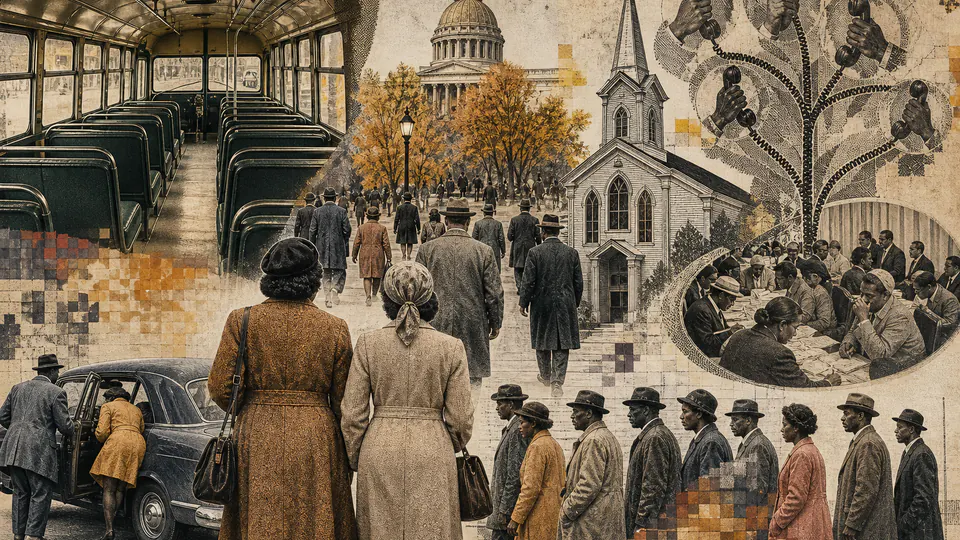
#storyJo Ann Robinson and her students produced about 50,000 boycott leaflets after Rosa Parks’s arrest on December 1, 1955. By Monday, most Black riders had left Montgomery’s buses nearly empty. The famous leadership came into focus after the printing run.
Organizing preceded the arrest
The Women’s Political Council had pressed the city about abusive drivers and segregation for years. Claudette Colvin, Mary Louise Smith, and others had already been arrested for refusing seats. Parks was an experienced NAACP secretary, not a tired stranger to organizing.
At a December 5 meeting, local leaders formed the Montgomery Improvement Association and elected Martin Luther King Jr. president. The one-day action became an open-ended boycott.
A transportation system replaced a transportation system
Thousands walked, shared rides, or used a church-backed carpool with dispatchers and dozens of pickup points. The city ticketed drivers, prosecuted leaders, and tried to block the carpool. King’s home and other homes were bombed. Participation held.
Four women, Aurelia Browder, Susie McDonald, Claudette Colvin, and Mary Louise Smith, became plaintiffs in Browder v. Gayle. A federal court struck down bus segregation in June 1956, and the Supreme Court affirmed the ruling. The boycott ended December 20 when the order reached Montgomery.
The campaign made King nationally known and supplied a model of mass nonviolent action. Its operating lesson belonged to the less glamorous work: a movement can survive 381 days when somebody has the leaflets, the phone list, and a car waiting at the pickup point.
Economic retaliation met an improvised public system
The Women’s Political Council, led by Jo Ann Robinson, printed and distributed tens of thousands of leaflets for the first one-day protest. Black churches hosted mass meetings, while the Montgomery Improvement Association coordinated volunteer drivers, dispatch points, repair work, and fundraising. Riders walked long distances or shared cars while the bus company lost fares.
City officials targeted that infrastructure. Police ticketed drivers, officials pressed insurers, and a grand jury indicted boycott leaders under an old anti-boycott law. King’s home was bombed. The carpool continued because responsibility was spread across congregations and neighborhoods. Browder v. Gayle supplied the federal legal route, while collective transportation supplied the time the case needed. The pairing matters: litigation could strike the law, but organization kept plaintiffs and their community moving until the ruling arrived.
Bus segregation extracted money and submission
Black riders supplied most of the Montgomery bus system’s passengers while facing segregated seating, insults, arbitrary driver orders, and arrest. They paid at the front, sometimes had to leave and reenter through the rear, and could watch a bus pull away before they boarded again.
The rule was economic as well as symbolic. Workers depended on buses to reach white households, shops, and other jobs. Drivers could use that dependence to enforce racial authority during an ordinary commute.
Complaints accumulated for years. The boycott emerged from repeated injury, not one isolated dispute over a seat.
Rosa Parks brought training and movement history to the arrest
Parks was secretary of the local NAACP, investigated cases of racial violence, attended Highlander Folk School, and had challenged bus treatment before December 1955. Calling her a tired seamstress without this history removes political judgment from her refusal.
Other women had resisted bus segregation. Claudette Colvin, Mary Louise Smith, Aurelia Browder, and Susie McDonald became plaintiffs in the federal case that ended the law. Movement leaders had to consider age, class, public treatment, and legal circumstance when building a campaign.
That strategic choice should not turn one plaintiff into the acceptable replacement for the others. The record shows a community with multiple women prepared to resist.
The Women’s Political Council made overnight action possible
Jo Ann Robinson and the Women’s Political Council had warned officials that mistreatment could provoke a boycott. After Parks’s arrest, Robinson helped produce and distribute thousands of leaflets calling for a one-day refusal to ride on December 5.
The speed was possible because teachers, churches, clubs, neighborhood networks, and workplace relationships already existed. A leaflet could move across Montgomery in one night because people knew where to take it and whom to trust.
The successful first day led to a mass meeting and creation of the Montgomery Improvement Association. A spontaneous appearance rested on organized capacity.
The carpool turned a protest into a transportation system
Walking expressed commitment but could not carry every worker for more than a year. The MIA organized cars, pickup points, dispatching, maintenance, drivers, and fundraising. Black taxi drivers helped until the city enforced minimum fares against them.
Churches supplied vehicles, rooms, money, and communications. Domestic workers and other riders adjusted long days around the system. The carpool made boycott participation possible for people whose jobs offered little flexibility.
City officials used insurance, licensing, arrests, and injunctions against the network. The conflict became a contest over whether a community could operate essential infrastructure outside the segregated service.
Leadership included a new spokesperson and older institutions
The MIA selected twenty-six-year-old Martin Luther King Jr. as president. His oratory and relative newness to local politics helped him become a unifying public leader. E. D. Nixon, Robinson, ministers, club members, and many others brought longer local experience.
King’s home was bombed, and organizers faced threats and arrests. At mass meetings he argued against retaliation, while the movement’s distributed structure kept it from depending on one home or office.
The boycott launched King’s national prominence. It should also demonstrate how a movement creates a spokesperson through work already in motion.
Browder v. Gayle attacked the law directly
Parks’s municipal case moved through state procedure. Attorneys Fred Gray and Charles Langford filed Browder v. Gayle in federal court on behalf of women subjected to bus segregation.
A three-judge panel ruled the system unconstitutional, and the Supreme Court affirmed the judgment. The legal case avoided the delay of relying only on city negotiation and produced a direct order against segregation.
Litigation and boycott had different jobs. The court could invalidate the law; the boycott maintained pressure, protected political attention, and gave the community a way to keep moving during the case.
Victory changed the buses and exposed the violence beneath the rule
The boycott ended in December 1956 after 381 days. Black riders returned to integrated buses. White violence followed, including attacks on buses, homes, and churches.
That reaction showed segregation was a claim to racial control backed by the threat of force. Removing the ordinance did not remove everyone invested in that control.
The boycott became a model because it joined consumer withdrawal, alternative service, mass meetings, nonviolent discipline, fundraising, litigation, and national publicity. Its most reusable lesson concerns the thousands of people who built the system that allowed refusal to last until law changed.
What people get wrong
#wrong- The myth
Rosa Parks was a tired seamstress who spontaneously refused to move. - The record
Parks was secretary of the local NAACP branch, had investigated cases of racial violence, and had attended the Highlander Folk School, a training center for organizers, before her arrest. Her own papers, held at the Library of Congress, document years of civil-rights work that preceded December 1, 1955.
- The myth
Rosa Parks was the first person arrested for refusing to give up a bus seat in Montgomery. - The record
Police arrested fifteen-year-old Claudette Colvin for the same refusal on March 2, 1955, nine months before Parks. Mary Louise Smith was also arrested for it that year. Both women later became plaintiffs in the federal case that struck down the segregation law.
- The myth
The Supreme Court overturned Rosa Parks's own criminal conviction, and that is what ended bus segregation. - The record
Parks's municipal case moved through ordinary state criminal procedure and was not the vehicle that struck down the law. A separate federal lawsuit, Browder v. Gayle, filed by attorneys Fred Gray and Charles Langford on behalf of four other women, produced the ruling a three-judge federal panel issued in June 1956 and the Supreme Court affirmed that December.
- The myth
Martin Luther King Jr. built the boycott's organizing network from scratch. - The record
The Women's Political Council, led by Jo Ann Robinson, had pressed the city about bus treatment for years and produced the leaflets that filled the buses' empty seats on the boycott's first day. The Montgomery Improvement Association elected King, then twenty-six and new to local politics, as its president after that first day already succeeded.
The dates that matter
#dates- March 2, 1955 Police arrest 15-year-old Claudette Colvin for refusing a segregated seat.
- December 1, 1955 Police arrest Rosa Parks.
- December 5, 1955 The one-day boycott succeeds and the MIA forms.
- February 1, 1956 Browder v. Gayle challenges bus segregation in federal court.
- June 5, 1956 A federal court declares bus segregation unconstitutional.
- December 20, 1956 The boycott ends after the Supreme Court judgment reaches Montgomery.
Questions people ask
#faqsHow long did the Montgomery bus boycott last?
381 days, from December 5, 1955 through December 20, 1956.
Who organized the Montgomery bus boycott?
The Women's Political Council, Jo Ann Robinson, E.D. Nixon, Rosa Parks, local ministers, the Montgomery Improvement Association, drivers, dispatchers, and thousands of riders built it. Martin Luther King Jr. was elected MIA president.
What court case ended bus segregation?
Browder v. Gayle, brought by four Black women, produced the federal ruling affirmed by the Supreme Court. Parks's criminal case was not the direct vehicle.
How should Montgomery Bus Boycott be evaluated?
Separate the immediate result from the institutions, tactics, exclusions, and enforcement record that followed it.
The bookshelf
#bookshelfWhere to go next. Buy from an independent bookstore, or find it at your library for nothing.
-
Rosa Parks: My Story Rosa Parks and Jim Haskins, 1992 primary
Parks's own account of the arrest, the years of organizing before it, and the boycott.
-
The Montgomery Bus Boycott and the Women Who Started It Jo Ann Gibson Robinson, 1987 primary
The Women's Political Council leader's own memoir of the leaflets, the meetings, and the carpool.
-
Parting the Waters: America in the King Years, 1954-63 Taylor Branch, 1988 secondary
The standard history of the period, with the boycott as its opening act.
-
Rosa Parks: A Life Douglas Brinkley, 2005 secondary
A biography that places the arrest inside decades of organizing, not a single tired evening.
Wear it: Montgomery Bus Boycott
#merchEvery design here links back to this page.
Sources
#sourcesPrimary sources
The documents themselves: laws, court opinions, speeches, letters, and the numbers from the agencies that count them.
Secondary sources
Written afterward, about the story.