Published
Frances Perkins
Frances Perkins Put Social Security in FDR's Desk Drawer
Born April 10, 1882. Died May 14, 1965
Frances Perkins turned the Triangle fire into a career writing labor law, then built Social Security, wage floors, and the forty-hour week.
The story
#storyFrances Perkins entered Franklin Roosevelt’s cabinet in 1933 with a typed list of what she expected to do there. It included unemployment insurance, old-age insurance, a federal employment service, limits on child labor, a minimum wage, and a forty-hour week. Roosevelt agreed. The first woman ever appointed to a U.S. presidential cabinet then spent twelve years making much of that list federal law.
The list did not appear from nowhere. Perkins had watched workers jump from the Triangle Shirtwaist Factory in 1911. She had investigated bakeries, lobbied Albany, worked under Al Smith, and run New York’s labor department for Governor Roosevelt. By the time Washington discovered her, she already knew which doors were locked.
The fire she could see from Washington Square
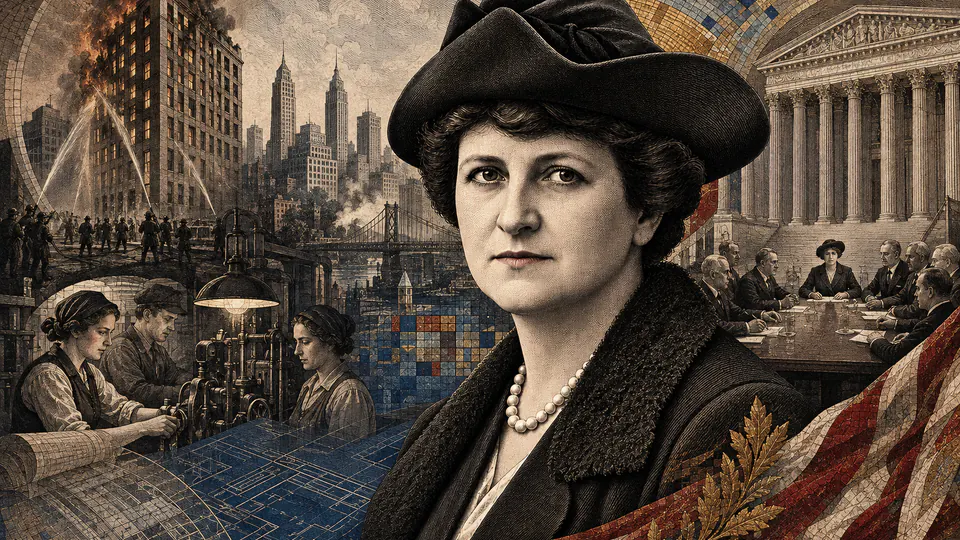
On March 25, 1911, Perkins was having tea near Washington Square when fire engines pulled her toward the Asch Building. The Triangle fire killed 146 people, most of them young immigrant women. Perkins later said the day marked a turning point in her life, but the work that followed matters more than the quotation. She became executive secretary of New York City’s Committee on Safety, then an investigator for the state Factory Investigating Commission.
The commission inspected workplaces, took testimony, and pushed laws on exits, sprinklers, fire drills, hours, and sanitation. Perkins learned how reform moved: inspect the factory, write the rule, count the votes, and return when a court threw the rule out. She also learned from labor organizers such as Rose Schneiderman, whose workers had been naming these hazards before officials arrived.
The first cabinet woman brought conditions
Roosevelt asked Perkins to lead the Labor Department in February 1933. According to her later account, she explained that taking the job meant pursuing her program. He accepted. On March 4 she became secretary of labor while banks were closing and about a quarter of the workforce was unemployed.
Her department helped build the Civilian Conservation Corps and strengthened the federal employment service. Perkins held annual conferences where state labor officials compared laws and enforcement. She created a Division of Labor Standards to spread working rules that the federal government still lacked power to impose directly. It was administrative work, the kind that rarely gets a mural because the artist would have to paint filing cabinets.
Social Security in six months
Roosevelt created the Committee on Economic Security in 1934 and put Perkins in the chair. Its staff, led by Edwin Witte with Arthur Altmeyer and other specialists, studied old-age pensions, unemployment insurance, public assistance, health, and the constitutional problems waiting for any national plan. The committee delivered its report in January 1935. Congress passed the Social Security Act that summer, and Roosevelt signed it on August 14.
The original law created old-age insurance, federal support for state unemployment insurance, and assistance programs for some older people, dependent children, and people with disabilities. It excluded large categories of workers, including many agricultural and domestic workers. Those exclusions fell heavily on Black workers and women. Calling the act a foundation is accurate. Calling it universal in 1935 would erase who stood outside the door.
The wage bill in the lower-left drawer
The Supreme Court struck down the National Industrial Recovery Act in 1935, destroying the New Deal’s first national wage-and-hour system. Perkins had asked Labor Department lawyers to prepare replacements. She later described keeping two bills in the lower-left drawer of her desk, ready for the emergency.
One became the Walsh-Healey Public Contracts Act of 1936. The broader fight produced the Fair Labor Standards Act in 1938. Its first rules covered about one-fifth of the labor force, set a 25-cent hourly minimum wage, capped the workweek at 44 hours before a scheduled reduction to 40, required overtime pay, and restricted oppressive child labor. Farmworkers, domestic workers, and many other employees were left out. The floor was real, and so were its holes.
Perkins supported collective bargaining as the Wagner Act moved through Congress, though Senator Robert Wagner and his staff wrote the law and Congress created an independent labor board outside her department. Union membership rose from 3.8 million in 1935 to 12.6 million in 1945, according to the Labor Department’s history. Federal policy had stopped treating every organizing drive as a conspiracy and begun, for a time, protecting it.
The record after Roosevelt
Perkins remained secretary until June 1945, weeks after Roosevelt’s death. Harry Truman then appointed her to the U.S. Civil Service Commission. She taught and lectured after leaving government and died on May 14, 1965.
The Labor Department headquarters in Washington bears her name. The sharper memorial appears on a pay stub: overtime after forty hours, an employer contribution toward old-age insurance, and a wage below which an employer may not legally go. None arrived complete, and none stayed safe from attack. Perkins understood that a social guarantee begins as paper in somebody’s desk and survives only after people make the government honor it.
The sequence changes the argument
Accounts often compress Frances Perkins into the woman standing behind Roosevelt at bill signings. The chronology makes a larger claim. Perkins witnessed the Triangle fire and treated preventable workplace death as an administrative and political failure. Her New York work joined factory investigation, fire safety, hours law, unemployment policy, and coalition building. Neither fact is background decoration. Together they explain why the conflict took the form it did and why participants did not treat patience as a serious answer.
As labor secretary, she entered office with a program that included unemployment relief, shorter hours, minimum wages, social insurance, and employment services. She chaired the committee that designed Social Security and defended a plan able to survive legislative and constitutional attack. The work depended on meetings, transportation, money, printed material, trusted messengers, and people willing to absorb retaliation. Public memory usually preserves the microphone or the confrontation. Organization lived in the less photogenic decisions that made a crowd, vote, strike, or policy demand possible.
Power worked through institutions
The central dispute concerned how investigation, administration, labor pressure, and political compromise turned catastrophe into enforceable public rules. That question could not be settled by a good argument alone. Employers, public officials, courts, parties, unions, churches, and newspapers controlled different resources. Organizers had to identify which body could change a rule, which ally could move it, and what pressure could make delay more expensive than action.
The system’s exclusions reflected concessions to legislators and administrators, with severe effects on Black agricultural and domestic workers. Perkins supported federal labor standards and collective bargaining while managing conflicts among unions, employers, agencies, and the White House. Those outcomes belong in the same account. A movement can gain public sympathy and still lose an immediate demand. It can win a statute while leaving people outside its coverage. It can build an institution that later becomes cautious. Calling one moment a victory or defeat without naming the measure hides more than it explains.
The limits were part of the result
The House Un-American Activities Committee pursued her over an immigration case involving union leader Harry Bridges, and she refused to abandon legal process. Her record shows that expertise can make demands durable, but administrators do not choose freely outside movements, courts, Congress, and racial power. These limits were not footnotes added by later critics. Participants argued about them at the time, often from unequal positions. Race, gender, citizenship, occupation, geography, and access to money affected who took the greatest risk and who received authority after a campaign became respectable.
This is why coalition should be treated as work rather than a photograph. Groups can share an opponent while wanting different remedies. They can cooperate on a march and disagree about a contract, a party, a war, or the pace of change. The useful question concerns the rules that allowed people to decide together, what resources they shared, and whose objections were easier to ignore.
What the record lets us say
The source trail matters because later retellings reward drama and erase maintenance. Government records show what officials claimed and enforced. Organizational papers show plans, budgets, arguments, and revisions. Oral histories recover work that formal minutes often omit, though memory recorded years later has its own limits. Newspapers capture public language while reflecting the interests and racial habits of editors. Reading those records against one another makes uncertainty visible instead of filling it with a convenient quotation.
The durable lesson of Frances Perkins is practical. Rights need procedures, money, institutions, and people able to enforce them after attention moves elsewhere. A law can change the field without ending the contest. A lost campaign can train organizers, expose an alliance, or leave a demand that later movements can use. History becomes more useful when it preserves both the achievement and the bill that remained unpaid.
In their own words
#wordsWhat Frances Perkins actually said, where, and when. Each one links to the page it was checked against.
-
We have come to learn that the large majority of our citizens must have protection against the loss of income due to unemployment, old age, death of the breadwinners and disabling accident and illness, not only on humanitarian grounds, but in the interest of our National welfare.
National radio address explaining the administration's economic security program, February 25, 1935. Frances Perkins, radio address on the Committee on Economic Security program (February 25, 1935) -
The measures we propose do not by any means provide a complete and permanent solution of our difficulties. If put into effect, however, they will provide a greater degree of security for the American citizen and his family than he has heretofore known.
Same February 25, 1935 radio address. Frances Perkins, radio address on the Committee on Economic Security program (February 25, 1935) -
People who work for a living in the United States of America can join with all other good citizens on this forty-eighth anniversary of Labor Day in satisfaction that the Congress has passed the Social Security Act.
National radio address on the Social Security Act, September 2, 1935, days after Roosevelt signed it. Frances Perkins, "Speech on the Social Security Act" (September 2, 1935) -
It is embodied in perhaps the most useful and fundamental single piece of Federal legislation in the interest of wage earners in the United States.
Same September 2, 1935 radio address, on the Social Security Act. Frances Perkins, "Speech on the Social Security Act" (September 2, 1935)
What people get wrong
#wrong- The myth
Frances Perkins wrote the Wagner Act, the law that protects union organizing. - The record
Senator Robert Wagner and his staff wrote the National Labor Relations Act and shepherded it through Congress in 1935, and it created an independent labor board outside Perkins's own department. Perkins supported the bill's goals but was not its author.
- The myth
The 1935 Social Security Act covered every American worker from the start. - The record
The original act excluded large categories of workers, including most agricultural and domestic workers, exclusions that fell heavily on Black workers and women. Universal coverage came only through amendments over the following decades.
- The myth
Perkins personally designed the Social Security Act from start to finish. - The record
She chaired Roosevelt's Committee on Economic Security, but the drafting was led by the committee's executive director, Edwin Witte, with staff including Arthur Altmeyer. Perkins directed the process and defended the result; she did not write the act alone.
The dates that matter
#dates- April 10, 1882 Born Fannie Coralie Perkins in Boston, Massachusetts.
- 1902 Graduates from Mount Holyoke College.
- March 25, 1911 Witnesses the Triangle Shirtwaist Factory fire in New York.
- 1919 Governor Al Smith appoints her to the New York State Industrial Commission.
- 1929 Becomes New York's industrial commissioner under Governor Franklin Roosevelt.
- March 4, 1933 Takes office as secretary of labor, the first woman in a U.S. cabinet.
- 1934 Chairs the President's Committee on Economic Security.
- August 14, 1935 Roosevelt signs the Social Security Act.
- June 25, 1938 Roosevelt signs the Fair Labor Standards Act.
- June 30, 1945 Ends more than twelve years as secretary of labor.
- May 14, 1965 Dies in New York City at age 83.
Questions people ask
#faqsWhat did Frances Perkins do?
Frances Perkins served as U.S. secretary of labor from 1933 to 1945. She helped design Social Security, federal wage and hour law, unemployment insurance, and New Deal labor policy.
Was Frances Perkins the first woman in the Cabinet?
Yes. Franklin Roosevelt appointed her secretary of labor in 1933, making her the first woman to serve in a U.S. presidential cabinet.
Did Frances Perkins create Social Security?
Perkins did not work alone, but she chaired Roosevelt's Committee on Economic Security and directed the policy process that produced the 1935 act. Edwin Witte, Arthur Altmeyer, Wilbur Cohen, and many others did major parts of the drafting and administration.
What did the Triangle fire have to do with Frances Perkins?
Perkins witnessed workers jumping from the Triangle factory on March 25, 1911. The fire pushed her deeper into factory-safety work and shaped the labor standards she pursued in New York and Washington.
The bookshelf
#bookshelfWhere to go next. Buy from an independent bookstore, or find it at your library for nothing.
-
The Roosevelt I Knew Frances Perkins, 1946 primary
Her own account of Roosevelt, the New Deal, and the cabinet years, written soon after his death.
-
The Woman Behind the New Deal: The Life and Legacy of Frances Perkins Kirstin Downey, 2009 secondary
The standard biography, drawn from her papers and the Columbia oral history project.
-
A Woman Unafraid: The Achievements of Frances Perkins Penny Colman, 1993 secondary
A clear, well-sourced account of the Triangle fire through the Labor Department years.
Wear it: Frances Perkins
#merchEvery design here links back to this page.

Sources
#sourcesPrimary sources
The documents themselves: laws, court opinions, speeches, letters, and the numbers from the agencies that count them.
Secondary sources
Written afterward, about the story.
- U.S. Department of Labor, Frances Perkins
- U.S. Department of Labor, Chapter 3: The Department in the New Deal and World War II
- Social Security Administration, Frances Perkins
- Social Security Administration, Background and Development of Social Security
- U.S. Department of Labor, Fair Labor Standards Act of 1938
- Frances Perkins Center, Her Life
- U.S. Department of Labor, Frances Perkins
- National Park Service, Frances Perkins
- Social Security Administration, Frances Perkins