Published
Social Security
How Social Security Went From a Desk Committee to Every Paycheck
The 1935 Social Security Act created old-age insurance, unemployment systems, and aid programs, with major exclusions later amended.
The story
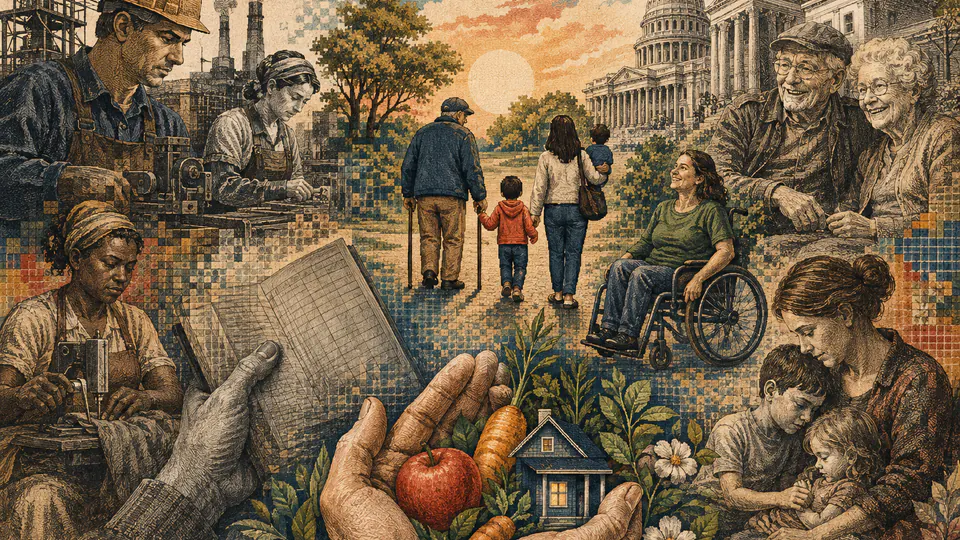
#storySocial Security began as a 1935 law with three different kinds of protection: federal old-age insurance, federal support for state unemployment insurance, and public aid for some older people, dependent children, and people with disabilities. The familiar monthly retirement system did not begin paying regular benefits until 1940. A national promise first required a national set of wage records.
The program is often credited to one president or one cabinet secretary. Franklin Roosevelt supplied presidential power. Frances Perkins supplied years of preparation and chaired the committee. Edwin Witte ran its staff. Arthur Altmeyer, Wilbur Cohen, Barbara Armstrong, Murray Latimer, legislators, labor groups, and state officials shaped the result. Social insurance was committee work with enormous consequences.
Old age was an economic risk
Before 1935, support in old age came from savings, work, family, private pensions, local relief, or state plans. Each could fail. The Depression destroyed savings and jobs at once, while private pensions covered only a slice of workers.
Competing proposals put pressure on Washington. Dr. Francis Townsend built a mass movement around a generous pension for older Americans. Huey Long promoted a broad wealth-sharing plan. The Roosevelt administration wanted a contributory insurance system tied to wages, plus assistance for people the insurance could not yet reach.
Six months around a committee table
Roosevelt created the Committee on Economic Security in 1934 and appointed Perkins chair. Witte, an economist from Wisconsin, directed the staff. The group divided its work among old age, unemployment, health, public assistance, and related questions. It studied European programs and state experiments while lawyers prepared for a Supreme Court that had already struck down economic regulation.
The committee reported in January 1935. After long hearings and changes in both houses, Roosevelt signed the Social Security Act on August 14. Congress provided no initial administrative appropriation, so the new board borrowed funds from another relief agency to start work. Even the safety net began by passing the hat inside the government.
What the first law covered
Old-age insurance used payroll contributions from covered workers and employers. Taxes began in 1937. The first payments were one-time lump sums for people who reached retirement before monthly benefits began. Regular monthly checks started in January 1940.
The act also encouraged states to build unemployment-insurance systems and funded assistance for some older people, dependent children, and blind people. These parts used different eligibility rules and federal-state arrangements. The name covered a family of programs, not one account.
The exclusions were large
Agricultural and domestic labor were outside the original old-age insurance system, along with many public employees, nonprofit workers, and self-employed people. Those occupational lines excluded a large share of Black workers and many women. Some exclusions reflected administrative difficulty. Southern political power and a labor system built on racial hierarchy also shaped what Congress would pass.
That history matters because Social Security’s later reach can make the first law look broader than it was. Congress expanded coverage in 1950 and in later amendments. Benefits for wives, dependent children, and survivors arrived in 1939. Disability insurance arrived in 1956. Medicare followed in 1965.
Insurance rather than a favor
Roosevelt defended payroll contributions partly because they gave workers a legal and political claim. Benefits would not read as a yearly gift from Congress. Workers had paid into a national insurance system recorded under their own names.
The design also tied benefits to covered earnings, which reproduced labor-market inequality. A person with low wages or interrupted work built a smaller benefit. The program reduced old-age poverty while carrying part of the wage structure into retirement.
A law that kept being rewritten
Social Security survived Supreme Court review in 1937 and expanded through repeated amendments. Each addition answered a gap the original law had left: spouses and survivors, more occupations, disability, health care, automatic cost-of-living adjustments.
The New Deal did not hand down a finished social contract in 1935. It created machinery people could fight to enter and defend. The number on a pay stub looks ordinary now. In 1937 it meant the federal government had begun keeping an account of a worker’s earnings because destitution in old age had become a public responsibility.
The sequence changes the argument
Accounts often compress Social Security into a monthly retirement check. The chronology makes a larger claim. The 1935 law created old-age benefits and federal-state programs while leaving major categories of workers outside initial coverage. Payroll contributions tied the program to employment and helped its supporters defend benefits as earned insurance. Neither fact is background decoration. Together they explain why the conflict took the form it did and why participants did not treat patience as a serious answer.
Amendments added survivors, dependents, disability coverage, and broader categories of workers. Agricultural and domestic exclusions fell over time, but workers lost years in which earnings did not count toward benefits. The work depended on meetings, transportation, money, printed material, trusted messengers, and people willing to absorb retaliation. Public memory usually preserves the microphone or the confrontation. Organization lived in the less photogenic decisions that made a crowd, vote, strike, or policy demand possible.
Power worked through institutions
The central dispute concerned how a public insurance system shares the costs of old age, disability, and family loss. That question could not be settled by a good argument alone. Employers, public officials, courts, parties, unions, churches, and newspapers controlled different resources. Organizers had to identify which body could change a rule, which ally could move it, and what pressure could make delay more expensive than action.
Benefits are progressive but reflect a worker’s covered earnings, so labor-market inequality follows people into retirement. Cost-of-living adjustments protect benefits from inflation through a formula rather than annual political discretion. Those outcomes belong in the same account. A movement can gain public sympathy and still lose an immediate demand. It can win a statute while leaving people outside its coverage. It can build an institution that later becomes cautious. Calling one moment a victory or defeat without naming the measure hides more than it explains.
The limits were part of the result
The trust funds account for dedicated revenue and benefits, while projections depend on wages, employment, demographics, and legislation. Proposals to close long-term financing gaps distribute costs differently across high earners, workers, beneficiaries, and employers. These limits were not footnotes added by later critics. Participants argued about them at the time, often from unequal positions. Race, gender, citizenship, occupation, geography, and access to money affected who took the greatest risk and who received authority after a campaign became respectable.
This is why coalition should be treated as work rather than a photograph. Groups can share an opponent while wanting different remedies. They can cooperate on a march and disagree about a contract, a party, a war, or the pace of change. The useful question concerns the rules that allowed people to decide together, what resources they shared, and whose objections were easier to ignore.
What the record lets us say
The source trail matters because later retellings reward drama and erase maintenance. Government records show what officials claimed and enforced. Organizational papers show plans, budgets, arguments, and revisions. Oral histories recover work that formal minutes often omit, though memory recorded years later has its own limits. Newspapers capture public language while reflecting the interests and racial habits of editors. Reading those records against one another makes uncertainty visible instead of filling it with a convenient quotation.
The durable lesson of Social Security is practical. Rights need procedures, money, institutions, and people able to enforce them after attention moves elsewhere. A law can change the field without ending the contest. A lost campaign can train organizers, expose an alliance, or leave a demand that later movements can use. History becomes more useful when it preserves both the achievement and the bill that remained unpaid.
Argue it
#argue4 claims about Social Security you can make out loud, the best case against each one, and the answer. Every number links to where it came from.
-
Claim 1
Social Security's trust fund shortfall is real, and pretending otherwise wastes the years left to fix it.
The evidence
The Social Security Board of Trustees' 2026 annual report projects the Old-Age and Survivors Insurance trust fund depleted in the fourth quarter of 2032, one quarter earlier than the 2025 report projected. After that date, continuing payroll tax revenue would still cover 78 percent of scheduled benefits, an automatic 22 percent cut, without congressional action. Combined with the Disability Insurance fund, the reserves last until the third quarter of 2034 and would then pay 83 percent of scheduled benefits. The 75-year shortfall is now estimated at 30.3 trillion dollars, larger than the prior year's estimate.
Their best case
Andrew Biggs of the American Enterprise Institute argues that calling the program's finances a crisis undersells it: "In real bankruptcies, it's also almost unknown for creditors to receive nothing," he writes, comparing the coming cut to Detroit's 2013 municipal bankruptcy, where bondholders on average recovered about 60 cents on the dollar. His conclusion: "Social Security reform has to break those promises, the tax formula, the benefit formula, or both."
The answer
The date and the number are right: 2032, 78 percent, and no vote required for either. Insolvent still does not mean empty, and Biggs's own framing is about which promise Congress adjusts rather than whether it can. Trustees data compiled by the Peter G. Peterson Foundation prices a narrower fix than an across-the-board cut: applying the 12.4 percent payroll tax to wages above the current cap, crediting the added earnings toward benefits, raises an estimated 3.4 trillion dollars over ten years and closes 48 percent of the 75-year gap on its own. The 2032 cut is a decision Congress makes by not deciding.
-
Claim 2
Social Security lifted 23.5 million people above the poverty line in 2024, and it did it without a means test.
The evidence
Without Social Security, 37.6 percent of people 65 and older would fall below the poverty line, according to the Center on Budget and Policy Priorities' analysis of the Census Bureau's Supplemental Poverty Measure. With it, the rate is 10.3 percent. CBPP estimates Social Security lifted 23.5 million people above the poverty line in 2024, nearly 17 million of them seniors.
Their best case
Andrew Biggs of the American Enterprise Institute argues the program is not well targeted: "The wealthiest fifth of households receives 38 percent of taxpayer dollars spent on Social Security and retirement tax preferences, more than the bottom 60 percent." He proposes capping benefits for higher-income retirees, writing the change would "eliminate most of Social Security's funding gap, reduce federal deficits and improve economic growth, all without threatening low- and middle-income seniors."
The answer
Well-off retirees do collect real Social Security dollars. But read what Biggs's 38 percent counts: Social Security and retirement tax preferences together, and only one of those is the program he proposes to cap. The retirement tax preferences, the 401(k) and IRA deductions that flow mostly to high earners, are what tilt that number toward the top. Social Security itself pays by formula: the average benefit for a worker retiring at full retirement age in 2026 is about 27,087 dollars a year by Biggs's own accounting, and that check is what keeps 27 percentage points of seniors above the poverty line, 10.3 percent below it with the program against 37.6 percent without. The 38 percent is mostly a fact about the tax code. The poverty figures are a fact about the check.
-
Claim 3
Nobody has built a private-account alternative that beats Social Security's guarantee without adding new risk, new debt, or both.
The evidence
The most serious attempt was President George W. Bush's 2005 push for personal retirement accounts, paired with slower benefit growth for middle- and high-earning workers. Modeling of that plan, for people retiring in 2025, found low, low-middle, and middle earners would have received total benefits 3 to 8 percent above those scheduled under current law, and the highest earners 2 to 4 percent below, according to a 2025 review by the American Enterprise Institute's Andrew Biggs, who supported the original proposal.
Their best case
President Bush made the case for the accounts directly: "As we fix Social Security, we must make it a better deal for our younger workers by allowing them to put part of their payroll taxes in personal retirement accounts. The money would go into a conservative mix of bond and stock funds that would have the opportunity to earn a higher rate of return than anything the current system could provide." He projected a worker earning 35,000 dollars a year on average over a career would have "nearly a quarter million dollars saved in his or her own account upon retirement," money that could "pass on to his or her children."
The answer
A well-invested private account can beat Social Security's return over a good stretch of years. But Bush's own plan paired the accounts with real benefit cuts for middle and high earners, and Biggs's 2025 review found it would still have closed only about two-thirds of the long-term funding gap. The quarter-million-dollar account never replaced the fix. It sat next to benefit cuts and left a third of the shortfall open, before counting the transition: payroll taxes routed into new individual accounts are payroll taxes no longer available to pay the people already retired. Benefit cuts, a partial fix, and new financing to get two-thirds of the way is not a free upgrade.
-
Claim 4
The 1972 benefit increase is why the poverty numbers hold today, not a 1970s giveaway that needs undoing.
The evidence
A medium-wage worker retiring at 65 received a replacement rate, benefits as a share of prior earnings, of about 24 percent in 1940 and 29 percent in 1969. By 1981 it was 54 percent, a jump Andrew Biggs of the American Enterprise Institute calls "an 86 percent relative increase," driven largely by the 1972 amendments that raised benefit levels and added automatic cost-of-living adjustments.
Their best case
Biggs argues the 1972 increase overshot and should be partly reversed: holding benefits closer to 1969 levels, he writes, "would have almost certainly avoided Social Security's near-death experience in 1977, its brush with insolvency in 1983 and the projected exhaustion of the trust funds" now dated to 2032. The alternative to rolling benefits back, he warns, is "the largest peacetime tax increase in history."
The answer
The arithmetic holds: the replacement rate did rise sharply after 1972, and Biggs's 86 percent figure checks out. What a 1969-level formula would cost is the other half of the ledger, and the poverty figures price it: 10.3 percent of people over 65 below the line with Social Security as it stands, 37.6 percent without it. A third option sits between rollback and a tax increase on everyone: applying the payroll tax to wages above the current cap reaches only the highest earners and, by Trustees data compiled by the Peter G. Peterson Foundation, closes nearly half the 75-year shortfall on its own. Which slice of income pays for the 1972 formula is the argument worth having.
What people get wrong
#wrong- The myth
Social Security is going bankrupt and will disappear before today's young workers retire. - The record
The Social Security Board of Trustees' 2026 report projects the Old-Age and Survivors Insurance trust fund depleted in the fourth quarter of 2032. Depletion does not mean the program stops: continuing payroll tax revenue would still cover 78 percent of scheduled benefits, and the combined retirement and disability funds would cover 83 percent through at least 2034. The Disability Insurance fund alone is projected solvent through at least 2099. Benefits keep arriving without any action from Congress, just smaller than scheduled.
- Social Security Board of Trustees, 2026 Annual Report
- Bipartisan Policy Center, "2026 Social Security Trustees Report, Explained"
- 401(k) Specialist, "Social Security Trust Fund Now Projected to Run Dry in 2032"
- The myth
Social Security is a Ponzi scheme, doomed the way any pyramid payout is doomed. - The record
A Ponzi scheme is secret, has no real revenue behind its payouts, and collapses the moment new money stops arriving. Social Security is the opposite on every count: it is required by law to publish a detailed public accounting of its finances every year, it is funded by a dedicated payroll tax rather than newly recruited investors, and its reserves are held in U.S. Treasury securities that have never defaulted. It has paid full scheduled benefits every year since regular payments began in 1940.
- The myth
Undocumented immigrants drain Social Security by using benefits they never paid into. - The record
The opposite is closer to the record. The Social Security Administration's Office of the Chief Actuary estimated in an April 2013 actuarial note that about 3.1 million unauthorized immigrants worked and paid Social Security payroll taxes in 2010 alone, contributing an estimated 13 billion dollars that year while an estimated 1 billion dollars in benefits went out on those earnings, a net contribution of about 12 billion dollars to the trust funds in a single year. Federal law enacted in 1996 and 2004 generally bars paying retirement benefits on earnings tied to a Social Security number that was never work-authorized, so most of that tax revenue funds benefits its payers will not collect.
- Social Security Administration, Office of the Chief Actuary, actuarial note on the effects of unauthorized immigration on the Social Security trust funds (April 2013)
- PolitiFact, "Clinton says undocumented immigrants pay 12 billion dollars a year into Social Security" (August 10, 2016)
- The myth
The trust fund is just paper IOUs the government wrote to itself, with no real money behind it. - The record
The trust funds hold U.S. Treasury securities, the same kind of debt instrument the federal government sells to any other bondholder, backed by the same full faith and credit. Combined OASI and DI trust fund reserves totaled 2.72 trillion dollars at the end of 2024. Those Treasury securities have never defaulted, and redeeming them to pay benefits works the same way redeeming any other Treasury bond does.
The dates that matter
#dates- June 1934 Roosevelt announces plans for a committee on economic security.
- August 1934 The Committee on Economic Security begins work under Frances Perkins.
- January 1935 The committee sends its report to Roosevelt.
- August 14, 1935 Roosevelt signs the Social Security Act.
- January 1937 Workers begin paying Social Security payroll taxes.
- 1939 Congress adds benefits for spouses, dependent children, and survivors.
- January 1940 Regular monthly old-age benefits begin.
- 1950 Amendments expand coverage to millions of workers.
- 1956 Congress adds disability insurance.
- 1965 Medicare becomes part of the Social Security Act.
Questions people ask
#faqsWhen did Social Security start?
Franklin Roosevelt signed the Social Security Act on August 14, 1935. Payroll-tax collection began in 1937 and regular monthly old-age benefits began in 1940.
Who created Social Security?
Congress enacted it and Roosevelt signed it. Frances Perkins chaired the Committee on Economic Security; Edwin Witte directed its staff; Arthur Altmeyer, Wilbur Cohen, Barbara Armstrong, and many others designed and administered major parts.
Who was excluded from early Social Security?
The old-age insurance system initially excluded agricultural and domestic labor, many public employees, and several other categories. The exclusions disproportionately affected Black workers and women. Later amendments expanded coverage.
Is Social Security only a retirement program?
No. The 1935 act also supported unemployment insurance and public assistance. The system later added survivor, dependent, disability, and Medicare benefits.
The bookshelf
#bookshelfWhere to go next. Buy from an independent bookstore, or find it at your library for nothing.
-
The Development of the Social Security Act Edwin E. Witte, 1962 primary
The staff director of the committee that drafted the Act, on how it got written.
-
Social Security: The Phony Crisis Dean Baker and Mark Weisbrot, 2001 secondary
Two economists take apart the turn-of-the-century privatization push on its own numbers.
-
The Battle for Social Security: From FDR's Vision to Bush's Gamble Nancy J. Altman, 2005 secondary
A former Social Security staffer traces the program from its design through the 2005 personal-accounts fight.
-
Social Security: Visions and Revisions W. Andrew Achenbaum, 1986 secondary
A historian's account of how the program's purpose was argued and re-argued across five decades.
Wear it: Social Security
#merchEvery design here links back to this page.
 Design proof
 Frances Perkins Engraved Tee
$36.00 Design proof
 Social Security Pixel Tee
$36.00 Design proof
 "Insolvent does not mean zero. It means 78%." Tee
$36.00 Design proof
 "Insolvent does not mean zero. It means 78%." Sticker
$5.00 Design proof
 "23.5 million kept out of poverty. No means test." Tee
$36.00 Design proof
 "23.5 million kept out of poverty. No means test." Sticker
$5.00 Design proof
 "Bush's accounts closed two-thirds of the gap." Tee
$36.00 Design proof
 "Bush's accounts closed two-thirds of the gap." Sticker
$5.00 Design proof
 "The 1972 raise is why the check still works." Tee
$36.00 Design proof
 "The 1972 raise is why the check still works." Sticker
$5.00Sources
#sourcesPrimary sources
The documents themselves: laws, court opinions, speeches, letters, and the numbers from the agencies that count them.
- Social Security Administration, Background and Development of Social Security
- Social Security Administration, Frances Perkins
- Social Security Administration, The Early Days of Social Security
- Social Security Administration, Frances Perkins radio address, February 25, 1935
- U.S. Department of Labor, The Department in the New Deal and World War II
- National Archives, Extending the New Deal
- Social Security Administration, Legislative History
- National Archives, Social Security Act
- Social Security Administration, Research and Statistical Publications
- Congressional Research Service, Social Security Primer
- Social Security Board of Trustees, 2026 Annual Report of the Board of Trustees of the Federal Old-Age and Survivors Insurance and Federal Disability Insurance Trust Funds
- Andrew G. Biggs, "In Talking Social Security Reform, 'Bankrupt' Actually Might Be the Best Word to Use," American Enterprise Institute (July 27, 2026)
- Andrew G. Biggs, "The Rich Don't Need That Retirement Check," American Enterprise Institute (August 28, 2026)
- Andrew G. Biggs, "It's Fine to Embrace FDR's Vision of Social Security," American Enterprise Institute (source of the 27,087 dollar average 2026 benefit figure)
- President George W. Bush, remarks on Social Security personal accounts, White House archive
- Andrew G. Biggs, "What If George W. Bush's Social Security Reforms Had Passed?" American Enterprise Institute (June 13, 2025)
- Social Security Board of Trustees, 2026 Annual Report
- Social Security Administration, Office of the Chief Actuary, actuarial note on the effects of unauthorized immigration on the Social Security trust funds (April 2013)
Secondary sources
Written afterward, about the story.
- Bipartisan Policy Center, "2026 Social Security Trustees Report, Explained"
- 401(k) Specialist, "Social Security Trust Fund Now Projected to Run Dry in 2032"
- Peter G. Peterson Foundation, "Social Security Reform: Options to Raise Revenues"
- Center on Budget and Policy Priorities, "Social Security Lifts More People Above the Poverty Line Than Any Other Program," reported by Newsweek
- National Committee to Preserve Social Security and Medicare, "Social Security Is Not a Ponzi Scheme"
- PolitiFact, "Clinton says undocumented immigrants pay 12 billion dollars a year into Social Security" (August 10, 2016)