Published
Harriet Tubman
Harriet Tubman Returned for People the Law Called Property
Born c. March 1822. Died March 10, 1913
Harriet Tubman escaped slavery, guided others to freedom, served the Union during the Civil War, and later organized for women's suffrage.
The story
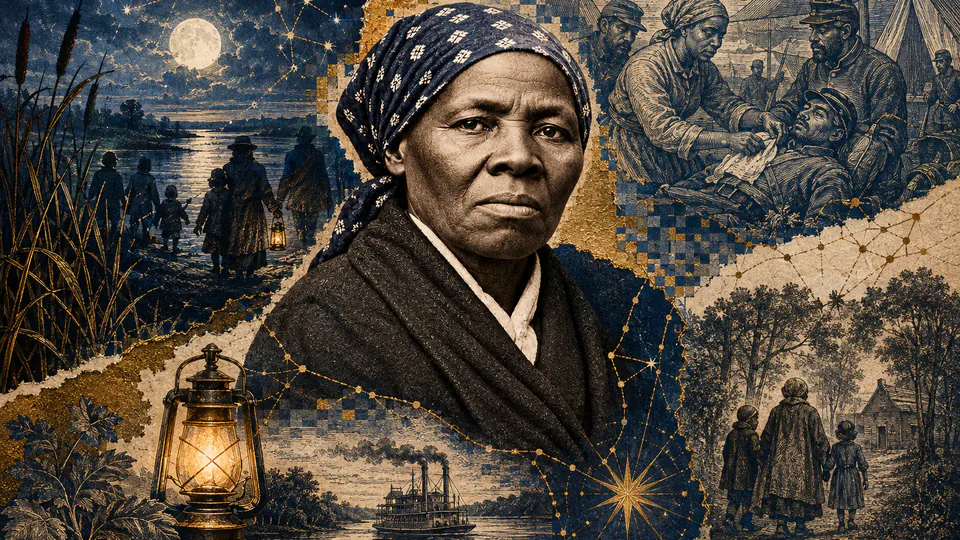
#storyHarriet Tubman escaped slavery in 1849, then returned to the place where the law said she could be captured and sold. She did it again and again. Her Underground Railroad work depended on secrecy, timing, local knowledge, trusted contacts, and the judgment to change a plan when danger moved.
Born Araminta Ross in Maryland, Tubman survived forced labor, family separation, and a head injury that caused lifelong seizures and pain. After reaching Philadelphia, she went back for relatives and other enslaved people. The Fugitive Slave Act of 1850 made capture possible even in free states, so she helped move people toward Canada.
War widened the route to freedom
During the Civil War, Tubman worked for Union forces as a cook, nurse, scout, and intelligence source. In June 1863 she guided gunboats through Confederate mines on the Combahee River. Black Union troops burned plantations and freed more than 700 enslaved people.
The federal government was far slower to pay Tubman than it had been to use her work. After the war, she lived in Auburn, New York, supported relatives, backed women’s suffrage, and helped establish a home for older Black residents.
Popular retellings sometimes turn Tubman into courage detached from organization. That misses the method. She studied terrain, built trust, used information, and took collective risk against the legal order of slavery. Her achievement was not simply that she believed people should be free. She repeatedly worked out how to get them there.
Many of Tubman’s missions centered on family. She guided siblings, nieces, nephews, and parents, while some relatives remained beyond reach. That record corrects the image of an Underground Railroad operating like a fixed public route. Movement depended on relationships, coded messages, temporary shelter, money, and people willing to enter danger for someone they knew. It also depended on Black communities in northern cities and Canada that received newcomers. Tubman became famous as a conductor, but a conductor needed a network willing to keep the route open.
Slavery used family separation as management
Tubman was born Araminta Ross in Dorchester County, Maryland, around 1822. Enslavers hired her out as a child, exposing her to beatings, illness, and dangerous work. The sale of her sisters showed that family bonds could be broken for an owner’s account.
As a teenager, she suffered a severe head injury when an overseer threw a heavy weight at another enslaved person. The injury caused pain, sudden sleep, and seizures for the rest of her life. Tubman interpreted some experiences through a powerful religious faith that guided her decisions without making the physical consequences disappear.
She married free Black man John Tubman, but her marriage did not make her free. Maryland’s law followed the mother’s status, and an enslaver could still sell her. The threat of sale helped drive her 1849 escape.
Return trips required planning more than legend
Tubman used knowledge of roads, waterways, weather, farms, and Black communities. She timed departures, communicated through trusted people, and changed plans when danger shifted. About thirteen return trips directly carried roughly seventy people out, according to the National Park Service, while instructions helped others escape.
Those numbers correct exaggerated accounts without shrinking the achievement. Each return placed Tubman within reach of slave catchers and anyone seeking a reward. She concentrated on family and people connected through reliable relationships because secrecy could not survive careless recruitment.
The Fugitive Slave Act of 1850 increased danger in northern states. Routes extended to Canada, and Black vigilance networks resisted capture. Tubman’s work joined individual navigation to an international question: the United States enforced property claims that British territory would not recognize.
John Brown and the war changed the scale
Tubman met John Brown and supported his opposition to slavery, helping him contact people with knowledge and experience. Illness prevented her from joining the Harpers Ferry raid. Their alliance reflected her willingness to consider armed action against a system already maintained by force.
During the Civil War, Tubman went to Union-held South Carolina. She nursed sick people, cooked, gathered intelligence, scouted territory, and recruited formerly enslaved people into Union service. Her knowledge and local networks made military action more effective.
At the Combahee River in June 1863, Union gunboats carrying Black troops moved past Confederate torpedoes with intelligence Tubman had helped gather. The raid damaged plantations and freed more than seven hundred people. Freedom arrived through an armed operation in which enslaved people ran to boats while owners tried to stop them.
The government delayed payment for work it used
Tubman’s Civil War labor crossed categories the federal bureaucracy paid unevenly. She worked as a nurse, cook, scout, guide, and intelligence source without receiving the regular compensation her service deserved. After the war, she spent decades seeking recognition and support.
She eventually received a pension connected first to her second husband, veteran Nelson Davis, and later an increase tied to her own nursing work. The process never fully valued her military contribution. Archival pension files show how the state can use informal labor during crisis and then demand formal proof from the worker later.
The delay mattered because Tubman supported relatives and community members from her home in Auburn, New York. Fame did not make her financially secure. Speaking tours and Sarah Bradford’s biographies helped raise money that public payment had failed to provide.
Freedom after slavery required land and care
Tubman acquired property in Auburn with help from William Seward and created a base for family and community. She later transferred land for the Harriet Tubman Home for the Aged, which opened with church support. The project treated care for older Black people as part of freedom rather than a private family failure.
She also spoke for women’s suffrage, appearing with other organizers while grounding political equality in work and public service she had already performed. Racism within the suffrage movement and sexism within public memory could each reduce her to a supporting role. Tubman did not divide her claims so neatly.
She died in Auburn in 1913. The most familiar stories emphasize a fearless solitary hero moving through darkness. The documented life is stronger. She relied on Black communities, family intelligence, military units, religious networks, abolitionists, and women’s organizations. Her courage lay partly in knowing that collective work did not make individual danger vanish, then returning anyway. was useful because a larger network supplied places to go.
In their own words
#wordsWhat Harriet Tubman actually said, where, and when. Each one links to the page it was checked against.
-
There was one of two things I had a right to, liberty, or death; if I could not have one, I would have de oder; for no man should take me alive.
Recalling to her biographer Sarah Bradford how she reasoned out her escape from slavery in Dorchester County, Maryland in September 1849. Sarah H. Bradford, Harriet, the Moses of Her People (1886) -
I looked at my hands to see if I was de same person now I was free. Dere was such a glory ober eberything, de sun came like gold trou de trees, and ober de fields, and I felt like I was in heaven.
On the moment she crossed into Pennsylvania after her escape in September 1849, dictated to Sarah Bradford. Sarah H. Bradford, Harriet, the Moses of Her People (1886) -
I was free, and dey should be free also; I would make a home for dem in de North, and de Lord helping me, I would bring dem all dere.
On deciding, once free in Pennsylvania in 1849, to go back for her family. Sarah H. Bradford, Harriet, the Moses of Her People (1886) -
Oh, Lord, convert ole master; Oh, dear Lord, change dat man's heart, and make him a Christian.
A prayer she said for the enslaver who planned to sell her, while she lay ill before her 1849 escape. Sarah H. Bradford, Harriet, the Moses of Her People (1886) -
Missus, de water never came above my chin; when we thought surely we were all going under, it became shallower and shallower.
On leading a group of fugitives across a river during a rescue in the 1850s. Sarah H. Bradford, Harriet, the Moses of Her People (1886) -
My claim against the U.S. is for three years services as nurse and cook in hospitals, and as commander of several men (eight or nine) as scouts during the late War of the Rebellion
From her sworn general affidavit supporting her Civil War pension claim, filed February 5, 1898. General Affidavit of Harriet Tubman Davis Regarding Payment from Government for Services Rendered During the Civil War
What people get wrong
#wrong- The myth
Harriet Tubman had a $40,000 bounty on her head for her capture. - The record
The only reward documented at the time is far smaller. An October 3, 1849 notice in the Cambridge Democrat offered $100 each for Tubman, then called Minty, and her brothers Ben and Harry if they were taken outside Maryland. The National Park Service puts the reward for her alone at $100.
- The myth
Harriet Tubman held a formal Union Army commission and rank. - The record
She was never commissioned. The National Park Service describes her Civil War role as spy, scout, nurse, and cook, and her 1898 pension affidavit asks compensation for exactly that unranked service, including informally commanding eight or nine scouts. Congress did not act on her own service until January 19, 1899, when it raised her pension for the nursing work, more than three decades after the war ended.
- The myth
Tubman walked hundreds of people north herself, trip after trip, alone. - The record
The National Park Service credits her with about thirteen direct trips into Maryland, guiding roughly seventy people out in person, while a larger number reached freedom using instructions she gave rather than her direct guidance. Each trip depended on a network of paid contacts, safe houses, and Black communities in the North and Canada who received the people she brought.
The dates that matter
#dates- c. March 1822 Born Araminta Ross into slavery in Dorchester County, Maryland.
- c. 1835 Suffers a severe head injury when an overseer throws a heavy weight.
- 1849 Escapes to Philadelphia and takes the name Harriet Tubman.
- 1850s Returns to Maryland on repeated missions to guide people out of slavery.
- June 2, 1863 Guides Union forces during the Combahee Ferry raid.
- 1869 Sarah Bradford publishes a biography that helps support Tubman.
- 1896 Buys land for a home serving older Black residents in Auburn, New York.
- March 10, 1913 Dies in Auburn.
Questions people ask
#faqsHow many trips did Harriet Tubman make on the Underground Railroad?
The National Park Service credits her with about 13 trips back to Maryland, directly guiding roughly 70 people and giving instructions to many more.
Was Harriet Tubman in the Union Army?
She served Union forces as a nurse, cook, scout, spy, and guide, though obtaining full federal compensation took decades.
What was the Combahee Ferry raid?
It was a June 1863 Union operation in South Carolina guided by Tubman's intelligence. Union gunboats and Black troops freed more than 700 enslaved people.
How should Harriet Tubman be evaluated?
Separate the immediate result from the institutions, tactics, exclusions, and enforcement record that followed it.
The bookshelf
#bookshelfWhere to go next. Buy from an independent bookstore, or find it at your library for nothing.
-
Harriet, the Moses of Her People Sarah H. Bradford, 1886 primary
Tubman's own account of her escapes, Civil War service, and faith, dictated to a sympathetic biographer during her lifetime.
-
Bound for the Promised Land: Harriet Tubman, Portrait of an American Hero Kate Clifford Larson, 2004 secondary
The standard modern biography, and the archival work that corrected the bounty and the trip counts.
-
Harriet Tubman: The Road to Freedom Catherine Clinton, 2004 secondary
A second modern biography, strong on Tubman's Civil War service and postwar life in Auburn.
Wear it: Harriet Tubman
#merchEvery design here links back to this page.
Sources
#sourcesPrimary sources
The documents themselves: laws, court opinions, speeches, letters, and the numbers from the agencies that count them.
Secondary sources
Written afterward, about the story.
- National Park Service, Harriet Tubman
- National Park Service, Harriet Tubman Underground Railroad
- National Women's History Museum, Harriet Tubman
- Wikipedia, Harriet Tubman
- National Park Service, Harriet Tubman National Historical Park
- Harriet Tubman Byway, How did Harriet Tubman escape?
- National Archives, Congress and Harriet Tubman's Claim for a Pension