Published
John Brown
John Brown Treated Slavery as a War Already Underway
Born May 9, 1800. Died December 2, 1859
John Brown fought proslavery forces in Kansas and led the 1859 raid on Harpers Ferry, forcing a country built on slavery to confront political violence.
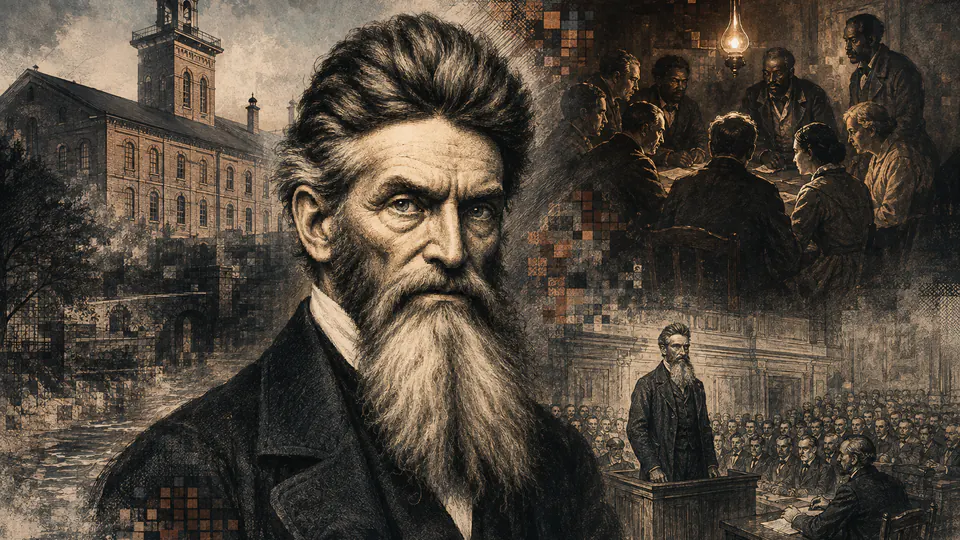
The story
#storyJohn Brown looked at slavery and saw organized violence backed by law. Slaveholders could sell families, chase fugitives across state lines, and use federal power to protect human property. Brown rejected the idea that polite persuasion alone would defeat that system.
In Kansas, where rival settlers fought over whether slavery would expand westward, Brown joined the armed conflict. After proslavery forces sacked Lawrence in 1856, his group killed five men near Pottawatomie Creek. The killings remain part of any honest account. Brown opposed a monstrous system and also chose lethal retaliation.
Harpers Ferry failed and changed the argument
Brown planned to seize weapons from the federal armory at Harpers Ferry, distribute them, and build a sustained uprising with enslaved people. Frederick Douglass refused to join, warning that the armory was a trap. On October 16, 1859, Brown entered the town with 21 followers. U.S. Marines captured the survivors two days later.
Virginia hanged Brown after a public trial. He used the courtroom to indict slavery, and his calm statements traveled farther than his raiding party had. White southerners saw proof that northern antislavery politics threatened their power. Abolitionists who rejected his plan still had to answer why federal weapons defended slavery more reliably than federal law defended Black freedom.
Brown did not end slavery, free an army, or survive his raid. He exposed a fact the country was trying to postpone: slavery was already maintained by force. The dispute was over who could use force, and for what.
The raiding party itself complicates the familiar portrait of a solitary white fanatic. Black participants included Dangerfield Newby, Osborne Perry Anderson, John Anthony Copeland Jr., Shields Green, and Lewis Sheridan Leary. Newby hoped to free his wife and children. Anderson escaped and later published an account. Copeland and Green were executed. Their presence does not prove Brown’s larger plan could have worked, but it does establish that the raid joined people with distinct lives and reasons. Treating them as scenery repeats the historical habit Brown claimed to oppose.
A failed businessman entered the antislavery underground
Brown was born in Connecticut in 1800 and raised in an antislavery household. He worked at tanning, farming, wool dealing, and other ventures, often unsuccessfully. Financial failure followed him, but so did a growing commitment to direct resistance against slavery.
He participated in abolitionist networks and helped Black fugitives and communities resist capture. After the Fugitive Slave Act strengthened federal recapture, Brown helped organize the League of Gileadites in Springfield, Massachusetts. Its members prepared to prevent slave catchers from taking people out of the city.
That work complicates the image of a man who appeared suddenly with a rifle. Brown’s militancy developed through years of watching law place national force behind slaveholders while peaceful protest met mob attack and political delay.
Kansas made the territorial vote a violent contest
The Kansas-Nebraska Act allowed settlers to determine whether Kansas would permit slavery. Proslavery forces crossed from Missouri, manipulated elections, threatened antislavery settlers, and sought to establish control through law and violence.
Brown joined several of his sons in Kansas. After proslavery forces sacked Lawrence in 1856, Brown and a small party killed five proslavery men near Pottawatomie Creek. The killings remain central to judgment of him. The victims were taken from homes and killed without trial; describing the wider violence does not remove Brown’s agency.
He later fought at Black Jack and defended the antislavery settlement at Osawatomie. Kansas showed that sovereignty was already being decided through armed power, not a peaceful local vote. Brown concluded that slavery would not yield to persuasion.
The Harpers Ferry plan depended on a widening revolt
Brown intended to seize federal weapons at Harpers Ferry, retreat into the mountains, and support an expanding campaign of escape and resistance. He met Black abolitionists, including Frederick Douglass, while seeking support. Douglass believed the target was a trap and declined to join.
Brown also held a convention in Chatham, Canada, where participants adopted a provisional constitution. These preparations show political ambition beyond a simple raid. They do not prove the plan had a realistic supply system, broad local support, or a workable path after the first seizure.
On October 16, 1859, Brown’s party entered Harpers Ferry and captured the armory. They took hostages and waited while local militia and federal forces closed in. Brown delayed escape, and the mass uprising he anticipated did not form in the available time.
Black participants had purposes of their own
Dangerfield Newby hoped the action would help free his wife and children. Osborne Perry Anderson survived and published an account. John Copeland and Shields Green were tried and executed. Lewis Leary died from wounds.
Naming them changes the unit of analysis. The raid was interracial, but Brown retained command. Participants shared opposition to slavery while bringing different family stakes and political judgments. A full history neither erases them beneath Brown’s name nor uses their presence to certify every part of his plan.
Harriet Tubman supported Brown’s purpose and provided knowledge, though illness kept her from the raid. Douglass’s refusal supplies another Black abolitionist judgment. There was no single Black verdict on the proposed action.
The trial gave Brown the audience the raid had not
Virginia prosecuted Brown for treason against the state, murder, and inciting enslaved people to rebel. Wounded and held in court, he conducted a defense that focused national attention on slavery. He denied seeking indiscriminate bloodshed and said his purpose had been liberation.
The legal outcome was never in serious doubt. Brown was convicted and hanged on December 2, 1859. Several of his surviving comrades were also executed. The trial converted a military failure into a political crisis because Brown accepted punishment without renouncing the cause.
White southerners treated northern admiration for Brown as evidence that coexistence within the Union was collapsing. Many northerners rejected the raid while becoming less willing to treat slavery as an ordinary policy difference.
Martyrdom cannot decide the tactical argument
Brown’s death inspired songs, speeches, and military marching. During the Civil War, Union soldiers sang of his body in the grave while his soul marched on. The image made him a symbol of the force slavery had long used and now faced.
Symbols can remove responsibility as easily as they create it. Brown killed at Pottawatomie and led an operation whose planning can be criticized on ethical and practical grounds. He also recognized before many white contemporaries that slavery was maintained by organized violence, and he was willing to risk his own life rather than reserve that risk for Black people.
The useful question is larger than whether Brown was hero or fanatic. It is how an abolitionist movement should respond when law protects an institution of daily force, peaceful opponents are attacked, and political compromise expands the harm. Brown gave one answer at Harpers Ferry. Its failure did not make the question disappear; the Civil War answered it on a far larger field two years later.
In their own words
#wordsWhat John Brown actually said, where, and when. Each one links to the page it was checked against.
-
I believe that to have interfered as I have done — as I have always freely admitted I have done — in behalf of his despised poor, was not wrong, but right.
Final address to the court, Charles Town, Virginia, November 2, 1859, at his sentencing for treason, murder, and inciting slave rebellion. John Brown's Last Speech to the Court -
Now, if it is deemed necessary that I should forfeit my life for the furtherance of the ends of justice, and mingle my blood further with the blood of my children and with the blood of millions in this slave country whose rights are disregarded by wicked, cruel, and unjust enactments, I submit; so let it be done!
Final address to the court, Charles Town, Virginia, November 2, 1859. John Brown's Last Speech to the Court -
I am waiting the hour of my public murder with great composure of mind and cheerfulness; feeling the strong assurance that in no other possible way could I be used to so much advantage to the cause of God and of humanity, and that nothing that either I or all my family have sacrificed or suffered will be lost.
Last letter to his wife and children, written from the Charles Town jail, November 30, 1859, two days before his execution. John Brown, Last Letter to His Family (1859) -
Whereas slavery, throughout its entire existence in the United States, is none other than a most barbarous, unprovoked, and unjustifiable war of one portion of its citizens upon another portion — the only conditions of which are perpetual imprisonment and hopeless servitude or absolute extermination — in utter disregard and violation of those eternal and self-evident truths set forth in our Declaration of Independence.
Preamble to the Provisional Constitution and Ordinances for the People of the United States, written at Frederick Douglass's house in Rochester, New York, in February 1858, and adopted at Brown's Chatham, Ontario convention, May 8 to 10, 1858. John Brown's Provisional Constitution and Ordinances (1858)
What people get wrong
#wrong- The myth
John Brown's actions can be explained away as the product of simple insanity. - The record
His own defense team raised a hereditary-insanity plea at trial, and Brown rejected it from his cot in the courtroom, calling it "a miserable artifice and pretext" and saying he was "perfectly unconscious of insanity." He told the court to judge what he had done.
- The myth
Brown's Harpers Ferry plan aimed at a single, all-at-once mass killing or expulsion of white southerners. - The record
In his final address to the court he denied any intent toward "murder, or treason, or the destruction of property, or to excite or incite slaves to rebellion or to make insurrection." He described the design instead as a larger repeat of the raid he led into Missouri the winter before, when, in his telling, he took enslaved people out to Canada without the snapping of a gun on either side. The Provisional Constitution he wrote sets up a government and a defense for a fugitive community.
- The myth
Brown planned and financed Harpers Ferry alone, an isolated fanatic acting without support. - The record
Six northern abolitionists, Gerrit Smith, Franklin Sanborn, Samuel Gridley Howe, Theodore Parker, Thomas Wentworth Higginson, and George Luther Stearns, gave Brown thousands of dollars that paid for recruiting and weapons. They did not act as an organized group and mostly did not correspond with one another. Writers nicknamed them the Secret Six later.
The dates that matter
#dates- May 9, 1800 Born in Torrington, Connecticut.
- 1837 Publicly dedicates his life to ending slavery after the murder of abolitionist Elijah Lovejoy.
- 1855 Moves to Kansas as conflict grows between antislavery and proslavery settlers.
- May 1856 Brown and his followers kill five proslavery men near Pottawatomie Creek.
- October 16, 1859 Begins the raid on the federal armory at Harpers Ferry.
- October 18, 1859 U.S. Marines capture Brown and the surviving raiders.
- December 2, 1859 Executed in Charles Town, Virginia.
Questions people ask
#faqsWhat was John Brown trying to do at Harpers Ferry?
Brown planned to seize federal weapons, recruit enslaved people, and sustain an armed antislavery movement in the Appalachian region.
Did enslaved people join John Brown's raid?
A small number of Black men were among Brown's raiders, but the quick federal response prevented the larger uprising he expected.
How did John Brown die?
Virginia convicted him of treason, murder, and inciting enslaved people to revolt. He was hanged on December 2, 1859.
How should John Brown be evaluated?
Separate the immediate result from the institutions, tactics, exclusions, and enforcement record that followed it.
The bookshelf
#bookshelfWhere to go next. Buy from an independent bookstore, or find it at your library for nothing.
-
The Life and Letters of John Brown Franklin B. Sanborn, editor, 1885 primary
Brown's own letters, collected by one of his financial backers shortly after his execution.
-
John Brown, Abolitionist: The Man Who Killed Slavery, Sparked the Civil War, and Seeded Civil Rights David S. Reynolds, 2005 secondary
The standard modern biography, and the one that puts Brown inside the antislavery networks and the violence of his time.
-
To Purge This Land with Blood: A Biography of John Brown Stephen B. Oates, 1970 secondary
An older biography, closest to the Kansas years and the Harpers Ferry trial record.
Wear it: John Brown
#merchEvery design here links back to this page.

Sources
#sourcesPrimary sources
The documents themselves: laws, court opinions, speeches, letters, and the numbers from the agencies that count them.
Secondary sources
Written afterward, about the story.