Published
Freedom Summer
Freedom Summer Put Mississippi's Ballot, Schools, and Delegation on Trial
The 1964 Mississippi campaign joined voter registration, Freedom Schools, community centers, and an interracial party challenge.
The story
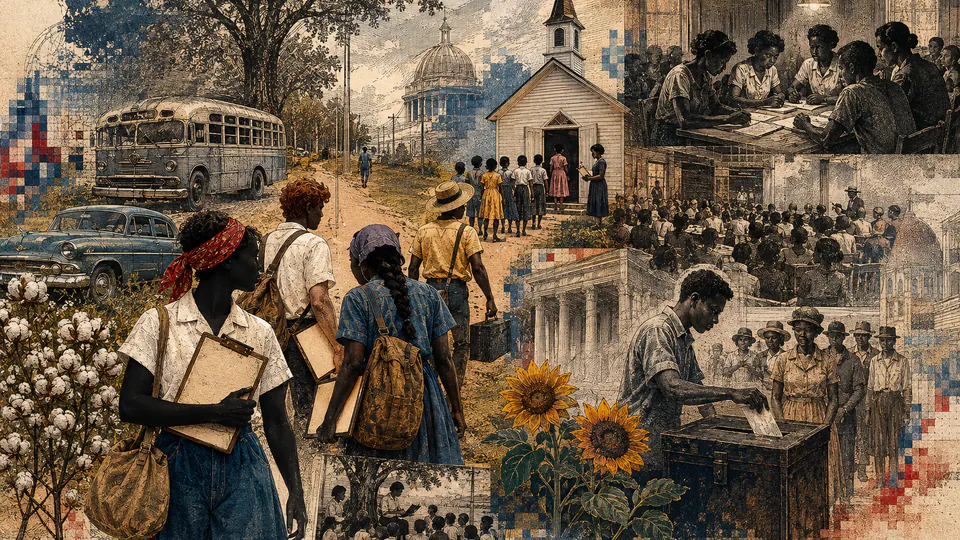
#storyFreedom Summer brought hundreds of volunteers to Mississippi in 1964, but the campaign did not arrive with them. Local organizers including Fannie Lou Hamer, Amzie Moore, Bob Moses, Dave Dennis, and many others had spent years confronting registrars, sheriffs, employers, and white terror.
The summer expanded voter registration, Freedom Schools, community centers, and the Mississippi Freedom Democratic Party. It also made the cost of that work impossible for national television to ignore.
Murder entered the first week
On June 21, James Chaney, Andrew Goodman, and Michael Schwerner disappeared after investigating a church burning near Philadelphia, Mississippi. Their bodies were found on August 4. Klan members and local law officers had participated in their murder.
Organizers continued. Freedom Schools taught Black history, government, reading, and organizing to thousands of students. Registration projects faced tests, intimidation, job loss, eviction, and violence.
The convention challenge
The interracial Mississippi Freedom Democratic Party challenged the state’s all-white delegation at the Democratic convention. Hamer’s televised testimony described the beating and repression she had survived. National leaders offered two at-large seats. The MFDP rejected the offer because it left the segregationist delegation in place.
Freedom Summer did not produce a clean victory in ten weeks. It built local leadership, exposed federal compromise, and fed the pressure behind the 1965 Voting Rights Act. The volunteer story lasts because outsiders wrote memoirs. The organizing story lasts because Mississippi people were still there after the buses went north.
Four organizations shared an uneasy structure
The Council of Federated Organizations brought SNCC, CORE, the NAACP, and SCLC into a common Mississippi project. The arrangement pooled staff and money without erasing differences over leadership, pace, and tactics. Planners believed the presence of mostly white northern volunteers would draw press attention that years of attacks on Black residents had failed to produce. The calculation worked, and the inequality inside it was bitterly clear.
Freedom Schools were central rather than supplemental. Teachers and students built a curriculum around Mississippi history, constitutional rights, Black literature, and questions students wanted answered. Community centers offered libraries, health help, and meeting space. These institutions treated people blocked from the ballot as a public already capable of governing. After the convention rejected the MFDP’s full challenge, participants also carried home a sharper view of national liberal allies and the limits of compromise.
The campaign also left records: testimony, student newspapers, photographs, arrest files, lesson plans, and oral histories. They preserve the work beyond its best-known martyrs and make it possible to trace how national attention rested on local knowledge.
The sequence changes the argument
Accounts often compress Freedom Summer into a voter-registration drive staffed by northern students. The chronology makes a larger claim. SNCC and allied organizers entered the summer after years of work by Mississippi residents who faced firing, eviction, assault, and murder for political activity. The Council of Federated Organizations coordinated registration, Freedom Schools, community centers, and the Mississippi Freedom Democratic Party. Neither fact is background decoration. Together they explain why the conflict took the form it did and why participants did not treat patience as a serious answer.
The murders of James Chaney, Andrew Goodman, and Michael Schwerner exposed violence that Black Mississippians had reported for years. Volunteer teachers worked from a curriculum that asked students to study power, history, and the conditions of their own communities. The work depended on meetings, transportation, money, printed material, trusted messengers, and people willing to absorb retaliation. Public memory usually preserves the microphone or the confrontation. Organization lived in the less photogenic decisions that made a crowd, vote, strike, or policy demand possible.
Power worked through institutions
The central dispute concerned whether local Black citizens could build political institutions under a state system maintained by exclusion and terror. That question could not be settled by a good argument alone. Employers, public officials, courts, parties, unions, churches, and newspapers controlled different resources. Organizers had to identify which body could change a rule, which ally could move it, and what pressure could make delay more expensive than action.
Only a small share of registration applicants were accepted because county officials retained devices designed to exclude Black voters. The MFDP challenged Mississippi’s all-white delegation at the Democratic National Convention and rejected a compromise that offered two at-large seats. Those outcomes belong in the same account. A movement can gain public sympathy and still lose an immediate demand. It can win a statute while leaving people outside its coverage. It can build an institution that later becomes cautious. Calling one moment a victory or defeat without naming the measure hides more than it explains.
The limits were part of the result
Fannie Lou Hamer’s televised testimony made state violence legible to a national audience even when party officials tried to limit its reach. The project expanded local leadership while exposing friction over race, gender, media attention, volunteer privilege, and control of the movement. These limits were not footnotes added by later critics. Participants argued about them at the time, often from unequal positions. Race, gender, citizenship, occupation, geography, and access to money affected who took the greatest risk and who received authority after a campaign became respectable.
This is why coalition should be treated as work rather than a photograph. Groups can share an opponent while wanting different remedies. They can cooperate on a march and disagree about a contract, a party, a war, or the pace of change. The useful question concerns the rules that allowed people to decide together, what resources they shared, and whose objections were easier to ignore.
What the record lets us say
The source trail matters because later retellings reward drama and erase maintenance. Government records show what officials claimed and enforced. Organizational papers show plans, budgets, arguments, and revisions. Oral histories recover work that formal minutes often omit, though memory recorded years later has its own limits. Newspapers capture public language while reflecting the interests and racial habits of editors. Reading those records against one another makes uncertainty visible instead of filling it with a convenient quotation.
The durable lesson of Freedom Summer is practical. Rights need procedures, money, institutions, and people able to enforce them after attention moves elsewhere. A law can change the field without ending the contest. A lost campaign can train organizers, expose an alliance, or leave a demand that later movements can use. History becomes more useful when it preserves both the achievement and the bill that remained unpaid.
What people get wrong
#wrong- The myth
Freedom Summer registered thousands of new Black voters that summer. - The record
About 17,000 Black Mississippians attempted to register during the ten-week project. Local registrars accepted only 1,600 of the completed applications, so the campaign's main gain was organizing and national attention, not an immediate rise in the rolls.
- The myth
The men who killed Chaney, Goodman, and Schwerner were convicted of murder soon after. - The record
A federal jury convicted eight defendants of conspiracy, not murder, in October 1967, with sentences of three to ten years. No state murder charge was ever filed. Edgar Ray Killen was convicted of three counts of manslaughter on June 21, 2005, 41 years to the day after the killings, and sentenced to 60 years.
- The myth
Freedom Summer was a campaign led by white college volunteers. - The record
About 700 volunteers, most of them white, arrived for the ten-week project. Local organizers, including Amzie Moore and Bob Moses, had already spent years building Mississippi's voter-registration movement before that summer began.
- The myth
The Mississippi Freedom Democratic Party won its challenge and replaced the state's delegation at the 1964 convention. - The record
National Democratic leaders offered the MFDP two at-large, non-voting seats, to be filled by Aaron Henry and Edwin King. Fannie Lou Hamer and the delegation rejected the offer, saying they had not come all that way for two seats, and the regular all-white delegation kept its place.
The dates that matter
#dates- 1961-1963 SNCC and local organizers build Mississippi voter-registration projects.
- June 1964 Freedom Summer begins with volunteer training in Ohio.
- June 21, 1964 James Chaney, Andrew Goodman, and Michael Schwerner disappear near Philadelphia, Mississippi.
- August 4, 1964 Their bodies are found in an earthen dam.
- August 1964 The MFDP challenges Mississippi's segregationist convention delegation.
Questions people ask
#faqsWhat was Freedom Summer?
It was a 1964 Mississippi campaign for voter registration, Freedom Schools, community centers, and political representation, organized by local activists and the Council of Federated Organizations.
Who were Chaney, Goodman, and Schwerner?
They were civil-rights workers murdered by members of the Ku Klux Klan with local law-enforcement involvement in June 1964.
Did Freedom Summer register many voters?
The immediate registration numbers were limited by official obstruction, but the campaign built leadership, documented repression, and strengthened the push for federal voting law.
How should Freedom Summer be evaluated?
Separate the immediate result from the institutions, tactics, exclusions, and enforcement record that followed it.
The bookshelf
#bookshelfWhere to go next. Buy from an independent bookstore, or find it at your library for nothing.
-
Freedom Summer Sally Belfrage, 1965 primary
A volunteer's own account of the ten weeks, written the year it happened.
-
Local People: The Struggle for Civil Rights in Mississippi John Dittmer, 1994 secondary
The standard history of the Mississippi movement, before and after the summer.
-
I've Got the Light of Freedom: The Organizing Tradition and the Mississippi Freedom Struggle Charles M. Payne, 1995 secondary
Traces the local organizing tradition that made the summer possible, not just the summer itself.
-
Freedom Summer: The Savage Season That Made Mississippi Burn and Made America a Democracy Bruce Watson, 2010 secondary
A narrative account built from the volunteers' letters and journals.
Wear it: Freedom Summer
#merchEvery design here links back to this page.
Sources
#sourcesPrimary sources
The documents themselves: laws, court opinions, speeches, letters, and the numbers from the agencies that count them.
- National Archives, Fannie Lou Hamer
- Library of Congress, Civil Rights History Project
- U.S. Department of Justice, Civil Rights Division, case summary on Michael Schwerner, James Chaney, Andrew Goodman (the 1967 federal conspiracy convictions and the 2005 state manslaughter conviction of Edgar Ray Killen)
Secondary sources
Written afterward, about the story.
- National Park Service, Mississippi Civil Rights Sites Study
- SNCC Digital Gateway, Freedom Summer
- SNCC Digital Gateway, Freedom Summer (catalog search)
- Library of Congress, Freedom Summer
- HISTORY, "Freedom Summer '64: When Students Mobilized for Voting Rights" (source of the registration numbers and volunteer count)
- SNCC Digital Gateway, "MFDP Challenge at Democratic National Convention" (the two-seat compromise offer and Hamer's rejection of it)