Published
Reproductive Justice
Reproductive Justice: Why Black women organizers joined the right to have children, not have children, and raise them safely
A sourced account of Reproductive Justice, covering the organizing, conflict, limits, and consequences behind the familiar version.
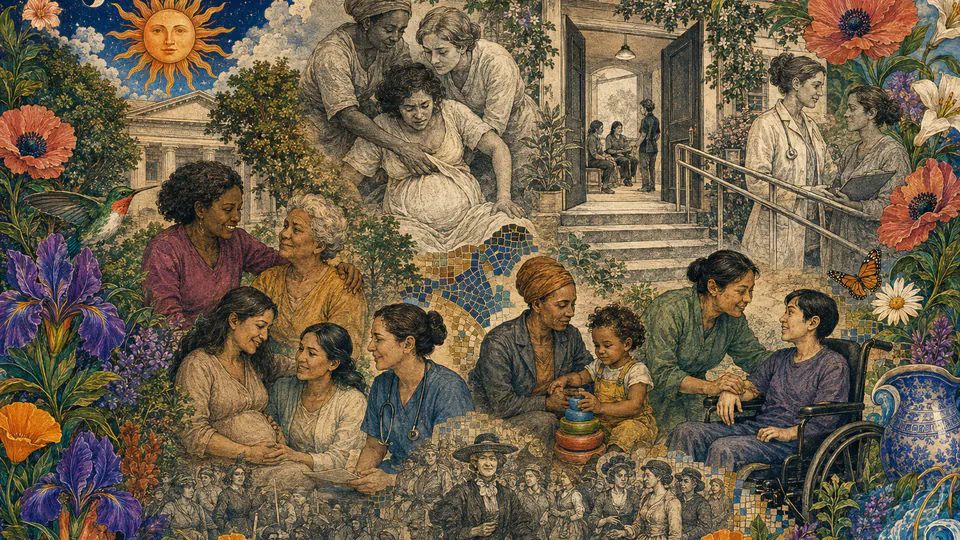
The story
#storyThe familiar version of Reproductive Justice usually begins at the moment cameras, police, or a national audience arrived. That makes a clean story and a bad explanation. Why Black women organizers joined the right to have children, not have children, and raise them safely. To understand that claim, the organizing before the famous scene and the institutions after it have to remain in view.
Reproductive justice joins bodily autonomy with the right to have children and raise families in safe and sustainable communities. That is the article’s measure of success. It asks who gained the power to make a decision, which rule changed, who remained outside it, and whether the gain lasted after attention moved elsewhere.
The conditions came before the headline
1973: Roe v. Wade protects abortion under a constitutional framework centered on privacy. 1976: The Hyde Amendment bars most federal Medicaid funding for abortion. Those events established the field on which later choices were made. People did not enter it with equal money, legal standing, mobility, safety, or access to the press. An order that looked ordinary to those who administered it could feel like a permanent emergency to those made to live under it.
This context does not turn participants into passengers of large forces. It identifies the constraints they learned to use. A workplace schedule could become a contact list. A church, apartment, union hall, campus, newspaper, or neighborhood association could become an office. A court case could collect evidence for a campaign, while a campaign could make judges and officials understand that a case would not disappear without resistance.
Organization made the public moment possible
1980s-1990s: Women of color organize against sterilization abuse, environmental harm, criminalization, and unequal access to care. 1994: Black women meeting in Chicago coin reproductive justice during debate over national health reform. Neither development moved by reputation alone. Organizers needed places to meet, ways to settle disputes, trusted people who could carry information, money for food and transport, and plans for arrest, dismissal, or retaliation. That daily work determined who could remain involved when the first burst of attention ended.
Coalition added reach and friction. Participants could share a target while disagreeing about tactics, leadership, parties, weapons, negotiation, or the desired settlement. Those arguments were evidence of real stakes. Unity imposed from above would have hidden differences without resolving them. Durable cooperation required rules for making decisions and a distribution of risk that people considered fair enough to continue.
The link to civil-rights organizing is practical. Rights become usable through registration, representation, hearings, contracts, budgets, and enforcement. Moral language can name an injury. Organization identifies the person or institution able to stop it and creates a cost for refusal.
Conflict exposed where authority sat
1997: SisterSong forms as a national women-of-color reproductive-justice collective. 2004: A national march in Washington adopts a wider reproductive-health and justice frame. At that point, opponents did more than offer a different opinion. They used the authority available to them: ownership, police, courts, party rules, licensing, hiring, firing, surveillance, or control of public information. The response reveals which interests a supposedly neutral system was prepared to protect.
Organizers also made choices under pressure. A dramatic tactic could bring attention while exhausting money. A legal compromise could protect people immediately while leaving a larger demand unanswered. Central leadership could coordinate action while silencing local knowledge. The right question is not whether every decision looks pure in hindsight. It is what alternatives existed, who bore their risks, and what the participants knew at the time.
This is where labor organizing enters the story. Work, housing, public space, education, policing, and voting were connected even when law placed them in separate boxes. A person blocked in one institution arrived at the next with fewer resources. Organizing across those boundaries could create power, but it also required more time and broader accountability.
A result is larger than a victory label
2010s: Organizers apply the framework to maternal health, incarceration, immigration, sexuality, disability, and family support. 2022: Dobbs ends federal constitutional protection for abortion and intensifies state conflict. These later events prevent a simple ending. A campaign may lose its immediate demand and still train leaders, expose a system, or leave a tactic others can use. It may win a law whose exclusions reproduce part of the old order. It may build an organization that protects members while becoming less willing to take the risks that built it.
A choice framework can ignore whether money, clinics, housing, safety, disability access, immigration status, or state custody makes any option real. Naming that limit does not cancel the achievement. It identifies the next conflict and gives credit to people who challenged the movement from within. Race, gender, class, citizenship, occupation, sexuality, and disability affected who was heard and who could survive retaliation. These were contemporary disputes, not standards invented after the fact.
The economic questions also continued. economic justice concerns who controls the resources needed to act: wages, time, transport, care, land, credit, and public services. Formal access without those resources can leave a right unusable. Material gains without a protected voice can disappear when management or government changes direction.
The archive has interests too
No source type sees the whole event. Government files document what an agency counted, feared, or prosecuted, often in the agency’s own language. Organizational minutes show plans and votes but may omit informal labor. Newspapers capture public claims while repeating the prejudices of owners, editors, police, or advertisers. Oral histories restore texture and motive, though memory recorded later can compress dates and settle old arguments too neatly.
The responsible method is comparison. When several independent records agree, a claim grows stronger. When they conflict, the disagreement belongs in the story. A missing name can show who lacked formal authority, but absence from minutes does not prove absence from the work. A famous quotation should be traced to a recording, transcript, letter, or contemporary report before it carries an argument.
What this history leaves us
Reproductive Justice matters because power was made visible in use. Participants learned which office could delay, which employer could punish, which law could be enforced, and which alliance could outlast a news cycle. Their answers were incomplete because all political answers are made under conditions they do not fully control.
The useful inheritance is therefore neither worship nor dismissal. Keep the organizing methods, measure the result, name the exclusions, and follow the institution after the celebration. That approach preserves drama without turning history into a poster. It also preserves the people whose patient work made the remembered moment possible.
Strategy can be measured in resources
Reproductive justice joins bodily autonomy with the right to have children and raise families in safe and sustainable communities. The sentence becomes more concrete when translated into resources. Who controlled the meeting room, membership list, printing bill, defense fund, car, telephone, childcare, food, medical help, or legal filing? Who could miss a shift, and who lost rent money by doing so? Those questions explain why an idea that sounded popular might remain weak and why a smaller group with trusted organization could alter an institution.
Opponents performed the same calculation. Delay could drain a strike fund or outlast public attention. Selective concessions could separate a coalition. Arrest or firing could remove a local leader without answering the demand. A hearing could collect testimony while postponing enforcement. A sympathetic statement could preserve an official’s reputation at lower cost than changing a budget or rule. Strategy meant recognizing those moves early enough to answer them.
A choice framework can ignore whether money, clinics, housing, safety, disability access, immigration status, or state custody makes any option real. The limit belongs inside the account because it affected the available strategy. People excluded from leadership often saw danger first. They knew which promise could not be enforced, which compromise shifted costs downward, and which supporter would leave after the photograph. Their criticism was organizational knowledge, even when officers treated it as disloyalty.
Three measures help separate durable change from ceremony. Capacity asks whether more people could act together after the campaign. Distribution asks who received money, time, safety, standing, or control. Enforcement asks what happened when an employer, agency, or leader ignored the new rule. A result can score well on one measure and poorly on another. That mixed finding is more informative than forcing the story into triumph or failure.
It also keeps the history alive without pretending the present is identical. The names of agencies, industries, and organizations change. The work of building trust, sharing risk, recording decisions, testing a promise, and preparing for retaliation remains recognizable. Reproductive Justice offers evidence about that work, including evidence of what could not be solved in one campaign or one lifetime.
Argue it
#argue5 claims about Reproductive Justice you can make out loud, the best case against each one, and the answer. Every number links to where it came from.
-
Claim 1
Roe protected the right not to have a child for 49 years, until the Supreme Court erased it in 2022.
The evidence
The Court ruled 5 to 4 to overturn Roe v. Wade and Planned Parenthood v. Casey outright on June 24, 2022, in Dobbs v. Jackson Women's Health Organization, an opinion written by Justice Samuel Alito. As of April 2026, 13 states ban abortion at fertilization or with almost no exceptions, and 41 states have some form of ban or gestational limit, according to KFF's tracker of state abortion laws.
Their best case
Justice Alito's majority opinion held that the Constitution makes no reference to abortion and that no such right is implicitly protected by the Due Process Clause, and concluded it is time to return the issue of abortion to the people's elected representatives rather than the courts.
The answer
Sending the question back to state legislatures did not change what happens to the person who is denied. The Turnaway Study at the University of California, San Francisco followed women who got the abortion they sought and women who were turned away: those turned away had almost four times the odds of living below the federal poverty line and three times the odds of being unemployed six months later.
-
Claim 2
Abortion has been legal since 1973, and Medicaid has been barred from paying for it since 1976.
The evidence
Rep. Henry Hyde told the House in 1976 he would like to prevent any abortion, for a rich woman, a middle class woman, or a poor woman, and that the Medicaid appropriations bill was the only tool available to him. His amendment banning most federal Medicaid funding for abortion passed that year and has been renewed every year since. As of 2025, 34 states and the District of Columbia follow the Hyde floor with no state money added, leaving 7.8 million Medicaid enrolled women aged 15 to 49 with insurance that excludes abortion, and the Guttmacher Institute finds about one in four of those who seek an abortion end up continuing the pregnancy because they cannot pay out of pocket.
Their best case
The United States Conference of Catholic Bishops defends the Hyde Amendment as a matter of conscience, arguing taxpayers who oppose abortion should not be forced to fund it through Medicaid, and cites research finding the amendment reduced Medicaid funded abortions by 18 to 37 percent by leaving some pregnancies without funding carried to term instead.
The answer
The bishops' own source carries the concession. By the research the USCCB cites, 18 to 37 percent of the pregnancies that would have ended in a funded abortion became births instead. That outcome is what Hyde told the House he wanted, and the rule producing it reaches only the people whose insurance is public. Everyone who can pay out of pocket still has the choice Hyde could not reach.
-
Claim 3
The Affordable Care Act requires no cost birth control, but the Supreme Court let religious employers opt their workers out of it.
The evidence
The ACA's contraceptive mandate requires most health plans to cover FDA approved birth control without a copay. In Burwell v. Hobby Lobby Stores, decided 5 to 4 on June 30, 2014, the Supreme Court ruled closely held for profit corporations with religious objections could not be required to comply, and by 2023 nineteen states plus the District of Columbia had their own refusal provisions letting some employers or insurers decline to cover contraceptives on religious or moral grounds, according to the Guttmacher Institute.
Their best case
Justice Alito's majority opinion held that the least restrictive means standard is exceptionally demanding and was not satisfied here, because the government's existing accommodation for religious nonprofits, which shifts the coverage obligation to the insurer, could extend to Hobby Lobby too and would leave the impact on its employees, in the opinion's words, "precisely zero."
The answer
The accommodation the Court called the fix did not hold still. The same regulators later wrote broader religious and moral exemptions, and some of the state refusal provisions reach past nonprofits to for profit employers and to insurers themselves. Precisely zero was a prediction about a rule that kept moving.
-
Claim 4
California paid doctors to sterilize incarcerated women without the consent state law required.
The evidence
A 2013 Center for Investigative Reporting investigation found doctors under contract with the California prison system performed nearly 150 tubal ligations on incarcerated women from 2006 to 2010 without the state-level approvals the rules required. The state auditor's June 2014 report counted 144 tubal ligations from fiscal 2005-06 through 2012-13, found that all but one lacked the required approval of two medical committees, documented consent-process deficiencies in 39 of them, and counted at least 794 other procedures that could have resulted in sterilization.
Their best case
Dr. James Heinrich, the physician under contract at Valley State Prison in Chowchilla who performed dozens of the procedures, told a reporter the cost the state paid him was minimal set against what it would spend on welfare for the children of women who kept having more of them.
The answer
State law had already answered Heinrich: an independent committee had to approve each sterilization, so that a doctor's cost projection could never stand in for a patient's consent. California paid the contracted doctors $147,460 for procedures that, by the state auditor's count, lacked that approval in all but one case. The legislature outlawed sterilizing people in custody for birth control in 2014 and built a reparations program in 2021; by October 2024 it had approved payments of $35,000 each to 118 people and denied more than three quarters of the applicants.
-
Claim 5
Black women in the United States die of pregnancy related causes at more than three times the rate of white women, and a college degree does not close the gap.
The evidence
In 2023, the pregnancy related mortality rate was 49.4 per 100,000 live births for Black women compared with 14.9 per 100,000 for white women, a ratio that held roughly steady even as the overall number of pregnancy related deaths fell from 793 in 2022 to 676 in 2023. Research on maternal deaths finds a higher pregnancy related mortality rate among Black women who finished college than among white women with the same education, according to KFF's analysis of the underlying CDC data.
Their best case
The National Center for Health Statistics has found that nearly the entire rise in the reported national maternal mortality rate between 2003 and 2017 can be attributed to states gradually adding a pregnancy checkbox to death certificates, which caught deaths that earlier records missed rather than reflecting a true increase in how many people were dying.
The answer
The checkbox finding is real and worth conceding: much of the reported national rise over those fourteen years was better counting rather than more deaths. It does not touch a same year comparison. The 2023 rate for Black women and the 2023 rate for white women came off the same death certificates with the same checkbox already in place, and the gap held. Better counting raised the number for everyone; it cannot explain why one group's is three times the other's.
What people get wrong
#wrong- The myth
Reproductive justice is another name for the right to an abortion. - The record
SisterSong defines the framework as the right to have children, not have children, and parent existing children in safe and sustainable communities, broader than abortion access alone. Black women meeting in Chicago coined the term in June 1994, three years before SisterSong itself formed in 1997, because the reproductive rights movement of the time centered abortion access and left out contraception, sterilization abuse, parenting conditions, and immigration status.
- The myth
The Hyde Amendment makes abortion illegal for people on Medicaid. - The record
Hyde restricts federal funding, not legality. Abortion has been legal since Roe in 1973 regardless of insurance, and 16 states use their own money to cover it for Medicaid enrollees. In the 34 states plus DC that follow the federal floor, a Medicaid enrollee can still obtain a legal abortion by paying out of pocket; the Guttmacher Institute finds about one in four of those who seek one instead continue the pregnancy because they cannot.
- The myth
Forced sterilization of poor women and women of color ended with the eugenics laws of the early twentieth century. - The record
California repealed its eugenics sterilization law in 1979, but a 2014 state audit found hundreds of sterilization related procedures in its women's prisons between 2005 and 2013 that skipped the informed consent steps state law required. The legislature did not ban sterilizing people in custody for birth control outright until Senate Bill 1135 in 2014, and did not create a reparations program for survivors until 2021.
The dates that matter
#dates- 1973 Roe v. Wade protects abortion under a constitutional framework centered on privacy.
- 1976 The Hyde Amendment bars most federal Medicaid funding for abortion.
- 1980s-1990s Women of color organize against sterilization abuse, environmental harm, criminalization, and unequal access to care.
- 1994 Black women meeting in Chicago coin reproductive justice during debate over national health reform.
- 1997 SisterSong forms as a national women-of-color reproductive-justice collective.
- 2004 A national march in Washington adopts a wider reproductive-health and justice frame.
- 2010s Organizers apply the framework to maternal health, incarceration, immigration, sexuality, disability, and family support.
- 2022 Dobbs ends federal constitutional protection for abortion and intensifies state conflict.
Questions people ask
#faqsWhat was Reproductive Justice known for?
Why Black women organizers joined the right to have children, not have children, and raise them safely
Why does Reproductive Justice matter?
Reproductive justice joins bodily autonomy with the right to have children and raise families in safe and sustainable communities.
What is often left out of this history?
A choice framework can ignore whether money, clinics, housing, safety, disability access, immigration status, or state custody makes any option real.
How should the evidence be read?
Compare official records with movement papers, contemporary reporting, and participant accounts, because each preserves different actions and interests.
The bookshelf
#bookshelfWhere to go next. Buy from an independent bookstore, or find it at your library for nothing.
-
Killing the Black Body: Race, Reproduction, and the Meaning of Liberty Dorothy Roberts, 1998 secondary
The legal and medical history of reproductive control aimed at Black women, from slavery through the 1970s consent fights.
-
Undivided Rights: Women of Color Organize for Reproductive Justice Jael Silliman, Marlene Gerber Fried, Loretta Ross, and Elena R. Gutierrez, 2004 secondary
The organizing history behind the 1994 Chicago statement, told through the women of color who built it.
-
Reproductive Justice: An Introduction Loretta Ross and Rickie Solinger, 2017 secondary
A movement co-founder's walk through the framework: bodily autonomy plus the right to have and to safely raise children.
-
Radical Reproductive Justice: Foundation, Theory, Practice, Critique Loretta Ross, Lynn Roberts, Whitney Peoples, Pamela Bridgewater, and Erika Derkas, 2017 secondary
Essays from SisterSong's own network extending the framework into prisons, disability, and queer and trans organizing.
Wear it: Reproductive Justice
#merchEvery design here links back to this page.
 Design proof
 Reproductive Justice Engraved Tee
$36.00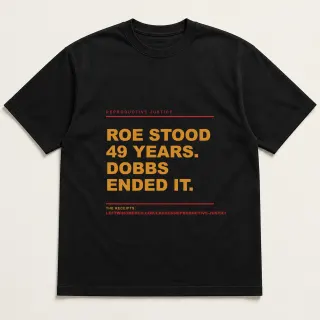 Design proof
 "Roe stood 49 years. Dobbs ended it." Tee
$36.00 Design proof
 "Roe stood 49 years. Dobbs ended it." Sticker
$5.00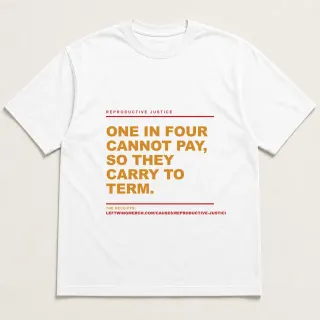 Design proof
 "One in four cannot pay, so they carry to term." Tee
$36.00 Design proof
 "One in four cannot pay, so they carry to term." Sticker
$5.00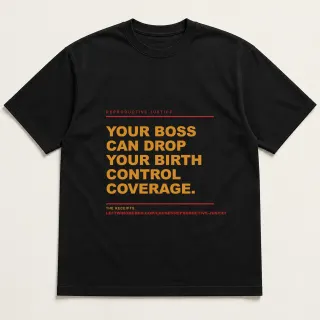 Design proof
 "Your boss can drop your birth control coverage." Tee
$36.00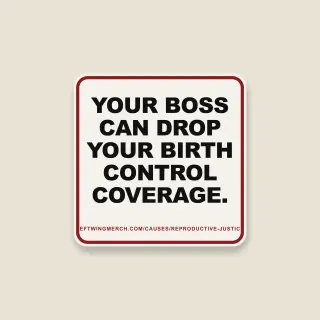 Design proof
 "Your boss can drop your birth control coverage." Sticker
$5.00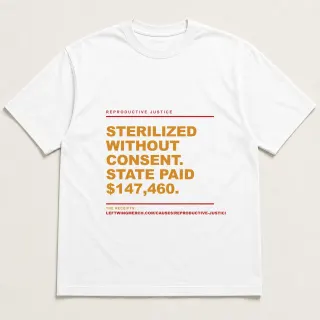 Design proof
 "Sterilized without consent. State paid $147,460." Tee
$36.00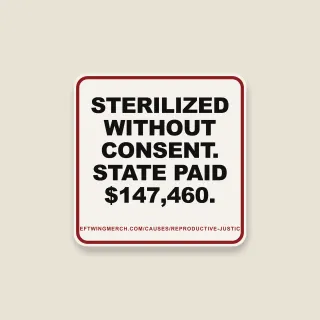 Design proof
 "Sterilized without consent. State paid $147,460." Sticker
$5.00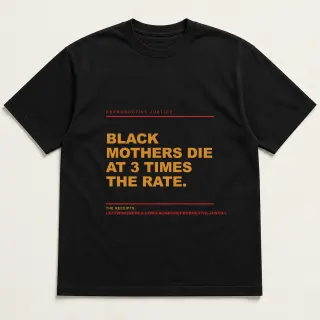 Design proof
 "Black mothers die at 3 times the rate." Tee
$36.00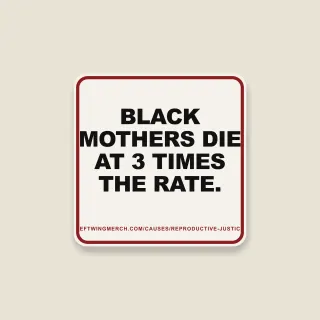 Design proof
 "Black mothers die at 3 times the rate." Sticker
$5.00Sources
#sourcesPrimary sources
The documents themselves: laws, court opinions, speeches, letters, and the numbers from the agencies that count them.
- SisterSong Women of Color Reproductive Justice Collective, "Reproductive Justice" (the organization's own definition of the framework and the 1994 origin story)
- Dobbs v. Jackson Women's Health Organization, Opinion of the Court, 597 U.S. 215 (June 24, 2022) (full text of Justice Alito's majority opinion overturning Roe v. Wade and Planned Parenthood v. Casey)
- Burwell v. Hobby Lobby Stores, Inc., 573 U.S. 682 (June 30, 2014), opinion text
- U.S. Conference of Catholic Bishops, Secretariat of Pro-Life Activities, "Backgrounder: Hyde Amendment and Related Policies" (updated July 2024)
- California Senate Bill 1135 (2014), Chapter 558, banning sterilization of inmates for birth control
- Foster DG, Biggs MA, Ralph L, Gerdts C, Roberts S, Glymour MM, "Socioeconomic Outcomes of Women Who Receive and Women Who Are Denied Wanted Abortions in the United States," American Journal of Public Health 108(3) (March 2018), summarized in an ANSIRH/UCSF Bixby Center issue brief (August 2018) (the underlying peer reviewed study behind the Turnaway Study cohort)
- California State Auditor, Report 2013-120, "Sterilization of Female Inmates" (June 2014)
- National Center for Health Statistics, evaluation of the effect of the 2003-2017 pregnancy checkbox rollout on reported maternal mortality rates
Secondary sources
Written afterward, about the story.
- Smithsonian National Museum of African American History and Culture, "Reproductive Justice"
- Guttmacher Institute, "The Hyde Amendment: A Discriminatory Ban on Insurance Coverage of Abortion"
- KFF, "Abortion in the U.S. Dashboard" (state gestational limit counts, April 27, 2026 snapshot)
- CalMatters, "'I would have been a great mom': California finally pays reparations to woman it sterilized" (October 2024)
- Center for American Progress, "The Hyde Amendment: 30 Years of Violating Women's Rights" (source of Rep. Hyde's 1976 floor statement; congress.gov's digitized record does not reach the 94th Congress)
- Guttmacher Institute, state policy explainer on contraceptive insurance coverage and refusal provisions
- Prison Legal News, "California Female Prisoners Sterilized" (March 15, 2014)
- Boston Indicators, "Maternal Morbidity and Mortality: Are they really up? And what's the role of measurement changes, real-world factors, and racism?" (June 2024)
- KFF, "Racial Disparities in Maternal and Infant Health: Current Status and Key Issues"