Published
James Baldwin
James Baldwin Put American Innocence on the Witness Stand
Born August 2, 1924. Died December 1, 1987
James Baldwin wrote novels and essays about race, sexuality, religion, class, and the stories America told to avoid its own record.
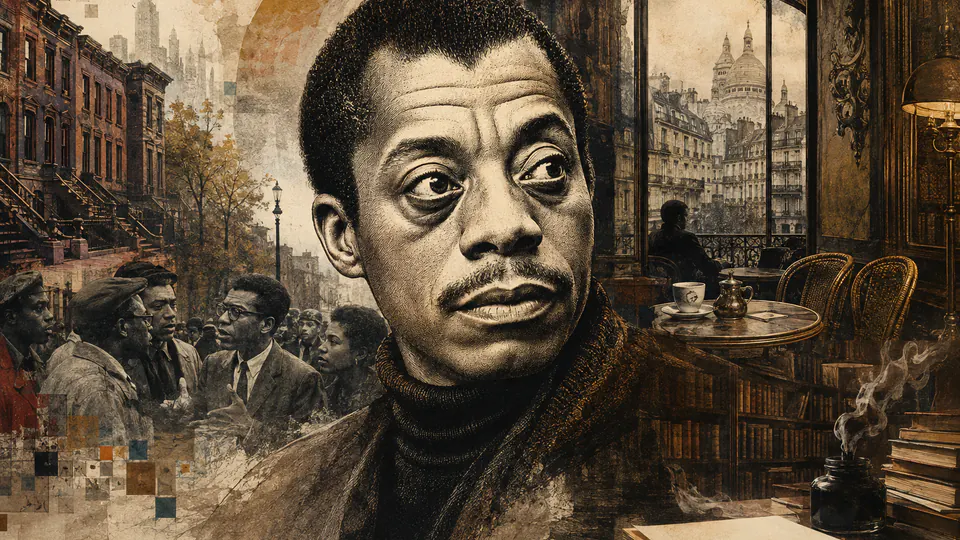
The story
#storyJames Baldwin left New York for Paris in 1948 because he feared American racism would kill him before he became a writer. From France he found enough distance to write about Harlem, church, family, sexuality, and the national habit of calling innocence what the record called avoidance.
He kept returning. Distance was a working position, not an alibi.
The preacher became an essayist
Baldwin was born in Harlem in 1924 and preached as a teenager. The pulpit taught him cadence, argument, and how a congregation hears evasion. He left the church but carried those tools into reviews and essays.
His first novel, Go Tell It on the Mountain, appeared in 1953. Notes of a Native Son followed in 1955 and Giovanni’s Room, centered on relationships between men, in 1956. Publishers and political movements often wanted race and sexuality in separate books. Baldwin wrote from a life where the subjects kept meeting.
In the rooms where officials listened badly
Baldwin reported from the South, raised money, and built relationships with Martin Luther King Jr., Malcolm X, Medgar Evers, Lorraine Hansberry, and many others. In 1963 he joined a group of Black artists and activists at a meeting with Attorney General Robert Kennedy. Jerome Smith’s anger at federal delay shocked Kennedy. Baldwin’s role was less spokesman than witness to how far official patience sat from lived danger.
The Fire Next Time made Baldwin a national figure that year. He spoke within the civil-rights movement but belonged to no organization’s line. That independence drew attacks from integrationists, Black nationalists, and later gay critics who each wanted a cleaner representative.
The archive keeps the relationships
Baldwin wrote novels, plays, screen treatments, and essays through the 1980s. His later work faced cooler reviews, then returned to wide readership after his death. The Smithsonian’s Baldwin collection includes correspondence from readers and famous friends, evidence of a writer operating through relationships as well as books.
Baldwin died in France in 1987. His sentences are quoted because they sound prophetic. Their source was less mysterious: he looked at the evidence America placed in front of everyone and declined the polite request to call it something else.
Harlem gave the argument an address
Baldwin was born in Harlem in 1924 and grew up in poverty as the eldest of nine children. His stepfather was a preacher, and Baldwin preached as a teenager. The church gave him rhythm, language, and a public platform while exposing authority that could turn fear into obedience.
He left the pulpit but carried its cadence into essays and fiction. Work, rent, police, store credit, family strain, and racial contempt supplied the material from which his moral arguments began.
As a young writer he encountered Richard Wright, whose support helped him, then later criticized the limits of protest fiction associated with Wright. The disagreement was about art and political representation, not a retreat from racism as a subject.
France created distance without exile from America
Baldwin moved to Paris in 1948, seeking room from U.S. racism and the constraints placed on his sexuality. Distance let him see the United States comparatively while poverty and outsider status prevented Europe from becoming a simple refuge.
His first novel, Go Tell It on the Mountain, drew on church and family life. Giovanni’s Room centered same-sex desire through white characters, a publishing risk that refused the demand that a Black writer address only one assigned subject.
Baldwin returned repeatedly to the United States. France became a working base, not an excuse to observe the freedom struggle safely from abroad.
The essay made personal witness answer history
Collections including Notes of a Native Son joined literary criticism, autobiography, and political analysis. Baldwin moved from a scene in a restaurant or family room to the structures behind it without pretending private experience proved every claim.
In The Fire Next Time, he addressed religion, race, love, and national denial. He criticized white supremacy while refusing the fantasy that innocence belonged to those who benefited from it. His writing asked readers to give up a comforting self-image as the price of living truthfully with others.
That demand explains why short quotations can misuse him. Baldwin’s sentences turn inside extended arguments. Removed from their conflict and qualification, they can become inspirational language for institutions he was criticizing.
Movement access did not make him a movement official
Baldwin traveled through the South, reported on school desegregation, and developed relationships with civil-rights leaders. He helped publicize campaigns and raise funds, but did not hold a formal leadership post in the major organizations.
His sexuality and independence complicated his position. Homophobia could narrow the roles open to a gay Black public figure. Baldwin defended Bayard Rustin and wrote about desire without accepting the era’s clinical or moral condemnation.
He also argued with friends and younger activists over nonviolence, nationalism, and the pace of change. Proximity to a movement did not require him to turn its internal debates into a single authorized message.
The Cambridge debate exposed liberal gradualism
In 1965, Baldwin debated William F. Buckley Jr. at Cambridge on whether the American dream had been achieved at the expense of Black Americans. Baldwin traced wealth and innocence to labor, dispossession, and a history the dominant society refused to name.
The event is remembered as a rhetorical victory, but applause was not the political measure. His argument challenged a liberal story in which inclusion would arrive through time if the excluded remained patient. Time had already been filled with policy, violence, and extracted labor.
Baldwin’s force came from connecting the listener’s ordinary world to that history. The dream’s comfort had been financed through another person’s exclusion.
Later work refused a finished civil-rights story
Assassinations of Medgar Evers, Malcolm X, and Martin Luther King Jr. shaped Baldwin’s later writing. He mourned friends while criticizing public memory that made slain leaders safer than their living politics had been.
In No Name in the Street and other later work, he addressed state violence, Black Power, war, and betrayal. Critics sometimes treated these books as evidence that anger had damaged his art. That judgment could function as another demand for the controlled voice white readers preferred.
He spent later years in Saint-Paul-de-Vence while continuing to write and teach. He died in 1987. His archive preserves drafts and revisions that undercut the myth of effortless prophecy. Baldwin made the sentence sharp through labor. He made it political by refusing to let beauty cover the bill someone else had been forced to pay.
In their own words
#wordsWhat James Baldwin actually said, where, and when. Each one links to the page it was checked against.
-
It comes as a great shock around the age of 5, or 6, or 7, to discover that the flag to which you have pledged allegiance, along with everybody else, has not pledged allegiance to you.
Opening remarks, Cambridge Union debate against William F. Buckley Jr., February 18, 1965, on the motion that the American Dream is at the expense of the American Negro. James Baldwin, opening and closing remarks, Cambridge Union debate with William F. Buckley Jr. (February 18, 1965), transcript -
I am stating very seriously, and this is not an overstatement: I picked the cotton, I carried it to the market, and I built the railroads under someone else's whip for nothing.
The same February 18, 1965 Cambridge Union debate, on who built the wealth the American Dream describes. James Baldwin, opening and closing remarks, Cambridge Union debate with William F. Buckley Jr. (February 18, 1965), transcript -
The Southern oligarchy, which has still today so very much power in Washington, and therefore some power in the world, was created by my labor and my sweat, and the violation of my women and the murder of my children.
The same February 18, 1965 Cambridge Union debate, tracing present-day political power to slavery's economics. James Baldwin, opening and closing remarks, Cambridge Union debate with William F. Buckley Jr. (February 18, 1965), transcript -
The people who are denied participation in it, by their very presence, will wreck it.
Closing remarks of the same February 18, 1965 Cambridge Union debate, on the American Dream's future. James Baldwin, opening and closing remarks, Cambridge Union debate with William F. Buckley Jr. (February 18, 1965), transcript -
No road whatever will lead Americans back to the simplicity of this European village where white men still have the luxury of looking on me as a stranger.
"Stranger in the Village," Harper's Magazine, October 1953, on being the first Black person residents of a Swiss village had seen, and on race in America by contrast. James Baldwin, "Stranger in the Village," Harper's Magazine (October 1953), collected in Notes of a Native Son (1955)
What people get wrong
#wrong- The myth
Baldwin lost his 1965 Cambridge debate with William F. Buckley Jr., or it was a narrow, inconclusive contest. - The record
The Cambridge Union's members voted on the motion afterward: 544 for Baldwin's side, 164 for Buckley's, a landslide by the debate's own rules.
- The myth
Baldwin held a formal leadership title inside a major civil rights organization such as SNCC or the SCLC. - The record
The Smithsonian's own account of Baldwin's activism describes him traveling the South, reporting, raising money, and building relationships with organizers rather than holding an officer's post; his 1963 meeting with Attorney General Robert Kennedy placed him among a group of invited artists and activists, not as a delegate of any single organization.
- The myth
Baldwin kept his sexuality out of his published fiction to protect his standing in the civil rights movement. - The record
His second novel, Giovanni's Room (1956), centers on a white American man's relationship with another man in Paris. Baldwin wrote and published a novel built entirely around same-sex desire in the same decade he was becoming a national voice on race, rather than waiting or writing around the subject.
The dates that matter
#dates- August 2, 1924 Born in Harlem, New York.
- 1948 Moves to Paris.
- 1953 Publishes Go Tell It on the Mountain.
- 1955 Publishes Notes of a Native Son.
- 1956 Publishes Giovanni's Room.
- 1963 Publishes The Fire Next Time and joins a meeting with Robert Kennedy.
- 1974 Publishes If Beale Street Could Talk.
- December 1, 1987 Dies in Saint-Paul-de-Vence, France.
Questions people ask
#faqsWho was James Baldwin?
James Baldwin was an American essayist, novelist, playwright, and public speaker whose work examined race, sexuality, religion, class, and American identity.
Why did James Baldwin move to France?
He left for Paris in 1948 seeking distance from U.S. racism and room to develop as a writer and gay man. He continued writing about and returning to the United States.
Was James Baldwin part of the civil-rights movement?
Yes. He traveled, raised funds, reported, debated, and worked alongside major organizers, while keeping enough independence to criticize movement factions and federal officials.
How should James Baldwin be evaluated?
Separate the immediate result from the institutions, tactics, exclusions, and enforcement record that followed it.
The bookshelf
#bookshelfWhere to go next. Buy from an independent bookstore, or find it at your library for nothing.
-
The Fire Next Time James Baldwin, 1963 primary
Two essays, short enough to read in an evening, that made him a national figure the year they appeared.
-
Notes of a Native Son James Baldwin, 1955 primary
The essay collection, "Stranger in the Village" included, where the essayist's voice first fully arrived.
-
James Baldwin: A Biography David Leeming, 1994 secondary
Written by Baldwin's own former personal assistant, with the access that job implies.
-
Begin Again: James Baldwin's America and Its Urgent Lessons for Our Own Eddie S. Glaude Jr., 2020 secondary
A Princeton scholar reads Baldwin's later, harder essays back into the present.
Wear it: James Baldwin
#merchEvery design here links back to this page.

Sources
#sourcesPrimary sources
The documents themselves: laws, court opinions, speeches, letters, and the numbers from the agencies that count them.
- James Baldwin, opening and closing remarks, Cambridge Union debate with William F. Buckley Jr., "That the American Dream Is at the Expense of the American Negro" (February 18, 1965), transcript (Baldwin's proposition won 544 votes to 164)
- James Baldwin, Cambridge Union debate with William F. Buckley Jr. (February 18, 1965), audio and video recording
- James Baldwin, "Stranger in the Village," Harper's Magazine (October 1953), collected in Notes of a Native Son (1955)
Secondary sources
Written afterward, about the story.
- Smithsonian NMAAHC, James Baldwin
- Smithsonian, The Makings of a Man
- Smithsonian, James A. Baldwin Collection
- Smithsonian American Women's History Museum, James Baldwin
- Wikipedia, James Baldwin
- Library of Congress, James Baldwin
- Smithsonian, James Baldwin collection guide
- Wikipedia, Baldwin-Buckley debate (confirms the 544-164 vote)