Published
Environmental Justice
Environmental Justice Starts With Who Lives Beside the Hazard
Environmental justice links pollution and climate risk to race, class, work, health, land, and political power.
The story
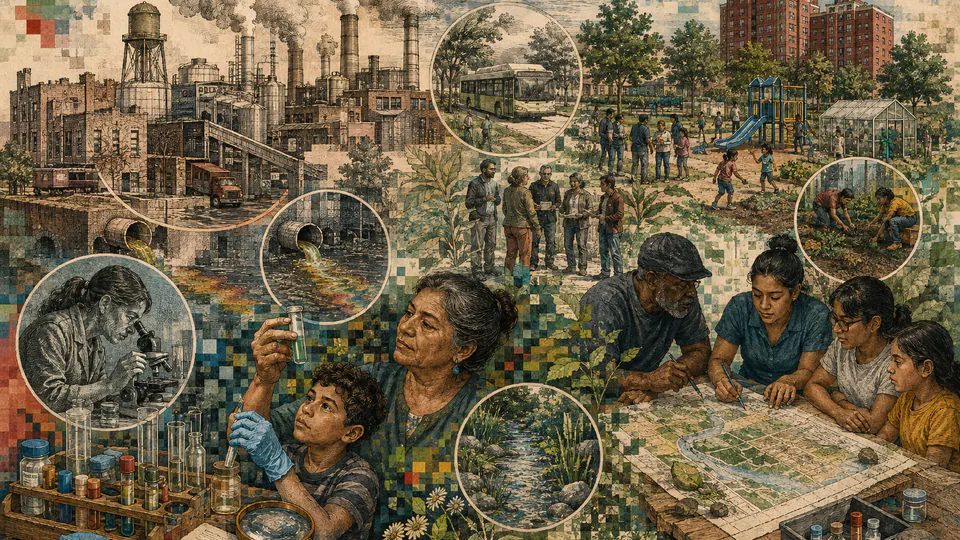
#storyEnvironmental justice asks a question missing from averages: who is breathing the pollution? A city can report cleaner air while one neighborhood remains beside a refinery, warehouse corridor, waste site, or highway. The distribution is shaped by zoning, segregation, land theft, workplace power, enforcement, and which communities officials expect to resist successfully.
The movement has many roots. Farmworkers organized against pesticide exposure. Indigenous nations defended land and water. Black sanitation workers in Memphis made safety part of a labor and civil-rights strike. In Houston, residents fought a landfill in a Black neighborhood. In 1982, Warren County residents used mass civil disobedience against a PCB landfill in North Carolina.
Evidence gave a pattern a name
Studies in the 1980s documented that hazardous sites were concentrated in communities of color. The 1991 People of Color Environmental Leadership Summit brought organizers together and adopted principles connecting ecological protection to self-determination, work, public health, and opposition to militarism.
Executive Order 12898 directed federal agencies to consider environmental justice in 1994. Formal recognition mattered, but a public meeting held after a decision is not community power. Organizers have demanded early participation, cumulative-impact analysis, language access, enforcement, health monitoring, and authority over land and development.
Climate change raises the same distributional question at larger scale. Heat, flooding, fire, insurance withdrawal, energy costs, and job transitions do not land evenly. Plans can reduce carbon while displacing residents or leaving polluted facilities in place. Environmental justice insists that the people living with the risk help decide the remedy and receive its material benefits.
Cumulative impact is one practical dividing line. A permit review may examine one facility and one pollutant at a time, while residents live with traffic, industrial emissions, contaminated soil, heat, and workplace exposure together. Measuring each source below a separate threshold can miss the burden created by their combination. Community monitoring and health surveys often begin because official data does not capture that lived total. Organizers then face a second problem: producing evidence should not make residents responsible for proving harm indefinitely before an agency acts. Equal protection needs enforcement capacity and precaution as well as another study.
The burden is produced by decisions, not geography alone
Polluting facilities do not simply appear where land is cheap. Zoning, segregation, redlining, highway placement, annexation, industrial recruitment, and weak enforcement shape which land becomes cheap and which residents have political bargaining power.
A neighborhood may face a refinery, truck routes, waste transfer stations, old lead paint, flooding, and poor access to health care at the same time. Each permit can pass review when considered alone while the combined burden remains intolerable.
Environmental justice therefore asks who receives benefits, who carries harm, who participates before a decision, and whether agencies enforce the same rules across race and income. It changes the unit of analysis from one smokestack to a lived place.
Warren County gave a national movement a nameable event
In 1982, North Carolina chose a predominantly Black county for a landfill holding soil contaminated with PCBs. Residents organized months of protest, lay in roads, and faced mass arrests as trucks carried the soil into the site.
The campaign did not stop the landfill. It drew national civil-rights organizations, churches, scientists, and media to a siting decision residents understood as racial and economic injustice. The protests helped make environmental racism a national political term.
Earlier communities had fought toxic exposure, from farmworkers opposing pesticides to residents at Love Canal and Black neighborhoods confronting industrial pollution. Warren County belongs as a convergence, not the claim that the movement began in a single road.
Research documented a pattern communities already knew
Studies by the U.S. General Accounting Office and the United Church of Christ examined the relationship between hazardous-waste sites, race, and income. Their methods and later studies have been debated, but they established that siting patterns required systematic public attention.
Community members also produced knowledge through odor logs, illness surveys, water sampling, mapping, and testimony. Agencies sometimes dismissed these records as anecdotal while relying on incomplete monitoring of their own.
Useful research can validate a claim and guide enforcement. It can also become a delay mechanism if officials demand endless proof after exposure is visible. Precaution asks whether residents should carry the risk of uncertainty created by a polluter.
The federal order changed procedure without creating a private right
President Clinton issued Executive Order 12898 in 1994, directing federal agencies to identify and address disproportionate environmental and health effects on minority and low-income populations. The order helped establish programs, screening, and review inside government.
An executive order is not the same as a statute creating an individual cause of action. Communities have also used civil-rights complaints, environmental laws, permitting hearings, zoning, state constitutions, and political organizing. Each route has procedural limits.
Title VI complaints can challenge discrimination by recipients of federal funds, but slow processing and proof standards have frustrated residents. A public-comment period offers little power if technical documents arrive late, translation is missing, or the permit is effectively decided before the meeting.
Climate hazards follow the same unequal map
Heat, flooding, wildfire smoke, storms, and energy costs interact with older patterns of housing and investment. Tree cover, drainage, air conditioning, insurance, transit, and emergency response determine whether the same weather becomes a different disaster across neighborhoods.
Climate policy can reproduce injustice if clean-energy facilities, mines, transmission lines, or buyouts are imposed without community authority. A transition away from fossil fuels changes the source of energy; justice asks who owns the new system, who gets the jobs, and who is displaced.
Workers in polluting industries also need income, pensions, and a path into safer work. Closing a facility without such guarantees can force residents to choose between a paycheck and breathable air, a choice created by policy rather than nature.
Enforcement is where equality becomes measurable
An agency can adopt equity language while inspections, penalties, cleanup schedules, and health protections remain unequal. Budgets and staffing determine whether a rule exists outside a website.
Community power changes that equation through local organizations, legal support, public records, independent monitoring, elections, and coalitions with workers and health professionals. The aim is to make public institutions act before residents must prove their suffering one household at a time.
Environmental justice is achieved when no community is treated as an acceptable loss zone and when the people living with a decision possess power over it. That standard reaches beyond equal distribution of pollution. It asks why the pollution is produced, whose needs production serves, and what repair is owed after decades of exposure.
Argue it
#argue3 claims about Environmental Justice you can make out loud, the best case against each one, and the answer. Every number links to where it came from.
-
Claim 1
Hazardous facilities cluster near communities of color and poor communities. That is not fully explained by people moving there afterward.
The evidence
A 1987 study by the United Church of Christ's Commission for Racial Justice found race the most statistically significant predictor of where hazardous waste sites sat nationally, and a study tracking the same individuals from 1991 to 2007 found Black respondents' cumulative industrial pollution exposure nearly double that of white respondents, with 33 percent of Black respondents experiencing persistent high exposure against 20 percent of white respondents.
Their best case
Vicki Been, in a widely cited 1994 analysis and a 1997 follow-up with Francis Gupta, argued that demographic change often follows rather than precedes facility siting: poorer and minority residents move into neighborhoods near already-built hazardous sites because the housing there is cheaper, so market dynamics rather than discriminatory siting decisions could explain much of the correlation between race and hazard proximity.
The answer
Pais, Crowder, and Downey tested that exact hypothesis by tracking individuals rather than neighborhoods, and isolated the households that never moved at all, which rules out the 'moved to the nuisance' explanation by definition. Even among those immobile households, the racial gap in pollution exposure was still statistically significant and grew over the study period. Some of the national correlation between race and hazard proximity is migration. The share of it visible in people who stayed in place the entire time is not.
-
Claim 2
Cleaning up pollution gets framed as a jobs killer. The ledger does not actually balance that way.
The evidence
The Environmental Protection Agency's own retrospective accounting of the Clean Air Act from 1990 to 2020 found that avoided deaths and illness alone produced benefits exceeding compliance costs by more than 30 to 1 in the central estimate, with a plausible range from about 3 to 1 up to 90 to 1.
Their best case
University of Chicago economists Michael Greenstone, John List, and Chad Syverson, studying nearly 1.2 million manufacturing plant observations from 1972 to 1993, found stricter air quality regulation cut total factor productivity at regulated polluting plants by up to 4.8 percent once price and output effects were accounted for, an estimated 21 billion dollars a year in cost, about 8.8 percent of manufacturing sector profits.
The answer
That 21 billion dollar figure is a real, peer reviewed number worth taking seriously rather than waving away. Weighed against the EPA's own 30-to-1 benefit-to-cost accounting for the same body of regulation, the productivity cost is real but small next to the health side of the ledger, and the two costs do not fall on the same people: the profit hit lands on manufacturing shareholders, while the asthma, heart disease, and missed work the regulation prevents falls hardest on the low-income and minority neighborhoods sited closest to the plants.
-
Claim 3
Documenting a disparate pattern is not the same as winning a case over it.
The evidence
Robert Bullard served as the expert witness in Bean v. Southwestern Waste Management Corp. in Houston in 1979, the first lawsuit in the country to charge environmental discrimination in waste facility siting under federal civil rights law, built on his own study of where the city's waste facilities sat.
Their best case
The Supreme Court held in Washington v. Davis (1976) that a facially neutral policy 'is not unconstitutional solely because it has a racially disproportionate impact,' since such impact 'is not the sole touchstone' of unconstitutional discrimination without separate proof of discriminatory purpose. Alexander v. Sandoval (2001) narrowed the statutory path further, holding there is 'no private right of action to enforce disparate-impact regulations promulgated under Title VI.'
The answer
Both rulings are real and still good law, and together they explain why so few environmental justice claims win in federal court even when the disparate pattern itself, the one Bullard documented as far back as 1979, is not seriously disputed. Sandoval closed one specific door, a private lawsuit under Title VI's own disparate impact regulations. It left two open: Section 601 of Title VI itself still allows a private suit over intentional discrimination, and federal agencies keep independent authority to investigate and resolve Title VI complaints through their own administrative process without a private lawsuit at all, however slowly that process moves.
What people get wrong
#wrong- The myth
A neighborhood cleanup automatically helps the community that suffered the pollution. - The record
A national study of brownfield redevelopment from 2006 to 2015 found white population share rose 0.03 percent and Latino population share fell 0.04 percent in redeveloped tracts, with white and Latino household income rising while Black household income did not move, the signature of displacement following cleanup rather than benefit reaching the people who lived with the pollution. Elizabeth Yeampierre, former chair of EPA's own National Environmental Justice Advisory Council, watched it happen in her own Brooklyn neighborhood: 'We made this community more green. People who work in this neighborhood live in this neighborhood. And now we're going to lose it to gentrification?'
- The myth
Executive Order 12898 guaranteed that polluted sites in minority and low-income areas would be prioritized for federal cleanup. - The record
A study tracking Superfund listings before and after the 1994 order found the opposite for sites discovered afterward: a 10-point rise in a tract's poverty rate cut the odds of formal listing by 31 percent, versus 16 percent before the order, and a 10-point rise in minority population cut listing odds by 7 percent versus 3 percent before. Undefined terms, no dedicated funding, and inconsistent regional guidance blunted what the order promised.
- The myth
Environmental justice is only about race. - The record
The movement's own founding document, the principles adopted at the 1991 First National People of Color Environmental Leadership Summit, linked ecological protection to labor rights, self-determination, and opposition to militarism, not race alone. The federal government's own current measurement tool follows that lead: CDC's Environmental Justice Index scores every census tract across 36 environmental, social, and health factors in three modules, not a single racial count.
The dates that matter
#dates- 1968 Black sanitation workers strike in Memphis over wages, safety, and dignity after two workers are killed.
- 1978 Residents of Houston's Northwood Manor oppose a landfill proposed for their Black neighborhood.
- 1982 Warren County, North Carolina, residents mount mass civil disobedience against a PCB landfill.
- 1983 A federal report finds most hazardous-waste landfills studied in the Southeast located in Black communities.
- 1987 Toxic Wastes and Race documents race as a strong predictor of hazardous-waste locations.
- 1991 The First National People of Color Environmental Leadership Summit adopts principles of environmental justice.
- 1994 Executive Order 12898 directs federal agencies to address environmental justice.
Questions people ask
#faqsWhat is environmental justice?
It is the principle and movement that all people deserve meaningful participation and equal protection in environmental decisions, regardless of race, income, or national origin.
Why is Warren County important?
The 1982 protests against a PCB landfill in a predominantly Black North Carolina county drew national attention and helped give the environmental-justice movement a shared name and reference point.
How is environmental justice different from conservation?
Conservation often centers land, wildlife, or resource protection. Environmental justice centers the people exposed to hazards and asks who has power over environmental decisions. The projects can overlap.
How should Environmental Justice be evaluated?
Separate the immediate result from the institutions, tactics, exclusions, and enforcement record that followed it.
The bookshelf
#bookshelfWhere to go next. Buy from an independent bookstore, or find it at your library for nothing.
-
Dumping in Dixie: Race, Class, and Environmental Quality Robert D. Bullard, 2008 secondary
The founding text of the field, from the sociologist who did the original fieldwork in five Southern cities.
-
The Wrong Complexion for Protection: How the Government Response to Disaster Endangers African American Communities Robert D. Bullard and Beverly Wright, 2012 secondary
Katrina and the disasters that followed it, read as environmental justice failures.
-
Toxic Communities: Environmental Racism, Industrial Pollution, and Residential Mobility Dorceta E. Taylor, 2014 secondary
Tests the siting-versus-migration debate directly against a century of housing and industrial records.
-
Noxious New York: The Racial Politics of Urban Health and Environmental Justice Julie Sze, 2006 secondary
Asthma, waste transfer stations, and the fight over where New York City puts its garbage.
Wear it: Environmental Justice
#merchEvery design here links back to this page.
 Design proof
 Grace Lee Boggs Engraved Tee
$36.00 Design proof
 Hazel M. Johnson Engraved Tee
$36.00 Design proof
 Lois Gibbs Engraved Tee
$36.00 Design proof
 Rachel Carson Pixel Tee
$36.00 Design proof
 Environmental Justice Pixel Tee
$36.00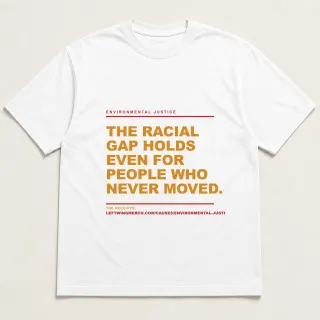 Design proof
 "The racial gap holds even for people who never moved." Tee
$36.00 Design proof
 "The racial gap holds even for people who never moved." Sticker
$5.00 Design proof
 "Health benefits beat compliance costs, 30 to 1." Tee
$36.00 Design proof
 "Health benefits beat compliance costs, 30 to 1." Sticker
$5.00 Design proof
 "Proving harm and winning in court, different things." Tee
$36.00 Design proof
 "Proving harm and winning in court, different things." Sticker
$5.00Sources
#sourcesPrimary sources
The documents themselves: laws, court opinions, speeches, letters, and the numbers from the agencies that count them.
- EPA Archive, Environmental Justice
- EPA Archive, Environmental Justice Timeline
- Government Accountability Office, Hazardous Waste Landfills
- National Archives, Executive Order 12898
- EPA, Environmental Justice Research Roadmap
- CDC, environmental justice index
- Jeremy Pais, Kyle Crowder, and Liam Downey, "Unequal Trajectories: Racial and Class Differences in Residential Exposure to Industrial Hazard," Social Forces 92(3) (2013)
- Vicki Been and Francis Gupta, "Coming to the Nuisance or Going to the Barrios? A Longitudinal Analysis of Environmental Justice Claims," Ecology Law Quarterly 24(1) (1997) (the hypothesis that Pais, Crowder, and Downey (2013) directly test)
- EPA, "Benefits and Costs of the Clean Air Act 1990 to 2020, the Second Prospective Study"
- Michael Greenstone, John A. List, and Chad Syverson, "The Effects of Environmental Regulation on the Competitiveness of U.S. Manufacturing," NBER Working Paper 18392 (September 2012)
- Washington v. Davis, 426 U.S. 229 (1976)
- Alexander v. Sandoval, 532 U.S. 275 (2001)
- Marisol Becerra, "Gentrifying Force or a Force for Environmental Justice? A National Assessment of Brownfield Redevelopment and Gentrification in the United States from 2006 to 2015," American Behavioral Scientist 68(4) (2022)
- Sandra George O'Neil, "Superfund: Evaluating the Impact of Executive Order 12898," Environmental Health Perspectives 115(7) (April 2007)
- CDC/ATSDR, Environmental Justice Index
Secondary sources
Written afterward, about the story.
- Wikipedia, "Robert Bullard" (orientation for Bean v. Southwestern Waste Management Corp.'s date, city, and parties)