Published
Malcolm X
Malcolm X's Politics After Mecca: What the Textbooks Leave Out
Born May 19, 1925. Died February 21, 1965
Malcolm X broke with the Nation of Islam in 1964, made the Hajj, and spent his last year building a human rights politics before his 1965 assassination.
The story
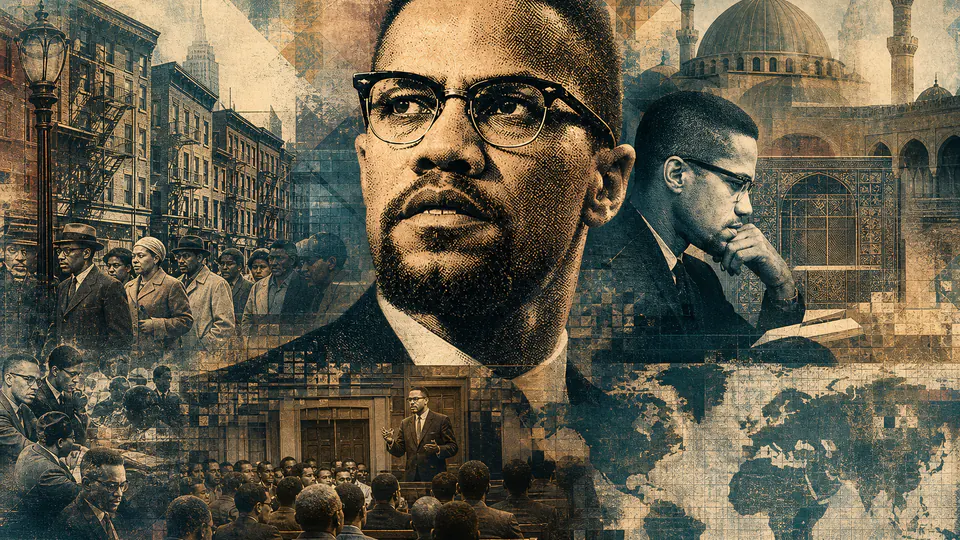
#storyAsk what Malcolm X believed and most people can supply one phrase: by any means necessary. Ask what he believed on February 20, 1965, the day before he was shot, and the confident answers usually run out. In the eleven months between his public break with the Nation of Islam and his assassination at the Audubon Ballroom, he made the Hajj to Mecca, changed his name, met Martin Luther King once, founded two organizations, carried his case to a summit of African heads of state in Cairo, and told a socialist magazine that capitalism could not survive without something to exploit. None of that fits on a T-shirt, which may be exactly why it gets left out of the textbook version.
Prison, the Nation of Islam, and the break
Malcolm Little was born May 19, 1925, in Omaha, Nebraska. His father, Earl Little, a Baptist preacher and organizer for Marcus Garvey’s Universal Negro Improvement Association, died in Lansing, Michigan in 1931, in a death police ruled a streetcar accident and his family always believed was a murder. His mother, Louise Little, was committed to a state hospital in Kalamazoo in 1938, and the children were split up into different households. Malcolm dropped out of school, drifted into burglary in Boston, and was arrested in 1946; in February of that year he began serving a sentence of 8 to 10 years. In prison he converted to the Nation of Islam, and by 1954, a couple of years after his parole, he was running the NOI’s Temple No. 7 in Harlem, the organization’s most visible minister for the next decade.
The break came in stages. On December 1, 1963, ten days after President Kennedy’s assassination, Malcolm told a Manhattan Center audience that the killing was a case of “chickens coming home to roost,” reasoning that a country that tolerated violence at home and abroad should not be shocked when that violence found its way back to it. Elijah Muhammad, who had ordered his ministers to say nothing about Kennedy’s death, suspended Malcolm from public speaking two days later. The suspension never fully lifted. In March 1964, with his standing in the NOI beyond repair, Malcolm announced he was leaving to found his own organization, Muslim Mosque, Inc., open to the religious and political work the Nation of Islam had kept him out of.
That same month produced a meeting most people don’t know happened at all. On March 26, 1964, Malcolm X and Martin Luther King Jr. crossed paths at the U.S. Capitol, both there for a Senate hearing on the Civil Rights Act, and shook hands for the only time in their lives. “I’m throwing myself into the heart of the civil rights struggle,” Malcolm told him. King later wrote to Malcolm’s widow that “while we did not always see eye to eye on methods to solve the race problem, I always had a deep affection for Malcolm and felt that he had a great ability to put his finger on the existence and root of the problem.” The photograph of the handshake is one of the most reproduced images of the era. The conversation behind it lasted about a minute, and there was never a second one.
What happened in Mecca
Three weeks later Malcolm left for the Hajj. He arrived in Saudi Arabia in April 1964, and on April 20 he wrote a letter to his aides in New York that became the hinge of his public life.
Never have I witnessed such sincere hospitality and the overwhelming spirit of true brotherhood as practiced by people of all colors and races here in this Ancient Holy Land, the home of Abraham, Muhammad and all other prophets of the Holy Scriptures.
He told his correspondents the trip had “forced me to re-arrange much of my thought patterns previously held, and to toss aside some of my previous conclusions.” He took a new name, El-Hajj Malik El-Shabazz, and from Jeddah went on to tour African nations rather than fly straight home.
In Accra, Ghana, he was taken in by Shirley Graham Du Bois, the widow of W. E. B. Du Bois, who had died in Ghana the year before. She introduced him to President Kwame Nkrumah, and Malcolm talked with African independence leaders who framed their fight as one against colonialism and economic exploitation rather than against a race. He did not abandon his belief that Black Americans needed to organize independently of white America. What he added was the argument that their fight was bigger than one country’s race problem, and belonged on a stage where newly independent African nations held votes.
Two organizations, and a turn toward human rights
Malcolm founded the Organization of Afro-American Unity on June 28, 1964, at the Audubon Ballroom in Washington Heights, Manhattan, the same room where he would be shot to death less than eight months later. Where the Nation of Islam had been a religious movement that stayed mostly out of electoral politics, the OAAU’s program committed it to voter registration, school boycotts, rent strikes, and self-defense, alongside a deliberate reframing: Malcolm argued that what Black Americans faced was not a domestic civil rights problem but an international human rights violation, the kind other countries could be pressed to answer for at the United Nations. On July 17, 1964, he carried that argument to Cairo, where the Organization of African Unity’s summit of African heads of state received him as the OAAU’s representative.
By any means necessary, in context
The line everyone knows, the one that has lasted longer than every organization he built, came from the OAAU’s founding rally that same June night.
We want freedom by any means necessary. We want justice by any means necessary. We want equality by any means necessary.
He was not calling for random violence. In that same speech, the phrase is tied to a specific claim: that Black Americans have the right to protect their own lives and property in places where the government is unable or unwilling to do it for them. It is a self-defense argument, aimed at a state Malcolm said would not do the protecting itself. The slogan kept traveling after the argument beside it fell away, becoming shorthand across the left, including at the founding of the Black Panther Party two years later.
The last year
Malcolm kept moving in directions the flattened version of him skips entirely. On January 18, 1965, five weeks before he died, he told the Young Socialist that “it is impossible for capitalism to survive, primarily because the system of capitalism needs some blood to suck,” and that as colonized nations won independence, capitalism would have “less to suck” and grow weaker. He stopped short of calling himself a socialist in that same interview. The record does not support pinning a finished ideology on him; it supports a man whose thinking about race, empire, and economics was still moving fast when it was cut off.
The assassination
On February 14, 1965, a week before he died, his family’s home in East Elmhurst, Queens was firebombed. Malcolm, his wife Betty Shabazz, and their four young daughters escaped unhurt. On February 21, 1965, as he rose to address an OAAU meeting at the Audubon Ballroom, gunmen in the crowd shot him. He was pronounced dead that afternoon at Columbia Presbyterian Hospital, at 39. Three men with Nation of Islam ties were convicted of his murder in 1966: Talmadge Hayer, Norman 3X Butler, and Thomas 15X Johnson. Hayer confessed at trial and testified, then and afterward, that Butler and Johnson had no part in the killing. Nobody acted on that testimony for fifty-five years. In November 2021, after a reinvestigation found that the FBI and NYPD had withheld evidence favorable to the defense at the original trial, Manhattan prosecutors moved to vacate the convictions of Butler, who by then went by Muhammad Aziz, and Johnson, who went by Khalil Islam.
What got written down
Malcolm had spent 1963 and 1964 telling his life story to the journalist Alex Haley across dozens of interviews. The result, The Autobiography of Malcolm X, was published nine months after his death, on October 29, 1965. Ossie Davis delivered the eulogy at the funeral on February 27, 1965, closing with a line that outlasted most of what else was said about Malcolm that year:
And we will know him then for what he was and is - a Prince - our own black shining Prince - who didn’t hesitate to die, because he loved us so.
The eulogy and the Autobiography kept Malcolm X famous. Keeping the dated record of his last eleven months as well known as the rest of his life took longer: Khalil Islam did not live to see his own name cleared, and Muhammad Aziz, then 83, did, fifty-six years after the Audubon Ballroom. The politics Malcolm X was building that year, aimed past Washington at the United Nations, arguing that Black Americans had to organize their own defense because no one else reliably would, took decades to catch up to the truth about his death. It caught up anyway.
In their own words
#wordsWhat Malcolm X actually said, where, and when. Each one links to the page it was checked against.
-
Never have I witnessed such sincere hospitality and the overwhelming spirit of true brotherhood as practiced by people of all colors and races here
From the Letter from Mecca, written to his aides in New York during his Hajj, April 20, 1964. Malcolm X, "Letter from Mecca" (April 20, 1964) -
America needs to understand Islam, because this is the one religion that erases from its society the race problem.
From the Letter from Mecca, April 20, 1964. Malcolm X, "Letter from Mecca" (April 20, 1964) -
We assert that in those areas where the government is either unable or unwilling to protect the lives and property of our people, that our people are within our rights to protect themselves by whatever means necessary.
From the founding rally of the Organization of Afro-American Unity at the Audubon Ballroom in Manhattan, June 28, 1964. Malcolm X, Speech at the Founding Rally of the Organization of Afro-American Unity (June 28, 1964) -
We want freedom by any means necessary. We want justice by any means necessary. We want equality by any means necessary.
From the same speech at the Audubon Ballroom, June 28, 1964, the line that outlasted the organization it launched. Malcolm X, Speech at the Founding Rally of the Organization of Afro-American Unity (June 28, 1964) -
It is impossible for capitalism to survive, primarily because the system of capitalism needs some blood to suck.
From an interview with the Young Socialist magazine, January 18, 1965, five weeks before his assassination. "Interview: Malcolm X and Young Socialist" (January 18, 1965)
What people get wrong
#wrong- The myth
By any means necessary was a call for indiscriminate violence. - The record
He used the phrase at the OAAU founding rally on June 28, 1964, in the same speech that spelled out what he meant by it: that Black Americans could protect their own lives and property in the places where the government would not. The claim in the text is self-defense.
- The myth
Malcolm X's politics were the Nation of Islam's, start to finish. - The record
He broke with the Nation of Islam in March 1964 and made the Hajj that April. In the eleven months left to him he founded the Organization of Afro-American Unity, addressed the Organization of African Unity summit of heads of state in Cairo on July 17, 1964 to put Black Americans' case as a human rights question, and on January 18, 1965 sat for an interview on capitalism and colonialism with a socialist magazine.
- The myth
Malcolm X and Martin Luther King Jr. were rivals who never had any direct contact. - The record
They met once, on March 26, 1964, at the U.S. Capitol, where both had come for a Senate hearing on the Civil Rights Act. They shook hands, and never met again.
The dates that matter
#dates- May 19, 1925 Born Malcolm Little in Omaha, Nebraska.
- 1931 His father, Earl Little, dies in Lansing, Michigan; the death is officially ruled a streetcar accident, and his family always believed he was murdered.
- Late 1938 His mother, Louise Little, is committed to a state hospital in Kalamazoo; the children are split up into different households.
- 1946 Arrested in Boston for burglary; in February he begins serving a sentence of 8 to 10 years.
- 1948 Converts to the Nation of Islam while in prison.
- August 1952 Paroled after about six and a half years; by 1954 he is minister of the NOI's Temple No. 7 in Harlem.
- December 1, 1963 Calls the Kennedy assassination a case of chickens coming home to roost; Elijah Muhammad suspends him from public speaking two days later.
- March 1964 Publicly breaks with the Nation of Islam and founds Muslim Mosque, Inc.
- March 26, 1964 Meets Martin Luther King Jr. for the only time, at the U.S. Capitol.
- April 1964 Makes the Hajj to Mecca, writes the Letter from Mecca on April 20, takes the name El-Hajj Malik El-Shabazz, and tours African nations including Ghana.
- June 28, 1964 Founds the Organization of Afro-American Unity at the Audubon Ballroom in Manhattan.
- July 17, 1964 Welcomed to the Organization of African Unity summit in Cairo as the OAAU's representative, pressing African governments on the treatment of Black Americans.
- February 21, 1965 Shot to death at the Audubon Ballroom while addressing the OAAU, a week after his family's home was firebombed. Three men are later convicted.
- November 18, 2021 Manhattan prosecutors vacate the convictions of two of the three men, Muhammad Aziz and Khalil Islam, after a reinvestigation finds withheld evidence.
Questions people ask
#faqsWhat did Malcolm X believe after he left the Nation of Islam?
After his March 1964 break with the Nation of Islam and his April 1964 Hajj to Mecca, Malcolm X moved toward orthodox Sunni Islam, argued that Black Americans should frame their struggle as a human rights issue to be raised at the United Nations rather than only a domestic civil rights issue, and grew more open to working with civil rights leaders and international anti-colonial movements. He still argued that Black Americans needed to organize independently and had the right to defend themselves.
Why did Malcolm X leave the Nation of Islam?
The proximate cause was a remark he made on December 1, 1963, calling President Kennedy's assassination a case of chickens coming home to roost, which led Elijah Muhammad to suspend him from public speaking. The suspension never lifted, and in March 1964, with his standing in the organization gone, Malcolm announced he was leaving to found his own group, Muslim Mosque, Inc.
What does Malcolm X's phrase by any means necessary actually mean?
He first used the phrase publicly at the founding rally of the Organization of Afro-American Unity on June 28, 1964, demanding freedom, justice, and equality by any means necessary. The same speech ties the phrase to a specific claim: that Black Americans have the right to defend their own lives and property where the government will not, a self-defense argument rather than a call for unprovoked violence.
Who killed Malcolm X, and was anyone ever exonerated?
He was shot at the Audubon Ballroom in Manhattan on February 21, 1965. Three men with Nation of Islam ties, Talmadge Hayer, Norman 3X Butler, and Thomas 15X Johnson, were convicted of murder in 1966. Hayer confessed and testified that Butler and Johnson had no part in the killing. In November 2021, after a reinvestigation found the FBI and NYPD had withheld evidence at trial, Manhattan prosecutors vacated the convictions of Butler (Muhammad Aziz) and Johnson (Khalil Islam).
Did Malcolm X write his own autobiography?
He told his life story to journalist Alex Haley over dozens of interviews starting in 1963. The Autobiography of Malcolm X was published under both their names on October 29, 1965, nine months after Malcolm X's assassination.
The bookshelf
#bookshelfWhere to go next. Buy from an independent bookstore, or find it at your library for nothing.
-
The Autobiography of Malcolm X Malcolm X and Alex Haley, 1965 primary
Told to Alex Haley across dozens of interviews; published nine months after his assassination.
-
Malcolm X Speaks: Selected Speeches and Statements Malcolm X, edited by George Breitman, 1965 primary
The speeches themselves, from the Nation of Islam years through the OAAU.
-
Malcolm X: A Life of Reinvention Manning Marable, 2011 secondary
The standard modern biography, and the source for the chronology of the 1964 break.
Wear it: Malcolm X
#merchEvery design here links back to this page.
Sources
#sourcesPrimary sources
The documents themselves: laws, court opinions, speeches, letters, and the numbers from the agencies that count them.
- Malcolm X, "Letter from Mecca" (April 20, 1964) (reproduction of the letter written from Mecca)
- Malcolm X, Speech at the Founding Rally of the Organization of Afro-American Unity (June 28, 1964) (source of the by any means necessary passage and the self-defense clause)
- "Interview: Malcolm X and Young Socialist" (January 18, 1965) (the capitalism interview, five weeks before his death)
- Ossie Davis, eulogy for Malcolm X (February 27, 1965)
Secondary sources
Written afterward, about the story.
- Wikipedia, "Malcolm X" (biographical dates, family history, imprisonment)
- Wikipedia, "Organization of Afro-American Unity"
- Wikipedia, "Assassination of Malcolm X" (firebombing, funeral, burial, and the 2021 exoneration)
- Wikipedia, "The Autobiography of Malcolm X"
- Innocence Project, "Historic and Long Overdue Exonerations of Muhammad A. Aziz and Khalil Islam"
- Biography.com, "Martin Luther King Jr. and Malcolm X Only Met Once"
- Manning Marable, Malcolm X: A Life of Reinvention (Viking, 2011) (source for the December 1963 remark, the NOI suspension, and the chronology of the March 1964 break)
- Cross Cultural Solidarity, "The International Malcolm X" (the Ghana trip and Shirley Graham Du Bois)