Published
Huey P. Newton
Huey P. Newton: The Black Panther co-founder, community programs, legal cases, and contested legacy
Born February 17, 1942. Died August 22, 1989
A sourced account of Huey P. Newton, covering the organizing, conflict, limits, and consequences behind the familiar version.
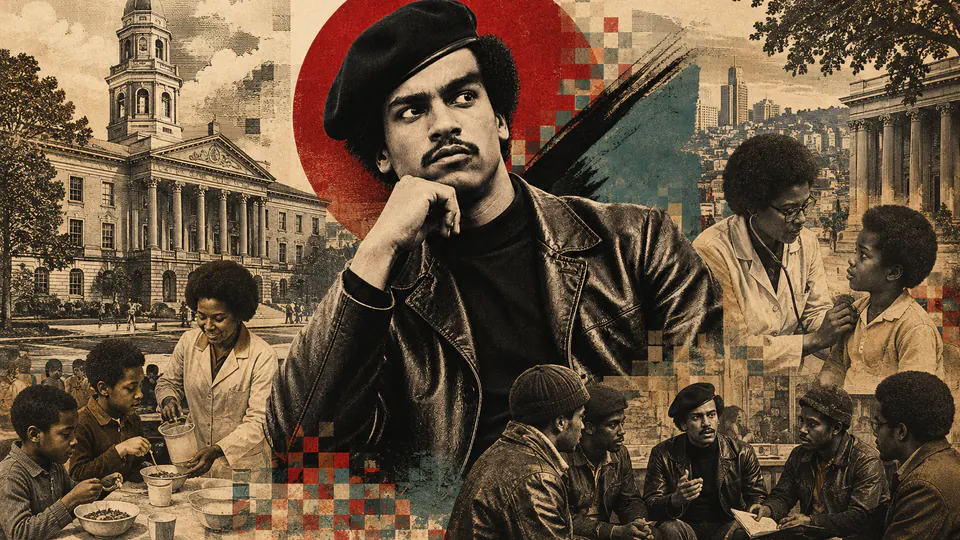
The story
#storyThe familiar version of Huey P. Newton usually begins at the moment cameras, police, or a national audience arrived. That makes a clean story and a bad explanation. The Black Panther co-founder, community programs, legal cases, and contested legacy. To understand that claim, the organizing before the famous scene and the institutions after it have to remain in view.
Newton joined armed observation of police to a program for housing, food, education, health, and political power. That is the article’s measure of success. It asks who gained the power to make a decision, which rule changed, who remained outside it, and whether the gain lasted after attention moved elsewhere.
The conditions came before the headline
February 17, 1942: Born in Monroe, Louisiana, before his family moves to Oakland. 1960s: Studies at Merritt College and reads law, Black history, and anticolonial theory. Those events established the field on which later choices were made. People did not enter it with equal money, legal standing, mobility, safety, or access to the press. An order that looked ordinary to those who administered it could feel like a permanent emergency to those made to live under it.
This context does not turn participants into passengers of large forces. It identifies the constraints they learned to use. A workplace schedule could become a contact list. A church, apartment, union hall, campus, newspaper, or neighborhood association could become an office. A court case could collect evidence for a campaign, while a campaign could make judges and officials understand that a case would not disappear without resistance.
Organization made the public moment possible
October 1966: Founds the Black Panther Party with Bobby Seale. 1967: Armed patrols and a Sacramento protest bring the party national attention. Neither development moved by reputation alone. Organizers needed places to meet, ways to settle disputes, trusted people who could carry information, money for food and transport, and plans for arrest, dismissal, or retaliation. That daily work determined who could remain involved when the first burst of attention ended.
Coalition added reach and friction. Participants could share a target while disagreeing about tactics, leadership, parties, weapons, negotiation, or the desired settlement. Those arguments were evidence of real stakes. Unity imposed from above would have hidden differences without resolving them. Durable cooperation required rules for making decisions and a distribution of risk that people considered fair enough to continue.
The link to civil rights is practical. Rights become usable through registration, representation, hearings, contracts, budgets, and enforcement. Moral language can name an injury. Organization identifies the person or institution able to stop it and creates a cost for refusal.
Conflict exposed where authority sat
October 28, 1967: A traffic stop ends with officer John Frey dead and Newton wounded and charged. 1968: A jury convicts Newton of voluntary manslaughter; the conviction is later reversed. At that point, opponents did more than offer a different opinion. They used the authority available to them: ownership, police, courts, party rules, licensing, hiring, firing, surveillance, or control of public information. The response reveals which interests a supposedly neutral system was prepared to protect.
Organizers also made choices under pressure. A dramatic tactic could bring attention while exhausting money. A legal compromise could protect people immediately while leaving a larger demand unanswered. Central leadership could coordinate action while silencing local knowledge. The right question is not whether every decision looks pure in hindsight. It is what alternatives existed, who bore their risks, and what the participants knew at the time.
This is where Black liberation enters the story. Work, housing, public space, education, policing, and voting were connected even when law placed them in separate boxes. A person blocked in one institution arrived at the next with fewer resources. Organizing across those boundaries could create power, but it also required more time and broader accountability.
A result is larger than a victory label
August 1970: Released after nearly three years in custody as prosecutors prepare a new trial. August 22, 1989: Killed in Oakland after years marked by study, exile, addiction, and party decline. These later events prevent a simple ending. A campaign may lose its immediate demand and still train leaders, expose a system, or leave a tactic others can use. It may win a law whose exclusions reproduce part of the old order. It may build an organization that protects members while becoming less willing to take the risks that built it.
His thought and the party’s public programs matter beside credible accounts of coercion, internal violence, and his later personal decline. Naming that limit does not cancel the achievement. It identifies the next conflict and gives credit to people who challenged the movement from within. Race, gender, class, citizenship, occupation, sexuality, and disability affected who was heard and who could survive retaliation. These were contemporary disputes, not standards invented after the fact.
The economic questions also continued. union organizing concerns who controls the resources needed to act: wages, time, transport, care, land, credit, and public services. Formal access without those resources can leave a right unusable. Material gains without a protected voice can disappear when management or government changes direction.
The archive has interests too
No source type sees the whole event. Government files document what an agency counted, feared, or prosecuted, often in the agency’s own language. Organizational minutes show plans and votes but may omit informal labor. Newspapers capture public claims while repeating the prejudices of owners, editors, police, or advertisers. Oral histories restore texture and motive, though memory recorded later can compress dates and settle old arguments too neatly.
The responsible method is comparison. When several independent records agree, a claim grows stronger. When they conflict, the disagreement belongs in the story. A missing name can show who lacked formal authority, but absence from minutes does not prove absence from the work. A famous quotation should be traced to a recording, transcript, letter, or contemporary report before it carries an argument.
What this history leaves us
Huey P. Newton matters because power was made visible in use. Participants learned which office could delay, which employer could punish, which law could be enforced, and which alliance could outlast a news cycle. Their answers were incomplete because all political answers are made under conditions they do not fully control.
The useful inheritance is therefore neither worship nor dismissal. Keep the organizing methods, measure the result, name the exclusions, and follow the institution after the celebration. That approach preserves drama without turning history into a poster. It also preserves the people whose patient work made the remembered moment possible.
Strategy can be measured in resources
Newton joined armed observation of police to a program for housing, food, education, health, and political power. The sentence becomes more concrete when translated into resources. Who controlled the meeting room, membership list, printing bill, defense fund, car, telephone, childcare, food, medical help, or legal filing? Who could miss a shift, and who lost rent money by doing so? Those questions explain why an idea that sounded popular might remain weak and why a smaller group with trusted organization could alter an institution.
Opponents performed the same calculation. Delay could drain a strike fund or outlast public attention. Selective concessions could separate a coalition. Arrest or firing could remove a local leader without answering the demand. A hearing could collect testimony while postponing enforcement. A sympathetic statement could preserve an official’s reputation at lower cost than changing a budget or rule. Strategy meant recognizing those moves early enough to answer them.
His thought and the party’s public programs matter beside credible accounts of coercion, internal violence, and his later personal decline. The limit belongs inside the account because it affected the available strategy. People excluded from leadership often saw danger first. They knew which promise could not be enforced, which compromise shifted costs downward, and which supporter would leave after the photograph. Their criticism was organizational knowledge, even when officers treated it as disloyalty.
Three measures help separate durable change from ceremony. Capacity asks whether more people could act together after the campaign. Distribution asks who received money, time, safety, standing, or control. Enforcement asks what happened when an employer, agency, or leader ignored the new rule. A result can score well on one measure and poorly on another. That mixed finding is more informative than forcing the story into triumph or failure.
It also keeps the history alive without pretending the present is identical. The names of agencies, industries, and organizations change. The work of building trust, sharing risk, recording decisions, testing a promise, and preparing for retaliation remains recognizable. Huey P. Newton offers evidence about that work, including evidence of what could not be solved in one campaign or one lifetime.
In their own words
#wordsWhat Huey P. Newton actually said, where, and when. Each one links to the page it was checked against.
-
An unarmed people are slaves or are subject to slavery at any given moment.
From "In Defense of Self Defense," published in The Black Panther, June 20, 1967. Huey P. Newton, "In Defense of Self Defense" (June 20, 1967) -
When the people move for liberation, they must have the basic tool of liberation: the gun.
From the same essay, "In Defense of Self Defense," June 20, 1967. Huey P. Newton, "In Defense of Self Defense" (June 20, 1967) -
We Want Full Employment For Our People. We believe that the federal government is responsible and obligated to give every man employment or a guaranteed income.
Point 2 of the Black Panther Party's Ten-Point Program, which Newton and Bobby Seale wrote, October 15, 1966. Black Panther Party, Ten-Point Program (October 15, 1966) -
We Want An Immediate End To Police Brutality And Murder Of Black People.
Point 7 of the Ten-Point Program, October 15, 1966. Black Panther Party, Ten-Point Program (October 15, 1966) -
The Vanguard Party must provide leadership for the people. It must teach the correct strategic methods of prolonged resistance through literature and activities.
From "The Correct Handling of a Revolution," July 20, 1967. Huey P. Newton, "The Correct Handling of a Revolution" (July 20, 1967)
What people get wrong
#wrong- The myth
The Black Panther Party was purely an armed militant group. - The record
The party ran survival programs alongside the guns. The Free Breakfast for Children Program started in January 1969 out of an Oakland church, and free medical clinics eventually ran in thirteen locations, with an ambulance service and other community services beside them.
- The myth
Newton was convicted of murdering officer John Frey and served a long prison sentence for it. - The record
He was convicted of voluntary manslaughter in September 1968 and sentenced to two to fifteen years. The California Court of Appeal reversed the conviction in May 1970. Two retrials ended in hung juries, the district attorney declined to pursue a fourth trial, and the charges were dismissed. Newton was released on August 5, 1970.
- The myth
Newton was a street militant who never saw the inside of a university. - The record
He finished a PhD in social philosophy at the University of California, Santa Cruz, in 1980, nine years before he was killed in Oakland.
The dates that matter
#dates- February 17, 1942 Born in Monroe, Louisiana, before his family moves to Oakland.
- 1960s Studies at Merritt College and reads law, Black history, and anticolonial theory.
- October 1966 Founds the Black Panther Party with Bobby Seale.
- 1967 Armed patrols and a Sacramento protest bring the party national attention.
- October 28, 1967 A traffic stop ends with officer John Frey dead and Newton wounded and charged.
- 1968 A jury convicts Newton of voluntary manslaughter; the conviction is later reversed.
- August 1970 Released after nearly three years in custody as prosecutors prepare a new trial.
- August 22, 1989 Killed in Oakland after years marked by study, exile, addiction, and party decline.
Questions people ask
#faqsWhat was Huey P. Newton known for?
The Black Panther co-founder, community programs, legal cases, and contested legacy
Why does Huey P. Newton matter?
Newton joined armed observation of police to a program for housing, food, education, health, and political power.
What is often left out of this history?
His thought and the party’s public programs matter beside credible accounts of coercion, internal violence, and his later personal decline.
How should the evidence be read?
Compare official records with movement papers, contemporary reporting, and participant accounts, because each preserves different actions and interests.
The bookshelf
#bookshelfWhere to go next. Buy from an independent bookstore, or find it at your library for nothing.
-
Revolutionary Suicide Huey P. Newton, with J. Herman Blake, 1973 primary
His own autobiography, published in 1973, three years after he got out of prison.
-
To Die for the People Huey P. Newton, 1972 primary
His own essays and speeches, later reissued with an introduction by Toni Morrison.
-
Black Against Empire: The History and Politics of the Black Panther Party Joshua Bloom and Waldo E. Martin Jr., 2013 secondary
The standard history of the party Newton co-founded with Bobby Seale.
Wear it: Huey P. Newton
#merchEvery design here links back to this page.
Sources
#sourcesPrimary sources
The documents themselves: laws, court opinions, speeches, letters, and the numbers from the agencies that count them.
Secondary sources
Written afterward, about the story.