Published
Stokely Carmichael
Stokely Carmichael: From SNCC field organizing to Black Power and Kwame Ture's Pan-African politics
Born June 29, 1941. Died November 15, 1998
A sourced account of Stokely Carmichael, covering the organizing, conflict, limits, and consequences behind the familiar version.
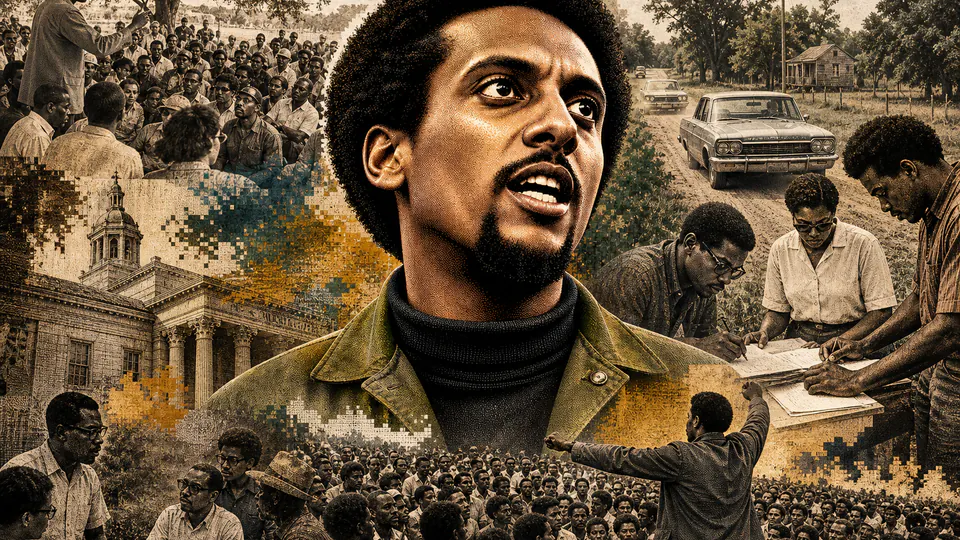
The story
#storyThe familiar version of Stokely Carmichael usually begins at the moment cameras, police, or a national audience arrived. That makes a clean story and a bad explanation. From SNCC field organizing to Black Power and Kwame Ture’s Pan-African politics. To understand that claim, the organizing before the famous scene and the institutions after it have to remain in view.
His shift from interracial direct action to Black Power grew from field experience with white violence, federal delay, and local institution building. That is the article’s measure of success. It asks who gained the power to make a decision, which rule changed, who remained outside it, and whether the gain lasted after attention moved elsewhere.
The conditions came before the headline
June 29, 1941: Born in Port of Spain, Trinidad. 1952: Moves to New York City and later attends the Bronx High School of Science. Those events established the field on which later choices were made. People did not enter it with equal money, legal standing, mobility, safety, or access to the press. An order that looked ordinary to those who administered it could feel like a permanent emergency to those made to live under it.
This context does not turn participants into passengers of large forces. It identifies the constraints they learned to use. A workplace schedule could become a contact list. A church, apartment, union hall, campus, newspaper, or neighborhood association could become an office. A court case could collect evidence for a campaign, while a campaign could make judges and officials understand that a case would not disappear without resistance.
Organization made the public moment possible
1961: Joins the Freedom Rides while a student at Howard University. 1964: Organizes in Mississippi during Freedom Summer. Neither development moved by reputation alone. Organizers needed places to meet, ways to settle disputes, trusted people who could carry information, money for food and transport, and plans for arrest, dismissal, or retaliation. That daily work determined who could remain involved when the first burst of attention ended.
Coalition added reach and friction. Participants could share a target while disagreeing about tactics, leadership, parties, weapons, negotiation, or the desired settlement. Those arguments were evidence of real stakes. Unity imposed from above would have hidden differences without resolving them. Durable cooperation required rules for making decisions and a distribution of risk that people considered fair enough to continue.
The link to civil rights is practical. Rights become usable through registration, representation, hearings, contracts, budgets, and enforcement. Moral language can name an injury. Organization identifies the person or institution able to stop it and creates a cost for refusal.
Conflict exposed where authority sat
1965: Helps build the Lowndes County Freedom Organization in Alabama. June 1966: Popularizes the call for Black Power during the Meredith March. At that point, opponents did more than offer a different opinion. They used the authority available to them: ownership, police, courts, party rules, licensing, hiring, firing, surveillance, or control of public information. The response reveals which interests a supposedly neutral system was prepared to protect.
Organizers also made choices under pressure. A dramatic tactic could bring attention while exhausting money. A legal compromise could protect people immediately while leaving a larger demand unanswered. Central leadership could coordinate action while silencing local knowledge. The right question is not whether every decision looks pure in hindsight. It is what alternatives existed, who bore their risks, and what the participants knew at the time.
This is where Black liberation enters the story. Work, housing, public space, education, policing, and voting were connected even when law placed them in separate boxes. A person blocked in one institution arrived at the next with fewer resources. Organizing across those boundaries could create power, but it also required more time and broader accountability.
A result is larger than a victory label
1967: Leaves SNCC leadership and works for a period with the Black Panther Party. 1969-1998: Lives in Guinea as Kwame Ture and organizes for Pan-African socialism. These later events prevent a simple ending. A campaign may lose its immediate demand and still train leaders, expose a system, or leave a tactic others can use. It may win a law whose exclusions reproduce part of the old order. It may build an organization that protects members while becoming less willing to take the risks that built it.
Black Power named self-determination but never had one program; electoral organizing, armed self-defense, socialism, culture, and nationalism competed within it. Naming that limit does not cancel the achievement. It identifies the next conflict and gives credit to people who challenged the movement from within. Race, gender, class, citizenship, occupation, sexuality, and disability affected who was heard and who could survive retaliation. These were contemporary disputes, not standards invented after the fact.
The economic questions also continued. union organizing concerns who controls the resources needed to act: wages, time, transport, care, land, credit, and public services. Formal access without those resources can leave a right unusable. Material gains without a protected voice can disappear when management or government changes direction.
The archive has interests too
No source type sees the whole event. Government files document what an agency counted, feared, or prosecuted, often in the agency’s own language. Organizational minutes show plans and votes but may omit informal labor. Newspapers capture public claims while repeating the prejudices of owners, editors, police, or advertisers. Oral histories restore texture and motive, though memory recorded later can compress dates and settle old arguments too neatly.
The responsible method is comparison. When several independent records agree, a claim grows stronger. When they conflict, the disagreement belongs in the story. A missing name can show who lacked formal authority, but absence from minutes does not prove absence from the work. A famous quotation should be traced to a recording, transcript, letter, or contemporary report before it carries an argument.
What this history leaves us
Stokely Carmichael matters because power was made visible in use. Participants learned which office could delay, which employer could punish, which law could be enforced, and which alliance could outlast a news cycle. Their answers were incomplete because all political answers are made under conditions they do not fully control.
The useful inheritance is therefore neither worship nor dismissal. Keep the organizing methods, measure the result, name the exclusions, and follow the institution after the celebration. That approach preserves drama without turning history into a poster. It also preserves the people whose patient work made the remembered moment possible.
Strategy can be measured in resources
His shift from interracial direct action to Black Power grew from field experience with white violence, federal delay, and local institution building. The sentence becomes more concrete when translated into resources. Who controlled the meeting room, membership list, printing bill, defense fund, car, telephone, childcare, food, medical help, or legal filing? Who could miss a shift, and who lost rent money by doing so? Those questions explain why an idea that sounded popular might remain weak and why a smaller group with trusted organization could alter an institution.
Opponents performed the same calculation. Delay could drain a strike fund or outlast public attention. Selective concessions could separate a coalition. Arrest or firing could remove a local leader without answering the demand. A hearing could collect testimony while postponing enforcement. A sympathetic statement could preserve an official’s reputation at lower cost than changing a budget or rule. Strategy meant recognizing those moves early enough to answer them.
Black Power named self-determination but never had one program; electoral organizing, armed self-defense, socialism, culture, and nationalism competed within it. The limit belongs inside the account because it affected the available strategy. People excluded from leadership often saw danger first. They knew which promise could not be enforced, which compromise shifted costs downward, and which supporter would leave after the photograph. Their criticism was organizational knowledge, even when officers treated it as disloyalty.
Three measures help separate durable change from ceremony. Capacity asks whether more people could act together after the campaign. Distribution asks who received money, time, safety, standing, or control. Enforcement asks what happened when an employer, agency, or leader ignored the new rule. A result can score well on one measure and poorly on another. That mixed finding is more informative than forcing the story into triumph or failure.
It also keeps the history alive without pretending the present is identical. The names of agencies, industries, and organizations change. The work of building trust, sharing risk, recording decisions, testing a promise, and preparing for retaliation remains recognizable. Stokely Carmichael offers evidence about that work, including evidence of what could not be solved in one campaign or one lifetime.
In their own words
#wordsWhat Stokely Carmichael actually said, where, and when. Each one links to the page it was checked against.
-
BLACK POWER can be clearly defined for those who do not attach the fears of white America to their questions about it.
From "What We Want," his own essay published in The New York Review of Books, September 22, 1966. Stokely Carmichael, "What We Want" (September 22, 1966) -
Black people do not want to 'take over' this country. They don't want to 'get whitey'; they just want to get him off their backs, as the saying goes.
From the same essay, answering the charge that Black Power meant coming for white people, September 22, 1966. Stokely Carmichael, "What We Want" (September 22, 1966) -
Only black people can convey the revolutionary idea that black people are able to do things themselves.
From "What We Want," September 22, 1966. Stokely Carmichael, "What We Want" (September 22, 1966) -
Integration today means the man who 'makes it,' leaving his black brothers behind in the ghetto as fast as his new sports car will take him.
From "What We Want," September 22, 1966. Stokely Carmichael, "What We Want" (September 22, 1966) -
Black people must do things for themselves; they must get poverty money they will control and spend themselves, they must conduct tutorial programs themselves so that black children can identify with black people.
From "What We Want," September 22, 1966. Stokely Carmichael, "What We Want" (September 22, 1966)
What people get wrong
#wrong- The myth
Black Power was a call for anti-white violence. - The record
In the essay that laid the term out for a national audience, Carmichael wrote that Black people did not want to take over the country or, in his words, get whitey, but to get him off their backs. He faulted the press in the same piece for reading the slogan as racism or separatism.
- The myth
Carmichael invented the phrase Black Power out of nothing in June 1966. - The record
The phrase was already in use. Richard Wright titled a 1954 book with it, Grace Lee Boggs and James Boggs organized a National Organization for Black Power in 1965, and Adam Clayton Powell Jr. used it at Howard University on May 29, 1966. Carmichael's June 16, 1966 speech in Greenwood, Mississippi, made it a movement slogan. He carried it, he did not coin it.
- The myth
His years in Guinea after 1969 were a retreat from politics. - The record
He spent the next twenty-nine years organizing across the African diaspora through the All-African People's Revolutionary Party. He took the name Kwame Ture in 1978 for Kwame Nkrumah and Sekou Toure, and he kept organizing the annual African Liberation Day gatherings in Washington, D.C. until his death in 1998.
The dates that matter
#dates- June 29, 1941 Born in Port of Spain, Trinidad.
- 1952 Moves to New York City and later attends the Bronx High School of Science.
- 1961 Joins the Freedom Rides while a student at Howard University.
- 1964 Organizes in Mississippi during Freedom Summer.
- 1965 Helps build the Lowndes County Freedom Organization in Alabama.
- June 1966 Popularizes the call for Black Power during the Meredith March.
- 1967 Leaves SNCC leadership and works for a period with the Black Panther Party.
- 1969-1998 Lives in Guinea as Kwame Ture and organizes for Pan-African socialism.
Questions people ask
#faqsWhat was Stokely Carmichael known for?
From SNCC field organizing to Black Power and Kwame Ture's Pan-African politics
Why does Stokely Carmichael matter?
His shift from interracial direct action to Black Power grew from field experience with white violence, federal delay, and local institution building.
What is often left out of this history?
Black Power named self-determination but never had one program; electoral organizing, armed self-defense, socialism, culture, and nationalism competed within it.
How should the evidence be read?
Compare official records with movement papers, contemporary reporting, and participant accounts, because each preserves different actions and interests.
The bookshelf
#bookshelfWhere to go next. Buy from an independent bookstore, or find it at your library for nothing.
-
Black Power: The Politics of Liberation Stokely Carmichael (Kwame Ture) and Charles V. Hamilton, 1967 primary
The book-length argument behind the slogan, written the year after the Meredith March.
-
Ready for Revolution: The Life and Struggles of Stokely Carmichael (Kwame Ture) Kwame Ture and Ekwueme Michael Thelwell, 2003 primary
His own autobiography, published five years after his death.
-
Stokely: A Life Peniel E. Joseph, 2014 secondary
The standard modern biography, covering SNCC through his Guinea years.
Wear it: Stokely Carmichael
#merchEvery design here links back to this page.
Sources
#sourcesPrimary sources
The documents themselves: laws, court opinions, speeches, letters, and the numbers from the agencies that count them.
Secondary sources
Written afterward, about the story.