Published
Pauline Newman
Pauline Newman Took the Triangle Factory's Lessons Into a Union Clinic
Born October 18, 1887. Died April 8, 1986
Pauline Newman moved from child labor at the Triangle factory to garment organizing, factory investigation, suffrage, and worker-run health care.
The story
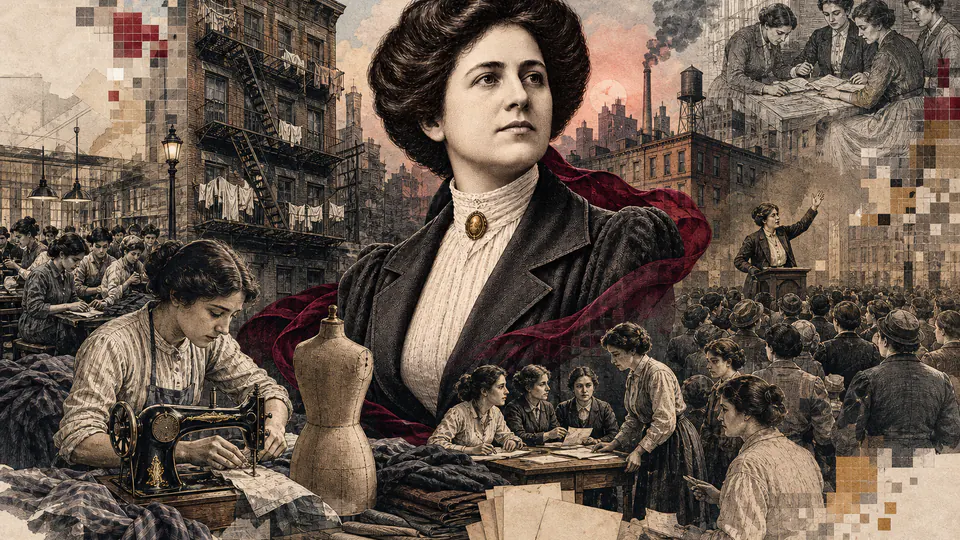
#storyPauline Newman entered the Triangle Shirtwaist Factory as a child and later described days arranged by the machine: early arrival, repetitive work, long hours, and little air worth breathing. She did not remember the factory merely as a terrible building. She remembered why workers stayed. A family needed the pay, other jobs could be worse, and an employer could replace a protester by lunchtime.
That attention to constraint shaped her politics. Newman organized for wages, but she also organized around rent, law, suffrage, education, and medical care. A worker’s life did not divide itself into neat departments. Her institutions should not either.
A child worker built a study circle
Newman was born in the Russian Empire, in territory now part of Lithuania, in the late 1880s. After her father died, she immigrated to New York with her mother and sisters in 1901. Formal schooling quickly gave way to paid work.
At Triangle, Newman taught herself English and read the Yiddish socialist press. She organized discussion groups among coworkers. The study circle was modest but strategic: workers who could name the system around them were better prepared to change it. Reading and organizing became parts of the same practice.
The shop also showed the power employers gained from immigration status, youth, and gender. Garment manufacturers relied on young Jewish and Italian women, then treated their wages as secondary family income. The workers knew otherwise. Their pay kept households fed.
The rent bill belonged in labor politics
In 1907, as landlords raised rents on the Lower East Side, Newman helped organize a rent strike involving thousands of families. The action widened the meaning of a worker campaign. A wage increase could disappear into a landlord’s demand; a union that ignored housing costs defended only half a paycheck.
The rent strike also placed women at the center. Women dealt with landlords, household budgets, and eviction threats. Those responsibilities created organizing knowledge even when unions failed to recognize it as such.
Newman carried that knowledge into the garment drive that produced the 1909 shirtwaist strike. Tens of thousands walked out. Pickets met arrests, employer violence, winter weather, and hunger. Wealthy supporters could attract press and restrain some police abuse, but workers supplied the strike’s risk and endurance.
A breakthrough strike left unfinished business
The 1909 action won improvements in many shops and made Newman the ILGWU’s first full-time woman organizer. She traveled to organize garment workers in other cities. The work exposed an old labor problem: male leaders praised women on a mass picket line while denying them authority inside the union.
Then the Triangle Shirtwaist Factory fire killed 146 workers on March 25, 1911. Newman no longer worked there, but former coworkers and friends did. The fire demonstrated what a partial settlement could not accomplish. Some Triangle workers had returned without union recognition, and locked exits, crowded floors, and weak enforcement remained lethal.
Grief did not automatically make reform. Organizers, survivors, investigators, and families had to convert public horror into rules that inspectors could enforce.
Investigation turned testimony into standards
Newman worked with the New York Factory Investigating Commission, alongside reformers including Frances Perkins. The commission examined buildings and heard workers describe industrial conditions. Its work contributed to a body of state fire, sanitation, and labor protections.
The process joined forms of knowledge that government often separates. Engineers could measure stairs and exits. Workers knew which doors bosses locked, when aisles filled with material, and whether a rule survived after an inspector left. Useful law required both.
Newman also campaigned for women’s suffrage. Voting rights would not abolish the factory system, but they could help working women choose lawmakers, influence enforcement, and speak as constituents rather than petitioners.
The union clinic carried organizing past the contract
Newman’s longest work took place at the ILGWU Union Health Center. Beginning during World War I, she spent decades in health education and administration. The clinic answered a plain fact: industrial work damaged bodies, and private medical care was often beyond a worker’s budget.
A worker-run health program could identify patterns that an individual doctor’s office missed. Repeated respiratory trouble, eye strain, exhaustion, and injuries pointed back to shop conditions. Care could relieve harm while its records strengthened demands for prevention.
The clinic also gave the union a daily presence in members’ lives. Bargaining happened at intervals. Illness did not keep that calendar. By treating health as a collective responsibility, garment workers built part of the social provision that employers and government had withheld.
Her archive keeps the worker’s reasoning intact
Newman lived until 1986 and left papers, letters, and an autobiography in archival collections. Her 1951 account of Triangle is valuable because it refuses the easy question of why workers tolerated bad conditions. They did not approve of them. They calculated among bad options while trying to organize better ones.
That distinction matters whenever a disaster is blamed on worker choice. A door can be physically present and still unavailable if it is locked. A job can be technically voluntary and still impossible to leave without rent money. Newman made those pressures visible, then built organizations capable of acting on them.
Her career moved from a factory study group to a rent strike, a general strike, a state investigation, and a union clinic. None solved the whole problem. Together they show a labor politics sized to the worker’s whole life.
Strategy can be measured in resources
Newman carried shop-floor knowledge from garment organizing into decades of union health, education, and labor-standards work. The sentence becomes more concrete when translated into resources. Who controlled the meeting room, membership list, printing bill, defense fund, car, telephone, childcare, food, medical help, or legal filing? Who could miss a shift, and who lost rent money by doing so? Those questions explain why an idea that sounded popular might remain weak and why a smaller group with trusted organization could alter an institution.
Opponents performed the same calculation. Delay could drain a strike fund or outlast public attention. Selective concessions could separate a coalition. Arrest or firing could remove a local leader without answering the demand. A hearing could collect testimony while postponing enforcement. A sympathetic statement could preserve an official’s reputation at lower cost than changing a budget or rule. Strategy meant recognizing those moves early enough to answer them.
Protective law could raise a floor while reinforcing sex divisions or excluding workers whose jobs fell outside its categories. The limit belongs inside the account because it affected the available strategy. People excluded from leadership often saw danger first. They knew which promise could not be enforced, which compromise shifted costs downward, and which supporter would leave after the photograph. Their criticism was organizational knowledge, even when officers treated it as disloyalty.
Three measures help separate durable change from ceremony. Capacity asks whether more people could act together after the campaign. Distribution asks who received money, time, safety, standing, or control. Enforcement asks what happened when an employer, agency, or leader ignored the new rule. A result can score well on one measure and poorly on another. That mixed finding is more informative than forcing the story into triumph or failure.
It also keeps the history alive without pretending the present is identical. The names of agencies, industries, and organizations change. The work of building trust, sharing risk, recording decisions, testing a promise, and preparing for retaliation remains recognizable. Pauline Newman offers evidence about that work, including evidence of what could not be solved in one campaign or one lifetime.
In their own words
#wordsWhat Pauline Newman actually said, where, and when. Each one links to the page it was checked against.
-
if you don't come in on Sunday you need not come in on Monday
In a letter written May 1951 aboard the SS Liberte, en route to an International Labour Organization meeting in Geneva, recalling the rule at the Triangle Shirtwaist Factory when she started around 1901. Pauline Newman, letter to Michael and Hugh Owens (May 1951), Papers of Pauline Newman -
my starting wage was just one dollar and a half a week -- a long week
In the same May 1951 letter, describing her pay as a child worker at the Triangle Shirtwaist Factory. Pauline Newman, letter to Michael and Hugh Owens (May 1951), Papers of Pauline Newman -
The job was not strenuous. It was tedious.
In an undated memoir among her papers at Harvard's Schlesinger Library, describing her earliest garment work sewing buttons on shirtwaists. Pauline Newman, unpublished memoir, Papers of Pauline Newman, Schlesinger Library, Radcliffe Institute, Harvard University -
One gets used to a place even if it is only a work shop. One gets to know the people you work with.
In the same undated memoir, explaining why child workers like her stayed in factory jobs they knew were bad. Pauline Newman, unpublished memoir, Papers of Pauline Newman, Schlesinger Library, Radcliffe Institute, Harvard University
What people get wrong
#wrong- The myth
Pauline Newman was working at the Triangle Shirtwaist Factory, or died there, when the fire broke out on March 25, 1911. - The record
By the time of the fire she was no longer employed at the factory, having become a full-time organizer for the International Ladies' Garment Workers' Union in 1909. Many of her former coworkers and friends died in it, but she was not among the 146 killed.
- The myth
The Triangle Shirtwaist Company recognized the union and fixed its safety hazards after the big 1909-1910 shirtwaist strike, so the 1911 fire was an unforeseeable accident. - The record
Triangle's owners, Max Blanck and Isaac Harris, refused to sign the union agreement most other shops accepted when the citywide strike settled in February 1910, and did not address the locked doors and blocked fire escapes that killed 146 workers thirteen months later.
- The myth
Pauline Newman founded the International Ladies' Garment Workers' Union. - The record
The ILGWU was founded June 3, 1900, in New York City by delegates from seven existing local unions, when Newman was still a child in Lithuania. She joined the labor movement as a Triangle factory worker years later and became the union's first full-time woman organizer during the 1909 strike.
The dates that matter
#dates- October 18, 1887 Born near Kaunas in the Russian Empire, now Lithuania.
- 1901 Immigrates with her mother and sisters to New York City.
- Early 1900s Works at the Triangle Shirtwaist Factory and organizes worker study groups.
- 1907 Helps lead a Lower East Side rent strike.
- 1909 Organizes during the shirtwaist strike and becomes an ILGWU organizer.
- March 25, 1911 The Triangle fire kills 146 workers, including former coworkers and friends.
- 1910s Works with the New York Factory Investigating Commission.
- 1918 Begins work with the ILGWU health program.
- 1951 Writes a firsthand account of working at Triangle while traveling to an International Labour Organization meeting.
- April 8, 1986 Dies in New York City.
Questions people ask
#faqsWho was Pauline Newman?
Pauline Newman was an immigrant garment worker, socialist, union organizer, suffragist, factory investigator, and labor health educator.
Did Pauline Newman work at the Triangle Shirtwaist Factory?
Yes. She worked there as a young garment worker but had left the factory before the 1911 fire.
What was Newman's role in the 1909 shirtwaist strike?
She helped organize garment workers and became the first full-time woman organizer for the International Ladies' Garment Workers' Union.
Why did Newman work in union health care?
Factory work produced illness and injury while many workers lacked affordable care. The union clinic made health part of collective worker protection.
The bookshelf
#bookshelfWhere to go next. Buy from an independent bookstore, or find it at your library for nothing.
-
Common Sense and a Little Fire: Women and Working-Class Politics in the United States, 1900-1965 Annelise Orleck, 1995 secondary
The standard group biography, built on Newman's own papers alongside Rose Schneiderman, Fannia Cohn, and Clara Lemlich.
-
The Triangle Fire Leon Stein, 1962 secondary
The classic account of the fire, built from survivor testimony including Newman's generation of Triangle workers.
-
Triangle: The Fire That Changed America David Von Drehle, 2003 secondary
Traces the story back through the 1909 strike Newman helped organize, to the fire two years later.
Wear it: Pauline Newman
#merchEvery design here links back to this page.
Sources
#sourcesPrimary sources
The documents themselves: laws, court opinions, speeches, letters, and the numbers from the agencies that count them.
Secondary sources
Written afterward, about the story.
- Cornell Kheel Center, Pauline Newman photograph and biography
- Cornell Kheel Center, Pauline M. Newman autobiography guide
- National Library of Medicine, Pauline Newman and worker health
- Library of Congress, ILGWU research guide
- Occupational Safety and Health Administration, Triangle fire
- Wikipedia, "New York shirtwaist strike of 1909"
- Wikipedia, "International Ladies' Garment Workers' Union"