Published
Mary Kenney O'Sullivan
Mary Kenney O'Sullivan Organized Women the AFL Had Overlooked
Born January 8, 1864. Died January 18, 1943
Mary Kenney O'Sullivan built unions among women bookbinders, became the AFL's first woman general organizer, and helped found the Women's Trade Union League.
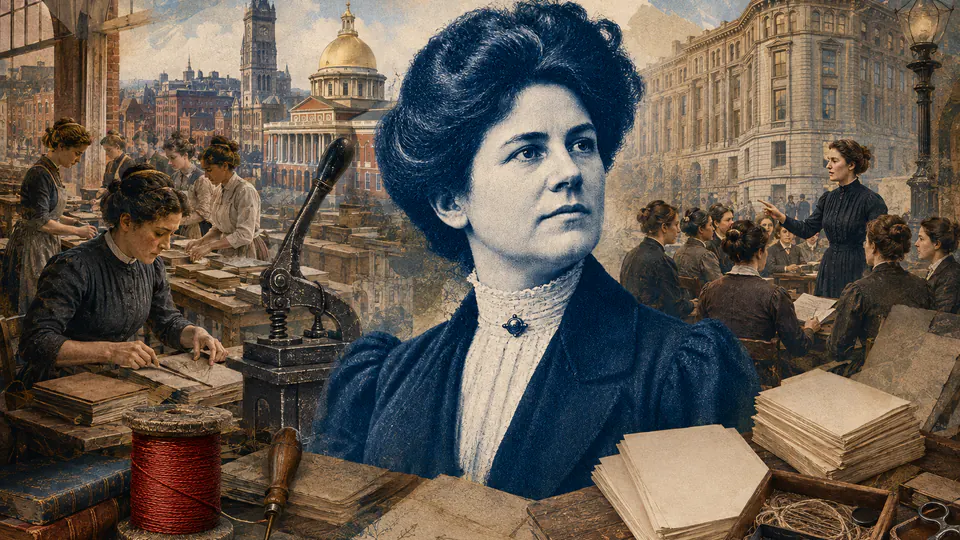
The story
#storyThe American Federation of Labor did not discover women workers when it hired Mary Kenney in 1892. Women had been binding books, sewing clothes, making shoes, packing food, and trying to organize those shops for years. The appointment mattered because a national federation finally paid a woman to do work women were already doing without its backing.
Kenney’s problem was larger than persuading employers. Many male trade unionists saw women as short-term workers who would leave after marriage, accept low wages, or undercut union standards. Employers helped create those conditions, then cited them as proof that women could not be organized. Kenney spent her career breaking that circle.
The bindery was her organizing school
Born in Hannibal, Missouri, in 1864, Kenney entered the printing trades and moved to Chicago. Bookbinding shops divided work and pay by gender. Skilled status, promotion, and the better wages usually went to men, while women handled repetitive jobs for less.
Kenney helped organize women bindery workers in the late 1880s. Shop-floor organizing taught her the durable lessons of unions: organizers had to reach workers where they lived, make dues possible on low wages, answer fears about dismissal, and treat women’s complaints as labor questions rather than private troubles.
She came into contact with Hull House reformers, including Jane Addams and Florence Kelley. That relationship gave labor campaigns meeting rooms, publicity, and allies who could press government. It also placed a working woman among wealthier reformers whose assumptions she did not always share.
One national appointment could not fix a federation
In 1892, AFL president Samuel Gompers appointed Kenney as a general organizer, the first woman to hold that job. She traveled and spoke for organization among garment workers, printers, and other trades. The title opened doors, but the appointment lasted less than a year.
The short tenure showed the contradiction inside the federation. AFL leaders wanted to claim women workers while devoting limited money and authority to organizing them. Craft unions built around skilled male trades often had little structure for the factories and service jobs where women worked. Kenney could recruit workers, but no single organizer could reverse those priorities.
Her appointment still changed the terms of the argument. A woman had represented the federation, and women workers could point to organized shops rather than promises about what might be possible.
Boston widened the field
Kenney married labor editor John O’Sullivan in 1894 and moved to Boston. She continued labor work while raising three children. After her husband died in 1902, paid organizing and public employment also became matters of household survival.
She worked with state factory inspection and campaigned for laws governing hours and conditions. Inspection did not replace union power. It created a second route for enforcing minimum standards, especially where employers had defeated organizing or workers faced immediate hazards.
O’Sullivan also supported women’s suffrage. A ballot could affect factory law, public appointments, and the officials responsible for enforcement. Her labor politics made suffrage concrete: voting was one instrument working women could use against an employer’s political influence.
The league joined workers and reformers
In 1903, O’Sullivan helped found the National Women’s Trade Union League. The league connected women unionists with affluent supporters. It raised strike funds, arranged legal help, publicized abuses, trained organizers, and backed labor legislation. During major garment strikes, those resources could keep a picket line alive.
The coalition was never socially simple. Working-class members had direct knowledge of the shop and needed organizations they controlled. Wealthier allies often had money, press access, and legislative connections but could treat workers as objects of reform. Racial exclusion within many unions and reform groups also limited claims of universal sisterhood.
O’Sullivan worked inside that tension because workers needed durable institutions, not perfect company. The league helped women such as Rose Schneiderman move between union halls, public investigations, and legislative campaigns. It also provided a national meeting place for arguments that the labor movement had tried to postpone.
Her method was institutional, not ceremonial
O’Sullivan remained active in labor, suffrage, peace, and reform causes into later life. Her papers preserve correspondence and writing rather than a single famous speech. That is fitting. Her contribution was a chain of organizations: a local union, a national appointment, an inspection office, and a league able to support the next strike.
The record also warns against telling women’s labor history as a sequence of benevolent invitations. Kenney was admitted to the AFL staff after women had proved they could organize. The federation’s recognition was narrow and temporary. Women workers built their own support networks because established institutions kept finding reasons to wait.
O’Sullivan died in 1943. By then, women had become indispensable to mass-production unions and wartime industry. They still faced segregated jobs, unequal pay, and leadership barriers. Her answer remained available: organize the job as it exists, build alliances without surrendering worker control, and turn a lone appointment into an institution that can outlast the person who holds it.
Strategy can be measured in resources
O’Sullivan organized women in factories before the AFL briefly made her its first woman general organizer, then built institutions that could outlast a single appointment. The sentence becomes more concrete when translated into resources. Who controlled the meeting room, membership list, printing bill, defense fund, car, telephone, childcare, food, medical help, or legal filing? Who could miss a shift, and who lost rent money by doing so? Those questions explain why an idea that sounded popular might remain weak and why a smaller group with trusted organization could alter an institution.
Opponents performed the same calculation. Delay could drain a strike fund or outlast public attention. Selective concessions could separate a coalition. Arrest or firing could remove a local leader without answering the demand. A hearing could collect testimony while postponing enforcement. A sympathetic statement could preserve an official’s reputation at lower cost than changing a budget or rule. Strategy meant recognizing those moves early enough to answer them.
Cross-class alliances supplied money and access while leaving working women to fight for control of programs conducted in their name. The limit belongs inside the account because it affected the available strategy. People excluded from leadership often saw danger first. They knew which promise could not be enforced, which compromise shifted costs downward, and which supporter would leave after the photograph. Their criticism was organizational knowledge, even when officers treated it as disloyalty.
Three measures help separate durable change from ceremony. Capacity asks whether more people could act together after the campaign. Distribution asks who received money, time, safety, standing, or control. Enforcement asks what happened when an employer, agency, or leader ignored the new rule. A result can score well on one measure and poorly on another. That mixed finding is more informative than forcing the story into triumph or failure.
It also keeps the history alive without pretending the present is identical. The names of agencies, industries, and organizations change. The work of building trust, sharing risk, recording decisions, testing a promise, and preparing for retaliation remains recognizable. Mary Kenney O’Sullivan offers evidence about that work, including evidence of what could not be solved in one campaign or one lifetime.
In their own words
#wordsWhat Mary Kenney O'Sullivan actually said, where, and when. Each one links to the page it was checked against.
-
We were drowning men ready to grasp at a straw when the Industrial Workers of the World appeared to save us.
On why the Lawrence strikers turned to the IWW, in "The Labor War at Lawrence," Survey, April 6, 1912. Mary K. O'Sullivan, "The Labor War at Lawrence," Survey (April 6, 1912) -
In the past the foreigners have been the element through which strikes in the textile industry have been lost.
On why employers had counted on ethnic division among mill workers, in the same 1912 Survey article. Mary K. O'Sullivan, "The Labor War at Lawrence," Survey (April 6, 1912) -
In four days he organized a fighting unit such as never existed in New England before.
On IWW organizer Joseph Ettor's speed in building the Lawrence strike committee, in the same 1912 Survey article. Mary K. O'Sullivan, "The Labor War at Lawrence," Survey (April 6, 1912) -
Catholics, Jews, Protestants, and unbelievers -- men and women of many races and languages -- were working together as human beings with a common cause.
On the strike committee's makeup at Lawrence, in the same 1912 Survey article. Mary K. O'Sullivan, "The Labor War at Lawrence," Survey (April 6, 1912) -
The American Federation of Labor alone refused to cooperate.
On the AFL's response to the Lawrence strike, in the same 1912 Survey article. Mary K. O'Sullivan, "The Labor War at Lawrence," Survey (April 6, 1912)
What people get wrong
#wrong- The myth
O'Sullivan's 1892 AFL appointment showed the federation was committed to organizing women. - The record
She spent only several months as general organizer before the post ended, and encyclopedia sources trace her limited results to the AFL's own ambivalence about unionizing women workers, not to any failure on her part.
- The myth
O'Sullivan and the Women's Trade Union League never broke ranks. - The record
She resigned from the league in 1912 to protest its inadequate support for the striking Lawrence textile workers, the strike she covered firsthand for Survey.
- The myth
Marriage and motherhood ended O'Sullivan's working life. - The record
After her husband John O'Sullivan died in 1902, she took paid work managing a tenement while raising three children, and in 1914 became one of five women named to the newly created Massachusetts State Board of Labor and Industries, serving as a factory inspector there until 1934.
The dates that matter
#dates- January 8, 1864 Born Mary Kenney in Hannibal, Missouri.
- 1880s Works in the printing and bookbinding trades and becomes active in Chicago labor organizing.
- 1888 Helps organize women bindery workers in Chicago.
- 1892 The American Federation of Labor appoints her its first woman general organizer.
- 1894 Marries labor editor John O'Sullivan and settles in Boston.
- 1903 Helps found the National Women's Trade Union League.
- 1910s Works in factory inspection and campaigns for labor legislation and suffrage.
- January 18, 1943 Dies in Massachusetts.
Questions people ask
#faqsWho was Mary Kenney O'Sullivan?
Mary Kenney O'Sullivan was a bookbinder, union organizer, factory inspector, suffragist, and co-founder of the National Women's Trade Union League.
What first did Mary Kenney O'Sullivan achieve in the AFL?
In 1892 she became the first woman appointed as a general organizer by the American Federation of Labor.
What was the Women's Trade Union League?
Founded in 1903, the league brought women wage earners and middle-class reformers together to support union drives, strikes, labor laws, and women's suffrage.
Did O'Sullivan only work in unions?
No. She also worked as a factory inspector and supported suffrage, protective labor laws, peace organizing, and public programs for working women.
The bookshelf
#bookshelfWhere to go next. Buy from an independent bookstore, or find it at your library for nothing.
-
The Necessity of Organization: Mary Kenney O'Sullivan and Trade Unionism for Women, 1892-1912 Kathleen Banks Nutter, 2016 secondary
The standard biography, focused on her first two decades as an organizer.
-
As Equals and as Sisters: Feminism, the Labor Movement, and the Women's Trade Union League of New York Nancy Schrom Dye, 1980 secondary
The alliance and the friction between wage earners and reformers that O'Sullivan navigated.
Wear it: Mary Kenney O'Sullivan
#merchEvery design here links back to this page.

Sources
#sourcesPrimary sources
The documents themselves: laws, court opinions, speeches, letters, and the numbers from the agencies that count them.
- Schlesinger Library, Papers of Mary Kenney O'Sullivan
- National Archives, Papers of the Women's Trade Union League
- Library of Congress, National Women's Trade Union League records
- Chicago History Museum, Mary Kenney O'Sullivan collection
- Mary K. O'Sullivan, "The Labor War at Lawrence," Survey (April 6, 1912)
Secondary sources
Written afterward, about the story.