Published
Septima Clark
Septima Clark Turned a Literacy Test Into a Citizenship School
Born May 3, 1898. Died December 15, 1987
Septima Clark built citizenship schools that taught reading through voter registration, creating grassroots leadership across the South.
The story
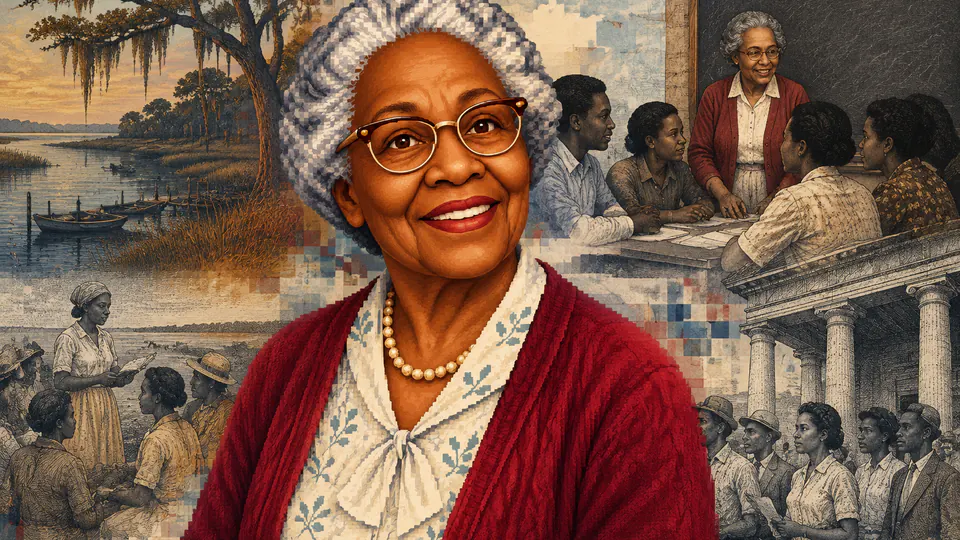
#storySouth Carolina used literacy tests to block Black citizens from voting. Septima Clark, Esau Jenkins, Bernice Robinson, and Johns Island residents turned the barrier into a curriculum. Citizenship-school students learned to read the registration form, write a check, understand local government, and teach the next class.
The schools did not treat adults as empty desks. Lessons began with the problems they needed to solve.
Teaching was political before the school had a name
Clark was born in Charleston in 1898. The city refused to hire Black teachers, so she began in a one-room school on Johns Island in 1916. She joined the NAACP and helped campaign to open Charleston teaching jobs and equalize Black teachers’ pay.
In 1956 South Carolina banned public employees from NAACP membership. Clark refused to quit and was fired after four decades in education.
Johns Island wrote the model
At Highlander Folk School, Clark worked with Jenkins and Robinson on an adult program rooted in the Sea Islands. Robinson taught the first classes at the Progressive Club. Students studied through everyday material and prepared for hostile registrars.
SCLC took over the program in 1961 and spread schools across the South. Clark directed education and trained teachers. The classes supported the organizing behind Freedom Summer, Selma, and local campaigns that national accounts often attribute to whoever held the largest microphone.
Clark retired from SCLC in 1970 and remained active in Charleston. She died in 1987. Citizenship schools worked because they joined a specific obstacle to local authority: pass the test, register, teach a neighbor, and learn enough about the county office to make it answer the phone.
The model spread because it could be adapted. Teachers used familiar people and places in reading exercises, held classes around work schedules, and connected each lesson to a task participants wanted to complete. Highlander trained local instructors rather than sending permanent outside staff. When Tennessee revoked the school’s charter, SCLC took over the program and expanded it across the South. Clark’s work supplied an organizational bridge between adult education and mass campaigns: thousands of new voters arrived with teachers, meeting habits, and local networks attached.
Charleston denied Black teachers access to its classrooms
Clark was born in Charleston in 1898 and trained as a teacher. The city did not hire Black educators in its public schools, so she began work on rural Johns Island. The school had fewer resources than white schools and required teachers to adapt lessons to students’ lives and the materials available.
Teaching quickly led to political action. Clark worked with the NAACP on a campaign that opened Charleston public-school positions to Black teachers. She later supported litigation for equal teacher pay. The victories joined employment, public budgets, and racial equality.
Classroom work taught her to begin with what students knew. That principle would later distinguish citizenship schools from programs that treated adults as deficient people waiting for an outside expert.
The state turned NAACP membership into a firing offense
South Carolina passed a law barring public employees from belonging to the NAACP. Clark had spent decades teaching and organizing through the association. In 1956 she refused to give up membership and lost her job and pension.
The punishment shows how segregation defended itself beyond a polling place. A teacher could be forced to choose between livelihood and the organization contesting unequal schools and disfranchisement. Professional status offered no safe distance from the system.
Clark’s firing freed her for movement work while imposing a severe personal cost. It also supplied an exact lesson for students: citizenship rights existed on paper while the state punished people who organized to use them.
Highlander joined local design to regional training
Clark worked at Highlander Folk School in Tennessee, a labor and civil-rights education center. Esau Jenkins, a Johns Island organizer who transported workers to Charleston, identified literacy requirements as a barrier to voting and helped develop the school idea.
Bernice Robinson, a beautician rather than a certified teacher, led the first classes at the Progressive Club. That choice reduced the hierarchy adults associated with formal schooling. Lessons used mail-order forms, newspapers, checks, and registration questions instead of children’s textbooks.
The curriculum aimed beyond passing a test. Students learned how government offices worked, discussed community problems, and gained practice leading others. Literacy became a route into public authority.
The state closed one school and spread the model
Tennessee revoked Highlander’s charter in 1961 after years of attacks on the school’s integration and politics. Confiscation of the site did not erase the program. The Southern Christian Leadership Conference took over the Citizenship Education Program, with Clark directing education and Dorothy Cotton and Andrew Young among the staff.
SCLC could carry training across a larger region. Local people became teachers and adapted material to county conditions. A centralized movement supplied resources while knowledge and leadership stayed rooted in community.
This arrangement was not free of hierarchy. Clark criticized sexism within movement leadership and the tendency to credit prominent ministers for work women administered. Citizenship schools showed why leadership development matters only if graduates receive room to lead.
Registration was one step in a longer chain
Literacy tests were deliberately arbitrary. Registrars could accept a white applicant’s answer and reject a Black applicant’s identical one. Education prepared people for the form, but organizing and federal enforcement were needed against officials committed to denial.
School participants supported voter drives, Freedom Schools, local campaigns, and the movement surrounding Freedom Summer. They brought skills in recordkeeping, public speaking, transportation, and meeting procedure.
The Voting Rights Act of 1965 gave the federal government stronger tools against such barriers. Its effect depended on residents willing to apply, document obstruction, and keep political organizations active after registration.
Adult education redistributed who could speak
Clark objected to teaching that placed all knowledge at the front of the room. Adults brought work, family, church, agricultural, and community experience. A useful teacher connected that knowledge to reading and political procedure.
The method changed the organizer’s role. Success was not a classroom dependent on the same charismatic instructor. It was a student ready to teach the next group, chair a meeting, challenge an official, and revise the lesson for a new problem.
Clark died in 1987 after returning to Charleston and remaining active in public life. Her citizenship schools are sometimes reduced to a clever response to a literacy test. Their larger purpose was democratic multiplication. The state had used education as a gate. Clark turned it into a way for people to build and guard gates of their own.
In their own words
#wordsWhat Septima Clark actually said, where, and when. Each one links to the page it was checked against.
-
The only thing I could see the teachers could do was to take you to the bathroom and back.
Describing the ABC gallery system in Charleston's segregated public schools, in a July 25, 1976 oral history interview for the Southern Oral History Program. Oral history interview with Septima Poinsette Clark, July 25, 1976, Southern Oral History Program #4007 -
Communication was poor, and transportation was more so. There weren't any bridges.
Explaining why she had no contact with the Penn School despite teaching nearby on Johns Island in the late 1910s, in the same 1976 interview. Oral history interview with Septima Poinsette Clark, July 25, 1976, Southern Oral History Program #4007 -
When I joined, it wasn't but a dollar a year.
Recalling her introduction to the NAACP around 1919 to 1920 through Presbyterian ministers visiting Johns Island, in the same 1976 interview. Oral history interview with Septima Poinsette Clark, July 25, 1976, Southern Oral History Program #4007 -
I was able to get some affidavits from both white and black teachers about salaries and show the discrepancies.
Describing her role gathering evidence for the Columbia, South Carolina NAACP's equal-pay campaign for Black teachers in the 1940s, in the same 1976 interview. Oral history interview with Septima Poinsette Clark, July 25, 1976, Southern Oral History Program #4007 -
Don't ever think that everything went right. It didn't. Many times there were failures. But we had to mull over those failures and work until we could get them ironed out.
On the citizenship schools' record, in an interview drawn on by the SNCC Digital Gateway's profile of Clark. SNCC Digital Gateway, "Septima Clark"
What people get wrong
#wrong- The myth
Citizenship schools were just literacy classes. - The record
Lessons paired reading and writing with the mechanics of registering to vote, filling out forms, and running a meeting, and every class was meant to produce a new teacher for the next class. Highlander and SCLC measured the program by organizers made, not just readers taught.
- The myth
Male SCLC ministers ran the citizenship education program that trained thousands of organizers. - The record
Clark directed the Citizenship Education Program's staff and curriculum after SCLC took it over in 1961, with Bernice Robinson, Dorothy Cotton, and Andrew Young among her staff. Clark said later that the movement's credit went to the ministers who spoke from podiums rather than the women who ran the schools day to day.
- The myth
Clark's activism began with the citizenship schools in the 1950s. - The record
She had joined the NAACP around 1919 to 1920, campaigned to open Charleston's public school teaching jobs to Black educators in the 1920s, and helped gather the salary evidence behind the Columbia NAACP's equal-pay campaign for Black teachers in the 1940s, all before Highlander's first citizenship class met in 1957.
- The myth
Tennessee shutting down Highlander Folk School in 1961 ended the citizenship school program. - The record
The state revoked Highlander's charter and confiscated its Monteagle property, but the Citizenship Education Program itself transferred to SCLC that year and kept expanding across the South under Clark's direction; Highlander itself reorganized and reopened elsewhere.
The dates that matter
#dates- May 3, 1898 Born in Charleston, South Carolina.
- 1916 Begins teaching on Johns Island.
- 1920 A campaign opens Charleston public-school teaching to Black educators.
- 1945 Equal-pay litigation raises Black teachers' salaries.
- 1956 Loses her job for keeping NAACP membership.
- 1957 The first citizenship school begins on Johns Island.
- 1961 The citizenship program transfers from Highlander to SCLC.
- December 15, 1987 Dies on Johns Island.
Questions people ask
#faqsWho was Septima Clark?
Septima Clark was a South Carolina teacher and civil-rights organizer known for developing and spreading citizenship schools.
What were citizenship schools?
They were community-run classes that taught reading, writing, practical civic knowledge, and voter-registration skills while developing local organizers.
Why was Septima Clark fired?
South Carolina barred state employees from belonging to the NAACP in 1956. Clark refused to resign her membership and lost her teaching job.
How should Septima Clark be evaluated?
Separate the immediate result from the institutions, tactics, exclusions, and enforcement record that followed it.
The bookshelf
#bookshelfWhere to go next. Buy from an independent bookstore, or find it at your library for nothing.
-
Ready from Within: Septima Clark and the Civil Rights Movement Septima Clark, edited by Cynthia Stokes Brown, 1990 primary
Her own first-person narrative, told in interviews with Brown and drawing on her papers.
-
Echo in My Soul Septima Clark with LeGette Blythe, 1962 primary
Her first autobiography, written while the citizenship schools were still expanding.
-
Freedom's Teacher: The Life of Septima Clark Katherine Mellen Charron, 2009 secondary
The standard biography, built from Clark's papers and the archives of the schools she ran.
Wear it: Septima Clark
#merchEvery design here links back to this page.
Sources
#sourcesPrimary sources
The documents themselves: laws, court opinions, speeches, letters, and the numbers from the agencies that count them.
Secondary sources
Written afterward, about the story.