Published
Samuel Gompers
Samuel Gompers Built the AFL Around a Narrow, Durable Bargain
Born January 27, 1850. Died December 13, 1924
Samuel Gompers helped build the American Federation of Labor around skilled unions, collective bargaining, and political independence, with lasting gains and exclusions.
The story
#storySamuel Gompers helped build a labor federation that survived. That sentence explains both his achievement and the argument around it. The American Federation of Labor made collective bargaining a durable national institution for many skilled workers. It did so through a structure that left many other workers outside the door.
Gompers chose concentrated power over universal claims he believed could not be enforced. The result won contracts and institutional stability. It also narrowed who counted as the organized working class.
The cigar shop taught control of the trade
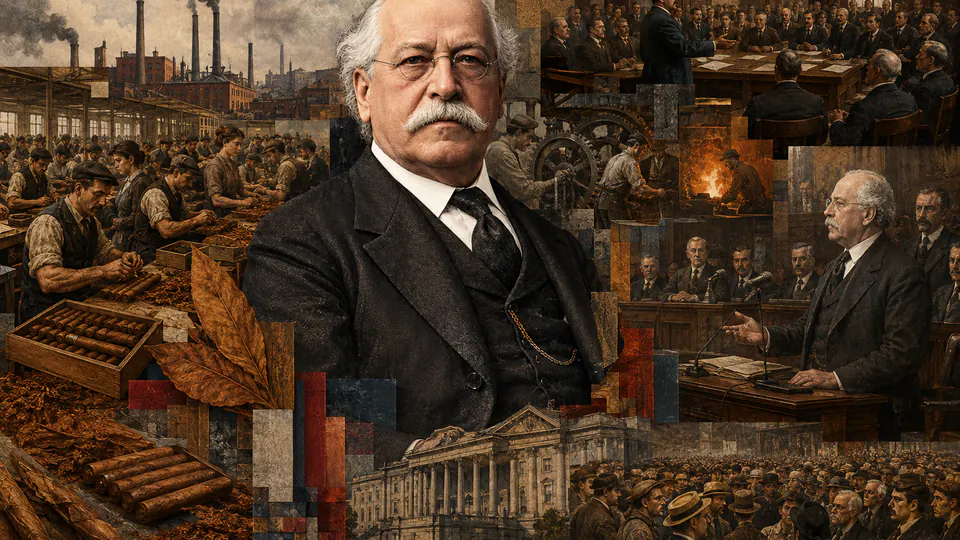
Gompers was born in London in 1850 and entered cigar making as a boy. His family immigrated to New York in 1863. He joined the Cigar Makers’ International Union and learned in shops where workers talked, read aloud, and controlled a skilled production process.
The cigar union suffered defeats, reorganized, and developed a system of dues and benefits. Gompers drew a lesson from that experience: a union needed money, administrative continuity, and authority rooted in the trade. Grand declarations without an organization able to sustain a strike were a poor substitute.
That view distinguished him from movements seeking one big organization of all producers or a rapid political reconstruction of the economy. Gompers was not uninterested in power. He wanted it accumulated through unions workers could keep alive.
The AFL was a federation, not one union
In 1886, craft unions formed the American Federation of Labor, and Gompers became its president. Affiliates retained substantial control over their jurisdictions, treasuries, and bargaining. The national body coordinated, issued charters, resolved disputes, and gave labor a public voice.
This arrangement attracted established unions wary of surrendering authority. It also produced jurisdictional conflict, as unions argued over which trade owned a task. Mass-production workplaces did not divide neatly into crafts, so organizing a whole factory could require negotiations among multiple affiliates before confronting the employer.
The AFL’s focus on wages, hours, and conditions became known as pure and simple unionism. The phrase can sound modest. A shorter workday or union wage required strikes, boycotts, and resistance to courts and police. The approach was practical, but never apolitical.
Stability had an exclusion bill
Craft structure favored workers with recognized skills and bargaining power. Women, Black workers, many recent immigrants, Asian workers, agricultural laborers, and workers in large unskilled factories were often excluded by affiliates or left with little support.
Gompers sometimes condemned racial division, but the federation tolerated segregated locals and discriminatory practices. He supported Chinese exclusion and later immigration restriction. Those policies treated workers from abroad as the danger rather than employers who used legal vulnerability and racial hostility to cut standards.
The appointment of Mary Kenney O’Sullivan as an AFL organizer in 1892 illustrates the limits of its approach to unions. Hiring the federation’s first woman general organizer acknowledged a need, but her tenure was brief and poorly backed. Recognition did not become a sustained organizing program, and later civil-rights struggles exposed how deeply exclusion had been built into labor institutions.
Politics meant pressure without a labor party
Gompers resisted binding labor to an independent political party. His rule was to reward friends and punish enemies, usually by pressuring candidates in the two major parties. He feared that electoral programs would divide unions and place workplace organizations under party control.
The policy let the AFL bargain with whoever held office. It also limited labor’s ability to develop a political program independent of those parties. Employers acted through law, courts, police, tariffs, and monetary policy. A movement centered on contracts could not avoid the state, even if it declined to build its own party.
Gompers increasingly lobbied federal officials and supported national legislation. The federation’s political independence was therefore tactical rather than a withdrawal from politics.
War brought access and discipline
During World War I, Gompers supported U.S. participation and cooperated with the Wilson administration. Organized labor gained representation on wartime boards, and the federal government sometimes encouraged bargaining to prevent production stoppages. Union membership grew during the war.
The partnership divided labor. Socialists, pacifists, and the Industrial Workers of the World opposed the war or conscription and faced repression. Gompers defended the war effort and attacked radical opponents. Government access came with pressure to discipline dissent and maintain production.
He later took part in international labor negotiations connected to the creation of the International Labour Organization. Here again, institutional recognition was real, while the terms favored labor leaders willing to operate inside a state-led settlement.
The narrow bargain shaped what followed
Gompers led the AFL for nearly its entire existence until his death in 1924. The federation survived depressions, employer offensives, injunctions, internal disputes, and rival movements. That durability gave millions of workers a base that outlived any single strike.
Industrial unionists later challenged the craft model by organizing entire plants through the CIO. Civil-rights unionists challenged racial exclusion. Women organizers built their own leagues and departments. Their work did not simply reject Gompers. It exposed the workers his bargain had failed to include.
His legacy is therefore neither a founder’s statue nor a list of betrayals. It is an institutional choice with consequences. Build where workers already have bargaining power, preserve union autonomy, seek enforceable gains, and distrust sweeping programs. That choice produced staying power. It also made labor weaker wherever employers could place excluded workers on the other side of the same shop floor.
Strategy can be measured in resources
Gompers built a durable federation by concentrating on trade autonomy, bargaining, and immediate workplace gains. The sentence becomes more concrete when translated into resources. Who controlled the meeting room, membership list, printing bill, defense fund, car, telephone, childcare, food, medical help, or legal filing? Who could miss a shift, and who lost rent money by doing so? Those questions explain why an idea that sounded popular might remain weak and why a smaller group with trusted organization could alter an institution.
Opponents performed the same calculation. Delay could drain a strike fund or outlast public attention. Selective concessions could separate a coalition. Arrest or firing could remove a local leader without answering the demand. A hearing could collect testimony while postponing enforcement. A sympathetic statement could preserve an official’s reputation at lower cost than changing a budget or rule. Strategy meant recognizing those moves early enough to answer them.
That model often excluded unskilled, Black, Asian, immigrant, and women workers and treated wider political demands as a threat to cohesion. The limit belongs inside the account because it affected the available strategy. People excluded from leadership often saw danger first. They knew which promise could not be enforced, which compromise shifted costs downward, and which supporter would leave after the photograph. Their criticism was organizational knowledge, even when officers treated it as disloyalty.
Three measures help separate durable change from ceremony. Capacity asks whether more people could act together after the campaign. Distribution asks who received money, time, safety, standing, or control. Enforcement asks what happened when an employer, agency, or leader ignored the new rule. A result can score well on one measure and poorly on another. That mixed finding is more informative than forcing the story into triumph or failure.
It also keeps the history alive without pretending the present is identical. The names of agencies, industries, and organizations change. The work of building trust, sharing risk, recording decisions, testing a promise, and preparing for retaliation remains recognizable. Samuel Gompers offers evidence about that work, including evidence of what could not be solved in one campaign or one lifetime.
In their own words
#wordsWhat Samuel Gompers actually said, where, and when. Each one links to the page it was checked against.
-
When I was ten years and three months I had to go to work.
On leaving school in London to work, from his autobiography, Seventy Years of Life and Labor (1925). Samuel Gompers, Seventy Years of Life and Labor: An Autobiography, vol. 1 (E. P. Dutton, 1925), Internet Archive -
It seemed to me that some great power for good had gone out of the world.
Recalling Lincoln's assassination, from his autobiography, Seventy Years of Life and Labor (1925). Samuel Gompers, Seventy Years of Life and Labor: An Autobiography, vol. 1 (E. P. Dutton, 1925), Internet Archive -
Socialists were doctrinaire internationalists who declared that the ties which bound together the working class of the world were stronger than the ties of country.
On Socialist opponents of the war, from his autobiography, Seventy Years of Life and Labor (1925). Samuel Gompers, Seventy Years of Life and Labor: An Autobiography, vol. 1 (E. P. Dutton, 1925), Internet Archive
What people get wrong
#wrong- The myth
Gompers was born in the United States. - The record
He was born in London in 1850 to a Jewish working-class family and, by his own account, went to work there at ten years and three months old before the family immigrated to New York in 1863.
- The myth
His 1913 line about "slavery" was a complaint about government control of labor. - The record
In that Senate testimony he used the word to describe what unchecked concentrated wealth and industry would do to individual workers who had no organization to answer it, an argument for unions, not against government.
- The myth
Gompers kept the AFL out of politics altogether. - The record
In the same 1913 testimony he described the AFL itself as "a movement and a federation founded as a replica of the American governments" and pressed Congress directly for the labor movement's demands, even while opposing a separate labor party.
The dates that matter
#dates- January 27, 1850 Born in London to a Jewish working-class family.
- 1863 Immigrates with his family to New York City.
- 1864 Joins the Cigar Makers' International Union.
- 1881 Helps establish the Federation of Organized Trades and Labor Unions.
- 1886 Helps found the American Federation of Labor and becomes its first president.
- 1894 The AFL declines to lead a general defense of the Pullman strike.
- 1906 The AFL issues Labor's Bill of Grievances and moves toward stronger national political pressure.
- 1917 Supports U.S. entry into World War I and serves on wartime labor bodies.
- 1919 Participates in the Paris Peace Conference and labor negotiations surrounding the ILO.
- December 13, 1924 Dies in San Antonio after returning from an international labor meeting.
Questions people ask
#faqsWho was Samuel Gompers?
Samuel Gompers was a cigar maker and the central founding leader of the American Federation of Labor, serving as its president for nearly all of 1886 through 1924.
What was pure and simple unionism?
It was an approach centered on workplace organization and attainable gains in wages, hours, and conditions, with unions retaining control over their own trades.
Why is Gompers controversial?
The AFL built durable skilled unions but often excluded or failed to organize workers outside its craft structure, and Gompers backed restrictive immigration policies and wartime cooperation.
Did Gompers support a labor party?
Generally no. He favored rewarding friendly candidates and opposing hostile ones within the existing party system rather than creating an independent workers' party.
The bookshelf
#bookshelfWhere to go next. Buy from an independent bookstore, or find it at your library for nothing.
-
Seventy Years of Life and Labor: An Autobiography Samuel Gompers, edited by Nick Salvatore, 1925 primary
His own account, from the London cigar shop to the AFL presidency.
-
Samuel Gompers and Organized Labor in America Harold C. Livesay, 1978 secondary
A standard short biography for the classroom shelf.
Wear it: Samuel Gompers
#merchEvery design here links back to this page.
Sources
#sourcesPrimary sources
The documents themselves: laws, court opinions, speeches, letters, and the numbers from the agencies that count them.
- Library of Congress, Samuel Gompers authority record
- Library of Congress, American Federation of Labor records
- National Archives, Records of the National War Labor Board
- Samuel Gompers, Seventy Years of Life and Labor: An Autobiography, vol. 1 (E. P. Dutton, 1925), Internet Archive
- University of Maryland, Samuel Gompers papers
Secondary sources
Written afterward, about the story.