Published
Marsha P. Johnson
Marsha P. Johnson Built Survival Into Gay Liberation
Born August 24, 1945. Died July 6, 1992
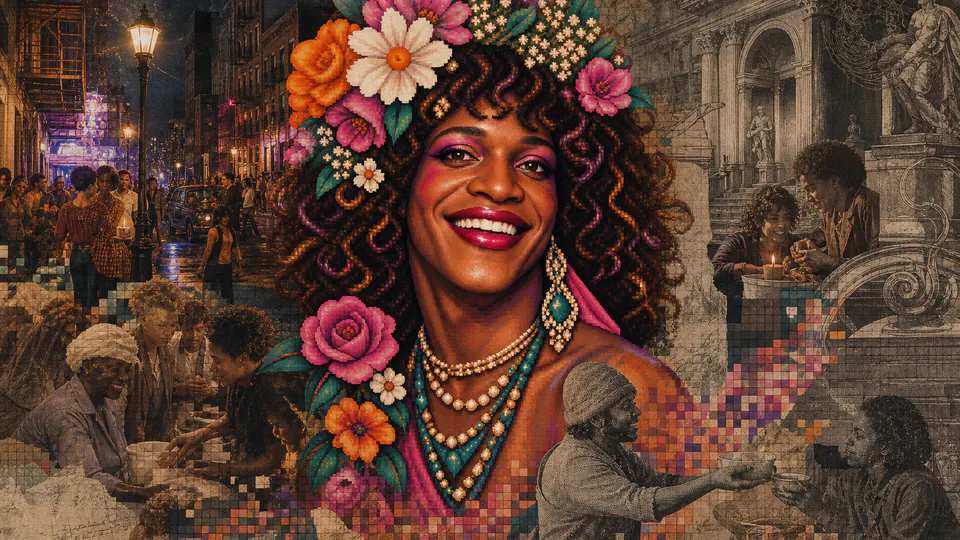
Marsha P. Johnson was a Black transgender activist, performer, and Street Transvestite Action Revolutionaries co-founder who connected protest with mutual aid.
The story
#storyMarsha P. Johnson understood that a movement asking people to live openly had to care whether they could live at all. Gay liberation meant confronting police and public shame. It also meant a bed, a meal, clothing, and a door that did not close on a poor queer or trans teenager.
Johnson moved from New Jersey to New York City in 1963. She survived through sex work, waited tables, performed, and became a familiar presence in Greenwich Village. She joined resistance at the Stonewall uprising, though the popular claim that she started it with a brick is unsupported and conflicts with her own account of arriving after the uprising began.
STAR joined protest to shelter
Johnson and Sylvia Rivera formed Street Transvestite Action Revolutionaries in 1970. STAR organized people pushed to the edge of the emerging gay movement and maintained a house for young people. Money was scarce and the project was short-lived. The political idea lasted: those facing the most exposure should not be treated as an embarrassing side issue.
Johnson organized with the Gay Liberation Front, performed with Hot Peaches, and later joined ACT UP during the AIDS crisis. She was generous in circumstances that gave her little margin, and she experienced arrests, homelessness, and mental-health crises.
Her 1992 death remains unresolved. Friends challenged the initial police ruling of suicide, and later reviews did not establish a definitive cause. Johnson’s work does not need a false Stonewall origin story or a solved ending. She made survival part of the political program, which is hard enough and more useful.
Terms for gender and identity changed across Johnson’s life. She used language common to her community and era and also answered to Marsha as a woman. Present accounts often describe her as transgender while noting that the current umbrella term was not her ordinary vocabulary. That care is more than etiquette. It prevents history from using modern certainty to flatten the categories people made for themselves. Johnson’s own record remains specific: chosen kin, performance, public femininity, street survival, and organizing with people whom established institutions refused to house.
New York offered community and criminalization
Johnson was born in Elizabeth, New Jersey, in 1945 and moved to New York after high school. She built a life through performance, sex work, chosen family, and the street economy around Greenwich Village. Money was unstable, and arrest was common.
The name Marsha P. Johnson became a public creation and a claim to womanhood on her own terms. Her elaborate clothing and flowers did not signal an easy life. Style could make joy visible under conditions that punished gender nonconformity.
Police, courts, hospitals, and shelters often treated people like Johnson as disorder to be removed. Community therefore had to perform functions formal institutions withheld: warn about danger, share a room, raise bail, find food, remember who was missing, and make celebration possible.
Stonewall belongs to her record without a false first
Johnson participated in resistance around the Stonewall uprising and became active in the Gay Liberation Front. Later accounts sometimes claim she threw the first brick or started the uprising. Available evidence does not establish that story, and Johnson herself described arriving after the initial confrontation.
Correcting the myth does not remove her from Stonewall history. The uprising extended over several nights and mattered because people joined resistance and then organized. Johnson’s sustained work after the raid is better documented than a cinematic first throw.
The urge to assign a founder can also hide the crowd. Stonewall involved people of different races, classes, sexualities, and gender expressions whose names and exact actions were unevenly recorded. Johnson’s history is strong enough to share the scene.
STAR made survival a liberation demand
Johnson and Sylvia Rivera formed Street Transvestite Action Revolutionaries in 1970. STAR protested policing and movement exclusion while trying to support queer and trans young people without stable housing.
At the STAR house, rent, food, and safety became movement work. Johnson and Rivera used money they earned on the street to support residents. The arrangement was fragile and the house did not last long, but its political claim endured: housing was not a side issue to be postponed until after legal recognition.
STAR also challenged who could lead. Established groups often wanted gender-nonconforming people on demonstrations but not in negotiations. Rivera and Johnson insisted that those facing police, poverty, and shelter exclusion possessed knowledge a movement needed at its center.
Performance and organizing shared a public stage
Johnson performed with the Hot Peaches and appeared in art and photography, including work associated with Andy Warhol. Performance brought community, expression, and some income, while refusing the demand that political credibility look respectable.
She was known for generosity despite having little money. Such stories can become sentimental if separated from the systems that made constant informal care necessary. Johnson’s giving existed because friends faced hunger, arrest, illness, and rejection from agencies with far greater resources.
Her public femininity also had political force. Walking, performing, and organizing as Marsha claimed city space that police and strangers contested. Joy did not replace resistance. It was one way of refusing the social death imposed by shame.
AIDS work brought care into a lethal emergency
Johnson became involved with ACT UP in the late 1980s. AIDS was killing friends while government delay and public stigma restricted care. People already marginalized by poverty, race, gender expression, sex work, or substance use faced additional barriers to treatment and attention.
ACT UP used direct action and medical research to challenge officials, drug companies, and institutions. Johnson’s participation connected an earlier gay- liberation generation with an epidemic that demanded new expertise and immense care labor.
Her own health and housing remained unstable. A movement can ask a person to provide care and symbolic leadership while failing to secure that person’s safety. Johnson’s life keeps those two facts in the same frame.
Her death raised questions the first ruling did not settle
Johnson’s body was found in the Hudson River in July 1992. Police initially treated the death as suicide. Friends rejected that conclusion, pointing to threats, possible violence, and deficiencies in the investigation. Authorities later reopened the case, but it remains unresolved.
Responsible history should not replace an inadequate official conclusion with an unproven certainty. The documented point is that people who knew Johnson believed the state had not taken her death seriously. That distrust grew from long experience with police treatment of queer and trans communities.
Public honors have expanded since her death, including a New York park bearing her name. Commemoration cannot answer the questions STAR posed about housing, policing, health, and poverty. Johnson’s legacy lives most accurately where those demands receive resources, not only where her flowers appear on a mural.
In their own words
#wordsWhat Marsha P. Johnson actually said, where, and when. Each one links to the page it was checked against.
-
I was uptown and I didn't get downtown until about two o'clock, because when I got downtown the place was already on fire.
On how she came to be at the Stonewall Inn on the night of the uprising, in a recorded conversation with Eric Marcus and Randy Wicker, Making Gay History podcast, first published March 2, 2017. Marsha P. Johnson and Randy Wicker, Episode 11, Making Gay History podcast -
I was one of the first drag queens to go to that place.
On the Stonewall Inn before the raid, in the same recorded conversation with Eric Marcus and Randy Wicker. Marsha P. Johnson and Randy Wicker, Episode 11, Making Gay History podcast -
Oh, no, because I'd been going to jail for like ten years before the Stonewall I was going to jail.
On her arrest record before 1969, in the same recorded conversation with Eric Marcus and Randy Wicker. Marsha P. Johnson and Randy Wicker, Episode 11, Making Gay History podcast -
We just were saying, no more police brutality and, oh, we had enough of police harassment.
On what the crowd was shouting during the uprising, in the same recorded conversation with Eric Marcus and Randy Wicker. Marsha P. Johnson and Randy Wicker, Episode 11, Making Gay History podcast -
Street Transvestites Action Revolutionaries started out as a very good group.
On STAR, the group she co-founded with Sylvia Rivera, in the same recorded conversation with Eric Marcus and Randy Wicker. Marsha P. Johnson and Randy Wicker, Episode 11, Making Gay History podcast
What people get wrong
#wrong- The myth
Johnson threw the first brick or bottle at Stonewall, starting the uprising. - The record
In her own 1987 recorded account, Johnson said she was uptown at a party and did not arrive downtown until about 2 a.m., after the bar was already on fire. No recording of her own words claims she threw the first object.
- The myth
STAR was a large, well-funded organization that operated for years. - The record
The STAR House, its only permanent address, was a four-room tenement at 213 East 2nd Street that housed 15 to 25 people between roughly November 1970 and July 1971, kept running mostly on money Johnson and Rivera earned themselves.
- The myth
Johnson's 1992 death was officially ruled a homicide. - The record
Police initially ruled it a suicide in 1992. The city changed the ruling to undetermined in 2002, and the NYPD reopened the case as a possible homicide in 2012, but no ruling of homicide has been issued.
The dates that matter
#dates- August 24, 1945 Born Malcolm Michaels Jr. in Elizabeth, New Jersey.
- 1963 Moves to New York City after high school.
- June 1969 Joins resistance during the Stonewall uprising after it begins.
- 1970 Forms STAR with Sylvia Rivera.
- 1970s Performs with the drag theater troupe Hot Peaches.
- 1980s Organizes with ACT UP during the AIDS crisis.
- July 6, 1992 Her body is recovered from the Hudson River.
Questions people ask
#faqsDid Marsha P. Johnson start the Stonewall uprising?
There is no reliable evidence that she threw the first brick or began the uprising, and Johnson said she arrived after it had started. She was part of the resistance and the movement that followed.
What was STAR?
Street Transvestite Action Revolutionaries was the group Johnson and Sylvia Rivera organized to support homeless queer and trans young people while fighting exclusion and police violence.
How did Marsha P. Johnson die?
Her body was found in the Hudson River in July 1992. Police initially ruled the death a suicide, a conclusion challenged by friends; later reviews did not establish a final cause.
How should Marsha P. Johnson be evaluated?
Separate the immediate result from the institutions, tactics, exclusions, and enforcement record that followed it.
The bookshelf
#bookshelfWhere to go next. Buy from an independent bookstore, or find it at your library for nothing.
-
Marsha: The Joy and Defiance of Marsha P. Johnson Tourmaline, 2025 secondary
The first full-length biography, built from her circle and archives.
-
The Stonewall Reader New York Public Library, edited by Jason Baumann, 2019 secondary
Contemporary accounts and documents from the uprising Johnson lived through.
-
Stonewall: The Riots That Sparked the Gay Revolution David Carter, 2004 secondary
The standard history of the raid and the days that followed.
Wear it: Marsha P. Johnson
#merchEvery design here links back to this page.
Sources
#sourcesPrimary sources
The documents themselves: laws, court opinions, speeches, letters, and the numbers from the agencies that count them.
Secondary sources
Written afterward, about the story.
- National Park Service, Stonewall Fact Sheet
- Smithsonian, Marsha P. Johnson
- New York Public Library, Gay Liberation Front
- Wikipedia, Marsha P. Johnson
- NYC LGBT Historic Sites Project, "Marsha P. Johnson's Place(s) in NYC's LGBT History"
- New York Public Library, AIDS and LGBTQ collections
- National Park Service, Stonewall National Monument
- NBC News, "#Pride50: Marsha P. Johnson, Transgender Rights Trailblazer"