Published
Stonewall Uprising
The Stonewall Uprising Was Six Nights, Not One Thrown Brick
The 1969 Stonewall uprising grew from routine police harassment and became six nights of resistance that accelerated an already developing gay-liberation movement.
The story
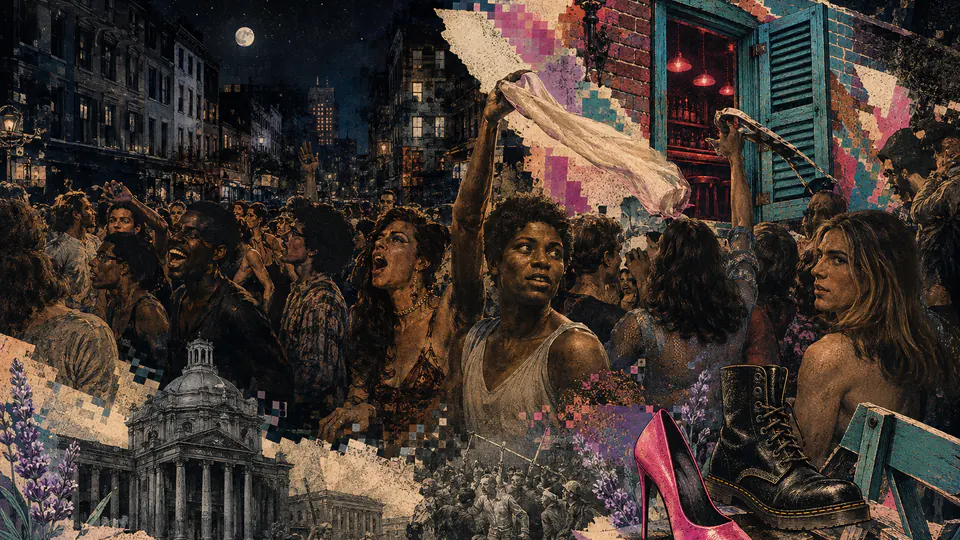
#storyPolice entered the Stonewall Inn early on June 28, 1969, expecting another controlled raid. Bars serving gay customers faced liquor enforcement, police harassment, arrest, and extortion. Customers were accustomed to being lined up, identified, and dispersed. This time the crowd outside stayed.
As police made arrests, people resisted. The crowd grew, officers retreated into the bar, objects flew, and the street became contested ground. Protest returned over six nights. The participants changed from hour to hour and included lesbians, gay men, street youth, transgender and gender-nonconforming people, neighborhood residents, and curious onlookers.
There was no first-brick committee
Later memory assigned the uprising to a single famous person and a single projectile. The record does not support a definitive first brick. Marsha P. Johnson said she arrived after the uprising had begun. Sylvia Rivera described participating, while accounts differ about timing. Their organizing matters without turning either person into a mascot for a collective event.
Stonewall was also not the birth of LGBTQ politics. Earlier homophile groups, Black and Latino queer organizing, publications, legal challenges, and uprisings in San Francisco and Los Angeles had built networks and experience. What changed was the scale, militancy, and speed of organization afterward.
Activists formed the Gay Liberation Front and Gay Activists Alliance. In June 1970, marchers marked the anniversary with Christopher Street Liberation Day, an ancestor of present-day Pride events. The useful Stonewall story shows ordinary repression meeting collective refusal, then gaining an address, a meeting, and another action.
The bar itself explains part of the conflict. New York liquor rules and police practice made openly serving gay customers risky, which left room for Mafia ownership and payoffs. Patrons paid for a place where they could gather while remaining exposed to both criminal management and state harassment. Raids enforced more than licensing: police inspected clothing and gender presentation, threatened public identification, and used arrest to endanger jobs and families. Resistance began inside that web of dependency. The uprising challenged the raid and the social arrangement that made a crowded bar one of the few available refuges.
The raid entered a room already organized by survival
The Stonewall Inn operated under Mafia ownership and lacked an ordinary liquor license. Customers still made it a gathering place, especially for people excluded from more respectable venues. Drag queens, gender-nonconforming people, young people, lesbians, gay men, hustlers, workers, and people without stable housing shared a room without forming one uniform community.
Police raids were familiar. Officers could demand identification, line people up, inspect clothing against gender rules, seize alcohol, arrest employees and patrons, and expose names publicly. The threat reached beyond a night in jail. Newspaper coverage or a police record could cost a job, family relationship, lease, or immigration security.
Routine procedure depended on patrons accepting humiliation and leaving. In the early hours of June 28, 1969, that script broke down.
Resistance moved from the doorway to the street
As police conducted the raid, released patrons and onlookers gathered outside rather than disperse. The crowd grew, mocked officers, protested arrests, and reacted as police used force. Accounts differ over precise first acts, a predictable problem in a moving crowd recorded through memory, hostile police reports, and limited journalism.
People threw coins and objects, freed detainees, and forced police to shelter inside the bar. The Tactical Patrol Force arrived, and conflict continued through the night. Further confrontations followed on later evenings, bringing more participants and attention.
No single person started Stonewall. Claims about a first brick or punch often place modern needs onto incomplete evidence. Marsha P. Johnson, Sylvia Rivera, Storme DeLarverie, and many others belong to the uprising’s history without requiring an invented stopwatch.
Earlier resistance made the event possible to understand
Stonewall was not the first queer resistance to police. Patrons and communities had fought back at Cooper Do-nuts in Los Angeles, Dewey’s in Philadelphia, Compton’s Cafeteria in San Francisco, and other locations. Homophile groups had spent years publishing, litigating, picketing, and challenging bar regulation.
Those precedents matter because an event becomes politically legible through prior experience. People knew police harassment was systemic. They had language for rights, organizations that could call meetings, and publications that could circulate news.
New York in 1969 also held anti-war, Black freedom, feminist, student, Puerto Rican, and labor organizing. Gay liberation drew methods and political language from that wider field while developing conflicts specific to sexuality and gender.
Organizations converted nights of revolt into a movement turn
Within weeks, activists formed the Gay Liberation Front. Its name and politics linked sexual liberation to struggles against war, racism, capitalism, and gender hierarchy. The Gay Activists Alliance later concentrated on targeted gay-rights actions and developed the confrontational tactic known as the zap.
These groups did the less dramatic work of meetings, rules, leaflets, fundraising, coalition arguments, and repeated demonstrations. They also reproduced exclusions. Women challenged male dominance. Black and Latino members challenged white control. Trans and street activists fought organizations that wanted a more acceptable public image.
The uprising did not automatically create unity. It opened space in which competing forms of LGBTQ liberation could organize at greater speed.
Anniversary marches built a national calendar
On the first anniversary in 1970, activists held Christopher Street Liberation Day in New York, with related marches in Los Angeles and Chicago. Annual commemoration helped spread Pride events to other cities.
The march did more than remember a raid. A recurring date allowed local groups to recruit, state demands, occupy public space, and see themselves as part of a wider movement. Celebration offered relief from politics defined only by injury.
Success created new debates. Corporate sponsorship, police participation, permits, commercial festivals, and the place of protest have divided Pride organizers. Those arguments return to Stonewall’s basic setting: a confrontation with police in a venue serving people other institutions rejected.
Monument status changes what visitors can miss
The Stonewall Inn became a city landmark, a National Historic Landmark, and the center of Stonewall National Monument. Federal recognition places LGBTQ resistance inside the official national story. It also risks compressing decades of organizing into one bar and one weekend.
A useful monument points outward. It should lead to the Lavender Scare, Compton’s, STAR, lesbian organizing, AIDS activism, court cases, shelters, unions, and the people whose names never entered an archive. It should also preserve uncertainty where the record is uncertain.
Stonewall matters because people refused an ordinary abuse and because organizers gave that refusal a future. The uprising was neither the birth of all LGBTQ resistance nor a colorful prologue to inevitable legal equality. It was a break in routine, followed by institutions that made the broken routine harder to restore.
What people get wrong
#wrong- The myth
One identifiable person threw the first brick that started Stonewall. - The record
No source names a single first thrower or a first brick. Contemporary reconstructions trace the crowd's turn to violence to police forcing a woman into a van and hitting her, after which the gathered crowd began throwing coins, bottles, and cobblestones, not to one named person or object.
- The myth
LGBTQ activism and organizing began at Stonewall. - The record
The National Park Service's own fact sheet on the site states plainly that the 1969 uprising "was not the first time members of the LGB community organized in their own interest," pointing to earlier homophile organizations and resistance that predate the raid.
- The myth
Stonewall was a single night of rioting. - The record
Protests and clashes with police continued across six days, from the raid on June 28 through July 3, 1969, with crowds numbering in the thousands returning on later nights.
The dates that matter
#dates- 1950s-1960s Police raids, liquor rules, and laws regulating gender presentation constrain queer public life.
- June 28, 1969 A police raid at the Stonewall Inn meets resistance from patrons and people gathered outside.
- June 28-July 3, 1969 Protests and clashes continue across six nights.
- July 1969 Activists organize the Gay Liberation Front.
- 1970 The first Christopher Street Liberation Day march marks the anniversary.
- 1999 The Stonewall Inn is listed on the National Register of Historic Places.
- 2016 Stonewall National Monument is established.
Questions people ask
#faqsWho threw the first brick at Stonewall?
The evidence does not identify one person or even confirm a brick as the first act. The search for a single starter obscures a collective uprising.
Did LGBTQ activism begin at Stonewall?
No. Earlier organizations, publications, court fights, pickets, and uprisings created a movement before 1969. Stonewall accelerated it and changed its style.
How long did the Stonewall uprising last?
Resistance and street clashes occurred across six nights beginning early on June 28, 1969.
How should Stonewall Uprising be evaluated?
Separate the immediate result from the institutions, tactics, exclusions, and enforcement record that followed it.
The bookshelf
#bookshelfWhere to go next. Buy from an independent bookstore, or find it at your library for nothing.
-
Out of the Closets: Voices of Gay Liberation Karla Jay and Allen Young, editors, 1972 primary
Manifestos and firsthand writing from the gay liberation movement Stonewall set off, in the participants' own words.
-
Stonewall: The Riots That Sparked the Gay Revolution David Carter, 2004 secondary
The most thoroughly documented reconstruction of the six nights, built from surviving participants and police records.
-
Stonewall Martin Duberman, 1993 secondary
Follows six people through the years before and after 1969, an oral-history approach to the same uprising.
Wear it: Stonewall Uprising
#merchEvery design here links back to this page.
Sources
#sourcesPrimary sources
The documents themselves: laws, court opinions, speeches, letters, and the numbers from the agencies that count them.
Secondary sources
Written afterward, about the story.
- National Park Service, Stonewall Fact Sheet
- National Park Service, Stonewall National Monument
- Library of Congress, LGBTQ Pride Resources
- New York Public Library, 1969 Gay Liberation Front
- New York Public Library, Stonewall reader resources
- Library of Congress, Stonewall era newspapers
- HISTORY, "Stonewall Riots: What Happened at the 1969 Uprising"