Published
Harvey Milk
Harvey Milk Turned Visibility Into a Local Political Machine
Born May 22, 1930. Died November 27, 1978
Harvey Milk organized San Francisco voters, neighborhood businesses, unions, and gay residents before becoming one of the first openly gay elected officials in the United States.
The story
#storyHarvey Milk won office because he made gay political power local and concrete. He registered voters, organized merchants, backed boycotts, courted unions, answered neighborhood complaints, and ran repeatedly. Visibility mattered because it was attached to a constituency.
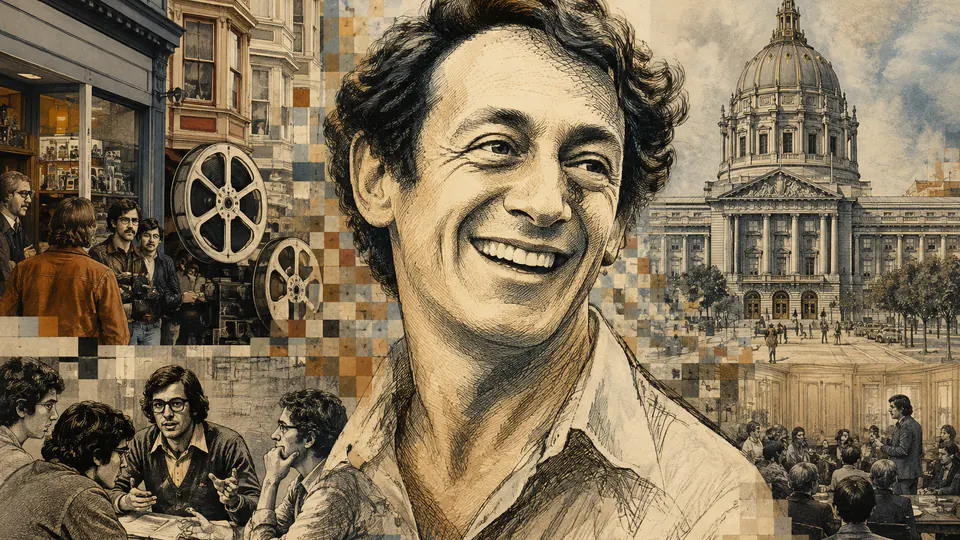
Milk moved to San Francisco in 1972 and opened Castro Camera with Scott Smith. The shop became campaign office, meeting room, and neighborhood switchboard. Three losing races taught him how the city’s at-large election system diluted district voices. When San Francisco restored district elections, Milk won a supervisor seat in 1977.
Coalition was a practice, not a slogan
Milk connected gay voters with tenants, seniors, small businesses, and organized labor. He had backed the Coors boycott led by Teamsters, and labor support later helped gay organizers fight discrimination. On the board, he sponsored a city gay rights ordinance and worked on practical district issues.
The largest campaign of his brief term took place statewide. Proposition 6, the Briggs Initiative, sought to remove gay and lesbian teachers and their public supporters from California schools. Milk traveled the state urging people to come out and organize. Voters rejected the measure in November 1978.
Weeks later, former supervisor Dan White killed Mayor George Moscone and Milk. The light sentence that followed produced the White Night riots. Milk’s afterlife is often reduced to personal courage. His sharper lesson for LGBTQ liberation is organizational: make a community countable, connected, and costly for politicians to ignore.
His months in office also kept the politics grounded in municipal power. Milk backed an ordinance barring discrimination based on sexual orientation, pressed for services in his district, and understood appointments and committee votes as movement terrain. The approach did not require every ally to share an identity. It required them to enter a durable exchange of support. That method explains why the Teamsters boycott and the campaign against Proposition 6 belong in the same biography. Milk built power by making separate constituencies answer one another’s calls.
Reinvention did not begin as a movement plan
Milk was born on Long Island in 1930, served in the Navy, and worked in finance, insurance, and theater before settling in San Francisco. His early adult life was not the straight line of an organizer preparing for office. He guarded his sexuality in workplaces where disclosure could end a career and initially held more conservative political views than the figure later placed on campaign posters.
The move to the Castro came as gay residents and businesses were changing the neighborhood. That growth did not occur on empty ground. Working-class families and other tenants experienced rising costs and commercial change. Milk’s political base therefore had to operate as a neighborhood coalition, not an identity enclave sealed from housing, transit, policing, and small-business concerns.
Castro Camera gave the project an address. People could bring a complaint, volunteer, meet a candidate, or hear about an action without entering a formal party office. The store turned ordinary retail space into political infrastructure.
Losing campaigns taught him how the city counted power
Milk ran for supervisor in 1973 and lost. He ran again, sought a state Assembly seat, and kept building a voter list and public profile. Repeated candidacy allowed him to test issues, identify precincts, recruit volunteers, and make gay political participation routine rather than exceptional.
San Francisco elected supervisors citywide, a system that favored candidates with money and broad establishment support. District elections made a concentrated neighborhood constituency more effective. When the city adopted the district system, Milk won in 1977 from District 5.
The institutional detail matters. Courage did not change the ballot structure. A district reform altered whose votes could translate into office. Movements gain power when they understand such rules well enough to change them.
The Coors boycott created a two-way alliance
Teamsters organizing against Coors needed support from bars and consumers. Gay activists could influence a major local market. Milk helped push the boycott in gay bars, while labor leaders increasingly backed gay employment rights and political candidates.
The exchange was practical. Each side had something the other needed, and cooperation gave members a reason to reconsider prejudice. It did not erase homophobia inside unions or every disagreement over business and labor. It created repeated joint work that made public support harder to withdraw.
Milk also helped organize Castro merchants. Small-business politics can conflict with tenant and worker interests, so the coalition required negotiation rather than easy labels. His skill lay in joining groups around specific actions while keeping a visible gay base capable of rewarding allies.
Proposition 6 made disclosure a campaign tactic
State senator John Briggs sponsored Proposition 6 in 1978. The initiative threatened gay and lesbian public-school employees and people who supported them. Its reach made silence dangerous: a teacher could be targeted for identity, speech, or association.
Opposition included teachers, unions, gay organizations, parents, students, public officials, and even conservative figures who regarded the measure as an intrusive use of government. Milk argued that coming out changed voters’ understanding because a known neighbor or relative was harder to reduce to a campaign warning.
Disclosure was never equally safe. A public employee, tenant, immigrant, or young person could face severe consequences. Milk’s call worked as political strategy only when paired with organization able to defend people who took the risk. California voters rejected the measure by a wide margin in November 1978.
Eleven months in office made municipal work visible
Milk sponsored an ordinance against discrimination based on sexual orientation, which Mayor George Moscone signed. He addressed dog waste, public transportation, child care, neighborhood development, and board appointments alongside statewide rights. The mixture was central to his method. Constituents judge power through the street and service in front of them as well as a movement declaration.
He also used the office as a public platform against attacks on gay people. Representation did not mean that one official could speak for an entire community. It meant city government could no longer discuss that community only when regulating or policing it.
Milk had been in office for less than a year when former supervisor Dan White entered City Hall and killed Moscone and Milk on November 27, 1978. The murders eliminated two elected officials and created an immediate fight over succession, grief, and public memory.
The trial widened the wound
White was convicted of voluntary manslaughter rather than murder and received a sentence many residents regarded as grossly lenient. A defense account emphasized his mental state; popular retelling reduced this into the misleading phrase “Twinkie defense.” The legal result, rather than a snack-food claim, drove the anger.
After the verdict in May 1979, protesters gathered at City Hall and some fought police and damaged property. Police later raided the Castro and assaulted people in bars and on the street. The White Night violence exposed a relationship with law enforcement that the election of one gay supervisor had not repaired.
Milk’s archive contains campaign materials, recordings, constituent work, and personal papers that recover more than martyrdom. His politics depended on repeated losses, procedural reform, a storefront, voter registration, reciprocal alliances, and local service. Visibility was one tool. Organization made it count.
In their own words
#wordsWhat Harvey Milk actually said, where, and when. Each one links to the page it was checked against.
-
My name is Harvey Milk and I'm here to recruit you.
Opening line of the "Hope Speech," delivered on the steps of San Francisco City Hall at the California Gay Freedom Day rally, June 25, 1978. Harvey Milk, "The Hope Speech" (June 25, 1978) -
It's not enough anymore just to have friends represent us. No matter how good that friend may be.
The same 1978 Hope Speech, on why gay candidates, not just sympathetic allies, needed to hold office. Harvey Milk, "The Hope Speech" (June 25, 1978) -
You have to give them hope. Hope for a better world, hope for a better tomorrow, hope for a better place to come to if the pressures at home are too great. Hope that all will be all right.
The same speech, near its close, addressed to young gay people who might hear Anita Bryant's anti-gay campaign on television. Harvey Milk, "The Hope Speech" (June 25, 1978) -
I'd love to see every gay doctor come out. I'd love to see every gay lawyer, every gay judge, every gay bureaucrat, every gay architect come out. Stand up. Let the world know. That would do more to end prejudice overnight than anybody could ever imagine.
From the tape Milk recorded at Castro Camera on the evening of November 18, 1977, to be played only if he were assassinated. Harvey Milk, recorded political will (November 18, 1977) -
It's not about personal gain, not about ego, not about power. It's about giving those young people out there hope. You gotta give 'em hope.
The same 1977 recorded will, on why he wanted the tape played if he were killed. Harvey Milk, recorded political will (November 18, 1977)
What people get wrong
#wrong- The myth
The "Twinkie defense" means Dan White's lawyers argued junk food made him kill Milk and Moscone. - The record
Neither White nor his defense ever argued that sugar caused the shootings. The defense's diminished-capacity claim rested on psychiatric testimony about long-standing depression, for which a psychiatrist cited White's shift toward junk food as one symptom among others. A journalist coined "Twinkie defense" afterward, and later coverage flattened the symptom into the supposed cause.
- The myth
Harvey Milk was the first openly gay elected official in the United States. - The record
Kathy Kozachenko won a city council seat in Ann Arbor, Michigan on April 2, 1974, three years before Milk's 1977 win, running openly as a lesbian candidate. Milk was the first openly gay man elected to office in California, not the first in the country.
- The myth
Harvey Milk was always a left-wing activist. - The record
Before he moved to San Francisco's Castro district in 1972, Milk worked in finance and on Wall Street and, by his own campaign's later account, volunteered for Barry Goldwater's conservative 1964 presidential run. His politics moved left after he settled in the Castro.
The dates that matter
#dates- May 22, 1930 Born in Woodmere, New York.
- 1972 Moves to San Francisco and opens Castro Camera with Scott Smith.
- 1973 Runs for the Board of Supervisors for the first time.
- 1974 Helps organize the Castro Village Association of local merchants.
- November 1977 Wins election as a district supervisor.
- 1978 Works in the statewide campaign defeating Proposition 6.
- November 27, 1978 Killed with Mayor George Moscone at City Hall.
Questions people ask
#faqsWas Harvey Milk the first openly gay elected official?
He was among the first in the United States and the first openly gay person elected to public office in California. Kathy Kozachenko won office in Ann Arbor earlier in 1974.
What was the Briggs Initiative?
California Proposition 6 would have allowed school systems to fire gay and lesbian employees and people who publicly supported them. Voters defeated it in 1978.
Who killed Harvey Milk?
Former city supervisor Dan White killed Milk and Mayor George Moscone at San Francisco City Hall on November 27, 1978.
How should Harvey Milk be evaluated?
Separate the immediate result from the institutions, tactics, exclusions, and enforcement record that followed it.
The bookshelf
#bookshelfWhere to go next. Buy from an independent bookstore, or find it at your library for nothing.
-
An Archive of Hope: Harvey Milk's Speeches and Writings Harvey Milk, edited by Jason Edward Black and Charles E. Morris III, 2013 primary
His speeches and writings collected in one volume, the Hope Speech among them.
-
The Mayor of Castro Street: The Life and Times of Harvey Milk Randy Shilts, 1982 secondary
The standard biography, reported from Milk's own circle before the archive fully opened.
-
Harvey Milk: His Lives and Death Lillian Faderman, 2018 secondary
A shorter, more recent life, weighing what the myth added to the record.
Wear it: Harvey Milk
#merchEvery design here links back to this page.
Sources
#sourcesPrimary sources
The documents themselves: laws, court opinions, speeches, letters, and the numbers from the agencies that count them.
Secondary sources
Written afterward, about the story.