Published
Right-to-Work Laws
Right-to-Work Laws: What these state laws do to union security, bargaining, and free-rider claims
A sourced account of Right-to-Work Laws, covering the organizing, conflict, limits, and consequences behind the familiar version.
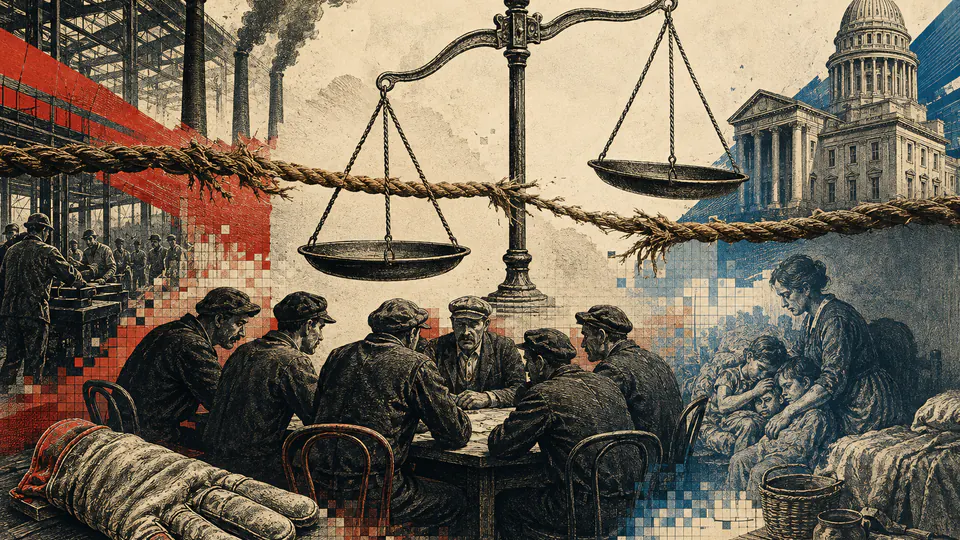
The story
#storyThe familiar version of Right-to-Work Laws usually begins at the moment cameras, police, or a national audience arrived. That makes a clean story and a bad explanation. What these state laws do to union security, bargaining, and free-rider claims. To understand that claim, the organizing before the famous scene and the institutions after it have to remain in view.
These laws do not create a general right to a job; they prohibit certain contracts that require represented workers to support bargaining costs. That is the article’s measure of success. It asks who gained the power to make a decision, which rule changed, who remained outside it, and whether the gain lasted after attention moved elsewhere.
The conditions came before the headline
1935: The Wagner Act establishes federal collective-bargaining rules without a right-to-work provision. 1944: Arkansas and Florida voters adopt early state right-to-work measures. Those events established the field on which later choices were made. People did not enter it with equal money, legal standing, mobility, safety, or access to the press. An order that looked ordinary to those who administered it could feel like a permanent emergency to those made to live under it.
This context does not turn participants into passengers of large forces. It identifies the constraints they learned to use. A workplace schedule could become a contact list. A church, apartment, union hall, campus, newspaper, or neighborhood association could become an office. A court case could collect evidence for a campaign, while a campaign could make judges and officials understand that a case would not disappear without resistance.
Organization made the public moment possible
1947: Taft-Hartley Section 14(b) authorizes states to prohibit union-security agreements. 1950s: Business groups promote state laws across the South, Plains, and Mountain West. Neither development moved by reputation alone. Organizers needed places to meet, ways to settle disputes, trusted people who could carry information, money for food and transport, and plans for arrest, dismissal, or retaliation. That daily work determined who could remain involved when the first burst of attention ended.
Coalition added reach and friction. Participants could share a target while disagreeing about tactics, leadership, parties, weapons, negotiation, or the desired settlement. Those arguments were evidence of real stakes. Unity imposed from above would have hidden differences without resolving them. Durable cooperation required rules for making decisions and a distribution of risk that people considered fair enough to continue.
The link to civil-rights organizing is practical. Rights become usable through registration, representation, hearings, contracts, budgets, and enforcement. Moral language can name an injury. Organization identifies the person or institution able to stop it and creates a cost for refusal.
Conflict exposed where authority sat
1980: Labor defeats a proposed right-to-work amendment in Missouri. 2012: Indiana and Michigan enact right-to-work statutes during a new state-level push. At that point, opponents did more than offer a different opinion. They used the authority available to them: ownership, police, courts, party rules, licensing, hiring, firing, surveillance, or control of public information. The response reveals which interests a supposedly neutral system was prepared to protect.
Organizers also made choices under pressure. A dramatic tactic could bring attention while exhausting money. A legal compromise could protect people immediately while leaving a larger demand unanswered. Central leadership could coordinate action while silencing local knowledge. The right question is not whether every decision looks pure in hindsight. It is what alternatives existed, who bore their risks, and what the participants knew at the time.
This is where labor organizing enters the story. Work, housing, public space, education, policing, and voting were connected even when law placed them in separate boxes. A person blocked in one institution arrived at the next with fewer resources. Organizing across those boundaries could create power, but it also required more time and broader accountability.
A result is larger than a victory label
2018: The Supreme Court bars agency fees for covered public employees in Janus v. AFSCME. 2023: Michigan repeals its private-sector right-to-work law. These later events prevent a simple ending. A campaign may lose its immediate demand and still train leaders, expose a system, or leave a tactic others can use. It may win a law whose exclusions reproduce part of the old order. It may build an organization that protects members while becoming less willing to take the risks that built it.
Free-rider and freedom-of-association claims point in opposite directions because a union must represent workers who may decline to fund it. Naming that limit does not cancel the achievement. It identifies the next conflict and gives credit to people who challenged the movement from within. Race, gender, class, citizenship, occupation, sexuality, and disability affected who was heard and who could survive retaliation. These were contemporary disputes, not standards invented after the fact.
The economic questions also continued. economic justice concerns who controls the resources needed to act: wages, time, transport, care, land, credit, and public services. Formal access without those resources can leave a right unusable. Material gains without a protected voice can disappear when management or government changes direction.
The archive has interests too
No source type sees the whole event. Government files document what an agency counted, feared, or prosecuted, often in the agency’s own language. Organizational minutes show plans and votes but may omit informal labor. Newspapers capture public claims while repeating the prejudices of owners, editors, police, or advertisers. Oral histories restore texture and motive, though memory recorded later can compress dates and settle old arguments too neatly.
The responsible method is comparison. When several independent records agree, a claim grows stronger. When they conflict, the disagreement belongs in the story. A missing name can show who lacked formal authority, but absence from minutes does not prove absence from the work. A famous quotation should be traced to a recording, transcript, letter, or contemporary report before it carries an argument.
What this history leaves us
Right-to-Work Laws matters because power was made visible in use. Participants learned which office could delay, which employer could punish, which law could be enforced, and which alliance could outlast a news cycle. Their answers were incomplete because all political answers are made under conditions they do not fully control.
The useful inheritance is therefore neither worship nor dismissal. Keep the organizing methods, measure the result, name the exclusions, and follow the institution after the celebration. That approach preserves drama without turning history into a poster. It also preserves the people whose patient work made the remembered moment possible.
Strategy can be measured in resources
These laws do not create a general right to a job; they prohibit certain contracts that require represented workers to support bargaining costs. The sentence becomes more concrete when translated into resources. Who controlled the meeting room, membership list, printing bill, defense fund, car, telephone, childcare, food, medical help, or legal filing? Who could miss a shift, and who lost rent money by doing so? Those questions explain why an idea that sounded popular might remain weak and why a smaller group with trusted organization could alter an institution.
Opponents performed the same calculation. Delay could drain a strike fund or outlast public attention. Selective concessions could separate a coalition. Arrest or firing could remove a local leader without answering the demand. A hearing could collect testimony while postponing enforcement. A sympathetic statement could preserve an official’s reputation at lower cost than changing a budget or rule. Strategy meant recognizing those moves early enough to answer them.
Free-rider and freedom-of-association claims point in opposite directions because a union must represent workers who may decline to fund it. The limit belongs inside the account because it affected the available strategy. People excluded from leadership often saw danger first. They knew which promise could not be enforced, which compromise shifted costs downward, and which supporter would leave after the photograph. Their criticism was organizational knowledge, even when officers treated it as disloyalty.
Three measures help separate durable change from ceremony. Capacity asks whether more people could act together after the campaign. Distribution asks who received money, time, safety, standing, or control. Enforcement asks what happened when an employer, agency, or leader ignored the new rule. A result can score well on one measure and poorly on another. That mixed finding is more informative than forcing the story into triumph or failure.
It also keeps the history alive without pretending the present is identical. The names of agencies, industries, and organizations change. The work of building trust, sharing risk, recording decisions, testing a promise, and preparing for retaliation remains recognizable. Right-to-Work Laws offers evidence about that work, including evidence of what could not be solved in one campaign or one lifetime.
Argue it
#argue4 claims about Right-to-Work Laws you can make out loud, the best case against each one, and the answer. Every number links to where it came from.
-
Claim 1
In the five states that passed right-to-work between 2011 and 2017, wages fell after the law, and fell furthest where unions were strongest.
The evidence
A 2022 NBER event study tracked five states before and after their own right-to-work law took effect (2011-2017) and found union density fell about 4 percentage points within five years, nearly 13 points in heavily unionized industries like construction and public administration, with wages down roughly 1 percent overall and more than 4 percent in those industries. Comparing right-to-work and non-right-to-work states directly, the same research finds density about 20 percent lower and wages about 7.5 percent lower where the law is in place.
Their best case
Mackinac Center economist Christopher Douglas argues the older 2015 Economic Policy Institute estimate, 3.1 percent lower wages and $1,558 a year, is itself an artifact of bad statistics: correcting for each state's fixed characteristics and clustering standard errors properly, he finds right-to-work states have 1.9 percent higher average wages, not lower.
The answer
Douglas is right about the older method. Comparing different states at one moment cannot separate the law from everything else that makes Texas not Michigan. The 2022 paper never makes that comparison: it watches the same five states cross the line themselves, and finds density and wages dropping on the near side of it, the same direction the EPI estimate pointed.
-
Claim 2
Right-to-work keeps the union's duty to represent every worker and takes away the dues that pay for it.
The evidence
The NLRA's exclusive-representation rule already requires a union to represent every worker in the bargaining unit, member or not, filing grievances and negotiating the contract on their behalf regardless of who pays dues. A right-to-work law does not touch that duty. It removes only the requirement that a represented worker help fund it, which is what creates the free ride in the first place.
Their best case
The National Right to Work Committee states its core principle plainly: "Every worker must have the right, but no worker should ever be compelled, to join or support a labor union," arguing that mandatory financial support for an organization a worker did not choose is itself the injustice, independent of who ends up paying for what.
The answer
Ending compelled association would mean ending the duty that comes with it, and right-to-work does not touch the duty. The statute leaves the exclusive-representation mandate fully in place and removes only the funding, so the union still has to file the grievance, bargain the contract, and defend the discharge for the worker who stopped paying. The 2022 NBER event study measures the result: the same legal obligations, and about 4 percentage points fewer members within five years to carry them.
-
Claim 3
Right-to-work laws move elections, cutting the Democratic presidential vote share by 3.5 points across a state line.
The evidence
Comparing counties on either side of a state's right-to-work border, a 2018 NBER study found right-to-work laws reduce the Democratic presidential vote share by 3.5 percentage points, with similar effects down the ballot in Senate, House, and gubernatorial races, and turnout 2 percentage points lower. The mechanism the researchers document is direct: right-to-work laws cut union campaign contributions and voter-contact spending, leaving state legislatures with fewer working-class members and a rightward policy shift.
Their best case
The National Right to Work Committee frames the law entirely around individual liberty, not partisan outcomes: no worker, in its language, should be "forced to subsidize or support political candidates or ideologies which he or she personally opposes," a principle stated as neutral between parties.
The answer
The framing can be sincere and the effect still lands where it lands. The border design was built to rule out the other differences between neighboring states, and the shift shows up anyway, down the ballot as well as at the top. Cutting off the money unions spend contacting voters is a political act, whatever the statute says about itself.
-
Claim 4
Right-to-work was sold in 1940s Arkansas as a way to keep white workers out of unions with Black workers.
The evidence
Vance Muse, who secured the Christian American Association's campaign to popularize the term "right-to-work" in the early 1940s, was described by his own grandson as a white supremacist and antisemite who fought unions for pay, not principle. A Christian American Association pamphlet from the Arkansas campaign warned that defeating the measure meant "white women and white men will be forced into organizations with black African apes," and the Arkansas Farm Bureau backed the campaign on the grounds that organized labor was "trying to pit tenant against landlord and black against white."
Their best case
Frederick Douglass Society president Stacy Swimp points to a demographic pattern as evidence right-to-work is not a racial project today: Black population growth in right-to-work states ran 17.4 percent from 2000 to 2010, more than double the 7.6 percent growth in states without such laws, migration Swimp argues would not happen toward a policy that harmed Black workers.
The answer
That migration started before the laws and runs wider than them. Demographer William Frey's Brookings analysis dates the reversal of the Great Migration back to the South to the 1970s, at record volume in the 1990s and early 2000s, driven by deindustrialization and discrimination in Northern cities and by jobs, family ties, and a rising Black middle class in Atlanta, Houston, Dallas, and North Carolina. People moved toward work in a region rather than toward a union-security statute. Today's advocates do not argue what Muse argued, and the statute he sold is still the statute: it works by defunding the union, which is what it was built to do in the 1940s.
What people get wrong
#wrong- The myth
Right-to-work means you can't be fired without a good reason. - The record
Right-to-work laws address one thing only: whether a union contract can require a represented worker to pay dues or fees as a condition of keeping the job. They say nothing about at-will employment or just-cause protections, and nearly every right-to-work state is also an at-will employment state, meaning a worker can still be fired for almost any reason or none.
- The myth
Right-to-work laws ban unions from operating in the state. - The record
Unions can still organize, hold elections, and bargain contracts in every right-to-work state. The law bars only a specific kind of contract clause requiring union membership or dues as a condition of employment; everything else about union organizing under the NLRA and Taft-Hartley applies the same as anywhere else.
- The myth
The name 'right-to-work' describes a general right to employment. - The record
The phrase was coined by a Dallas Morning News editorial writer in 1941 and adopted by Vance Muse's Christian American Association specifically to brand a ban on union-security clauses, not a job guarantee. No right-to-work statute creates a right to be hired or to keep a job; it regulates only what a union contract can require of workers it already represents.
The dates that matter
#dates- 1935 The Wagner Act establishes federal collective-bargaining rules without a right-to-work provision.
- 1944 Arkansas and Florida voters adopt early state right-to-work measures.
- 1947 Taft-Hartley Section 14(b) authorizes states to prohibit union-security agreements.
- 1950s Business groups promote state laws across the South, Plains, and Mountain West.
- 1980 Labor defeats a proposed right-to-work amendment in Missouri.
- 2012 Indiana and Michigan enact right-to-work statutes during a new state-level push.
- 2018 The Supreme Court bars agency fees for covered public employees in Janus v. AFSCME.
- 2023 Michigan repeals its private-sector right-to-work law.
Questions people ask
#faqsWhat was Right-to-Work Laws known for?
What these state laws do to union security, bargaining, and free-rider claims
Why does Right-to-Work Laws matter?
These laws do not create a general right to a job; they prohibit certain contracts that require represented workers to support bargaining costs.
What is often left out of this history?
Free-rider and freedom-of-association claims point in opposite directions because a union must represent workers who may decline to fund it.
How should the evidence be read?
Compare official records with movement papers, contemporary reporting, and participant accounts, because each preserves different actions and interests.
The bookshelf
#bookshelfWhere to go next. Buy from an independent bookstore, or find it at your library for nothing.
-
The Southern Key: Class, Race, and Radicalism in the 1930s and 1940s Michael Goldfield, 2020 secondary
Why the failure to organize the South in the 1930s and 1940s, right-to-work's home turf, still shapes American inequality.
-
The Labor Policy of the Free Society Sylvester Petro, 1957 primary
The free-association case for right-to-work, argued at length by a law professor in 1957.
-
State of the Union: A Century of American Labor Nelson Lichtenstein, 2013 secondary
Where Taft-Hartley and Section 14(b) sit inside the longer story of American labor law.
Wear it: Right-to-Work Laws
#merchEvery design here links back to this page.
 Design proof
 Right-to-Work Laws Collage Tee
$36.00 Design proof
 "Right-to-work laws cut wages within five years." Tee
$36.00 Design proof
 "Right-to-work laws cut wages within five years." Sticker
$5.00 Design proof
 "Same duty to represent. No dues to pay for it." Tee
$36.00 Design proof
 "Same duty to represent. No dues to pay for it." Sticker
$5.00 Design proof
 "Right-to-work cuts the Democratic vote 3.5 points." Tee
$36.00 Design proof
 "Right-to-work cuts the Democratic vote 3.5 points." Sticker
$5.00 Design proof
 "Sold in 1940s Arkansas as a color line." Tee
$36.00 Design proof
 "Sold in 1940s Arkansas as a color line." Sticker
$5.00Sources
#sourcesPrimary sources
The documents themselves: laws, court opinions, speeches, letters, and the numbers from the agencies that count them.
- National Labor Relations Board, Right to Work
- Congressional Research Service, Right-to-Work Laws
- National Right to Work Committee, Statement of Principles
- James Feigenbaum, Alexander Hertel-Fernandez, and Vanessa Williamson, "From the Bargaining Table to the Ballot Box: Political Effects of Right to Work Laws," NBER Working Paper 24259 (January 2018, revised February 2019)
Secondary sources
Written afterward, about the story.
- Elise Gould and Will Kimball, "'Right-to-Work' States Still Have Lower Wages," Economic Policy Institute (April 22, 2015), verified via contemporary reporting (3.1 percent lower wages, $1,558 a year, controlling for demographic, socioeconomic, and state macroeconomic factors)
- Christopher C. Douglas, "Right-to-Work States Do Not Have Lower Wages," Mackinac Center (December 20, 2024)
- Nicole Fortin, Thomas Lemieux, and Neil Lloyd, "Right-to-Work Laws, Unionization, and Wage Setting," NBER Working Paper 30098 (2022), reported in the NBER Digest
- Michael Pierce, "The Origins of Right-to-Work: Vance Muse, Anti-Semitism, and the Maintenance of Jim Crow Labor Relations," Labor and Working-Class History Association (January 12, 2017)
- Tom Gantert, "Is Right-to-Work Racist?", Mackinac Center (January 23, 2013)
- Lulit Shewan, "For Southern Black Workers, The Fight Against Racist Right-to-Work Legislation is Nothing New," Center for Law and Social Policy (February 27, 2025)
- William H. Frey, "A new Great Migration is bringing Black Americans back to the South," Brookings (September 12, 2022)