Published
Battle of Blair Mountain
Blair Mountain: The Largest Armed Uprising Since the Civil War
In late August 1921, roughly 10,000 armed coal miners marched on Logan County, West Virginia: the largest armed uprising in the US since the Civil War.
The story
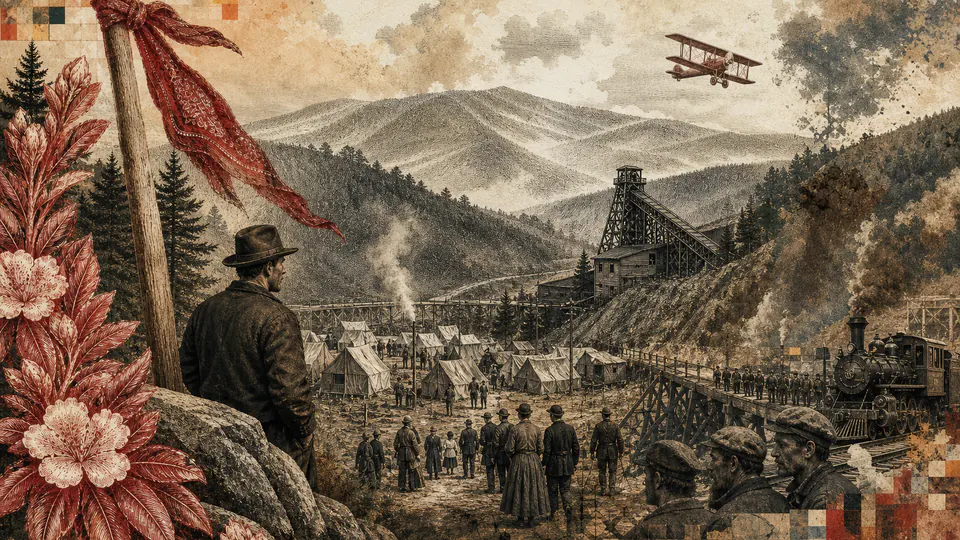
#storyFor nine days at the end of August and start of September 1921, something like 10,000 armed coal miners marched on Logan County, West Virginia, to fight their way through a private army defending the coalfields. It is the largest armed uprising in the United States since the Civil War, and before federal troops ended it, the government readied Army bombers loaded with poison gas for the miners still on the mountain.
Sheriff Don Chafin held the ridge with roughly 3,000 deputies, state police, and hired guards, paid for by the Logan County Coal Operators Association. Estimates of the miners’ side run from about 7,000, the figure on the state historical marker, to as many as 15,000; ten thousand is the figure that shows up most often in the record. Whatever the exact count, it was the largest armed force organized labor ever put in the field in this country, and the other side had airplanes.
Matewan, then Welch
The march had two immediate triggers, a little over a year apart. On May 19, 1920, agents of the Baldwin-Felts Detective Agency arrived in Matewan, Mingo County, to evict striking miners’ families from company housing. Matewan’s police chief, Sid Hatfield, sided with the miners and confronted the agents with arrest warrants. The gunfight that followed killed ten people: seven Baldwin-Felts men, including brothers Albert and Lee Felts, and three townspeople, among them Matewan’s mayor, Cabell Testerman. A jury acquitted Hatfield of murder, and the coalfields treated him as a hero for it.
West Virginia was not inventing this fight. Colorado’s Ludlow Massacre had already shown, in 1914, what a company’s private guards would do to a tent colony of strikers; the Baldwin-Felts agency ran the same playbook for the coal operators of southern West Virginia. The following year, the agency answered Matewan directly. On August 1, 1921, Hatfield and a friend, Ed Chambers, climbed the steps of the McDowell County courthouse in Welch, unarmed, wives at their sides, to face an unrelated charge. Baldwin-Felts men shot both of them dead on the steps. None of the shooters was convicted. They claimed self-defense. Thousands turned out for Hatfield’s funeral, and miners across the region started arming themselves within days.
A telegram that wasn’t real
United Mine Workers District 17, led by president Frank Keeney and secretary-treasurer Fred Mooney, called the miners to assemble in the Kanawha Valley. On August 24, with thousands gathered at Marmet and ready to march south, the union’s most famous organizer, Mother Jones, tried to stop them. She held up a telegram she said came from President Harding, promising he would end the mine-guard system if the miners went home. Keeney telephoned Harding’s secretary, George Christian, who told him no such telegram existed. Jones would not produce the document when the miners asked to see it. They marched anyway.
Chafin’s line
Chafin struck first, raiding the mining camp at Sharples on August 27 with about 70 officers. The main fighting opened three days later. On August 30, a 45-year-old miner and Baptist minister named John Wilburn told his congregation he was laying down his Bible to take up his rifle, and led 50 to 75 armed men up the mountain. At dawn his group ran into three of Chafin’s deputies, and the shooting started. Who fired first is disputed in the record: by one account, Deputy John Gore shot and killed a Black miner in Wilburn’s group, Eli Kemp, and died in the return fire; by the National Park Service’s telling, the miners wounded Gore first, Gore killed Kemp, and Wilburn’s men then finished Gore. Both versions end the same way, with Kemp and Gore dead and the battle open. The line, eventually some 15 miles of ridge, was held by miners Black and white together.
Across the battle, close to a million rounds reportedly went off along that ridge. Chafin’s side hired three private biplanes and dropped homemade bombs on the miners at Spruce Fork Ridge: two canisters of gas and two loaded with gunpowder, nuts, and bolts for shrapnel, according to the historian James Green. One bomb never exploded. Miners recovered it whole and later carried it into a courtroom as evidence.
Washington sends its own bombers
President Harding federalized troops on September 1. Separately, on the government’s order, General Billy Mitchell sent Army Air Service bombers into West Virginia, staged at an airfield near Charleston and loaded to drop gas on the miners below if the order came. The Appalachian Forest National Heritage Area, which researched the wreck of one of the planes, calls it the only time the US military has readied itself to bomb American citizens. The order never came. On September 3, Mitchell recalled the planes to Langley, Virginia, and one of them, a twin-engine Martin bomber called Bomber No. 5, went down in a storm over Nicholas County on the flight back, killing four of its five crew. No federal bomb ever reached Blair Mountain. The nearest the government came to gassing its own miners ended in a training-flight crash instead.
Miners lay down their rifles
More than 2,000 federal soldiers arrived under General Harry Bandholtz. Many of the miners were World War I veterans themselves, and by the accounts left behind, that mattered: they would fight Chafin’s private army, not the United States Army. By September 3 they were surrendering by the hundreds; roughly 1,000 turned their weapons in directly to federal troops, and the rest scattered home on their own. Nobody kept a reliable count of the dead. Figures for miners killed run from about sixteen, a modern historian’s estimate, to as high as a hundred, and for Chafin’s side up to around thirty, and every one of those numbers shows up in a source describing the same nine days.
The trials, and who never stood one
West Virginia indicted 985 miners, on charges that ran from murder to treason against the state government. The trials moved to Charles Town, hundreds of miles from the coalfields. Bill Blizzard, the 28-year-old miner the union treated as the march’s field general, faced treason charges in three venues, Charles Town, Lewisburg, and Fayetteville; a jury acquitted him in the main trial, and prosecutors dropped the rest. The recovered dud bomb from Spruce Fork Ridge, entered as evidence, argued his side of the story better than any lawyer could. Keeney and Mooney, who had called the march in the first place, faced treason charges too, along with roughly twenty other UMWA officers. Most of the 985 either walked free or drew light sentences, the last of them paroled in 1925.
John Wilburn did not walk free. He and his son were convicted of murder for killing Deputy Gore, sentenced to eleven years apiece, had the term cut to five by one governor, and were pardoned by the next after three years in the state penitentiary. Sheriff Don Chafin, whose hired army held the ridge and whose planes dropped the bombs, was never charged with anything. Neither were the coal operators who paid for his army.
The union paid a longer bill than any courtroom handed down. Membership in the southern coalfields collapsed for most of the following decade, and union organizing did not return to those counties with legal protection behind it until the New Deal’s labor laws in the mid-1930s.
The Redneck Army
The West Virginia Mine Wars Museum records that miners tied red bandanas around their necks at Blair Mountain as a mark of their solidarity, and that they called their own force the Redneck Army. The word is older than the battle by about a century: dictionaries trace redneck to at least the 1830s, describing poor, sunburned white farm laborers across the rural South. The miners did not coin the insult. They wore it up the mountain.
A fight over the mountain that hasn’t stopped
The battlefield’s legal fight ran longer than any of the criminal trials. In 2006 it made the National Trust for Historic Preservation’s list of the country’s most endangered historic sites, threatened by mountaintop-removal mining. On March 30, 2009, roughly 1,600 acres of it were added to the National Register of Historic Places. Nine months later, on December 30, 2009, it came back off, after Alpha Natural Resources and Arch Coal, two coal companies holding overlapping mining permits on the ridge, produced a list of landowners objecting to the listing.
A Charleston attorney checked that list. Two of the objectors were dead, one of them for 27 years. Two more were life-estate holders who did not legally own the land they lived on. US District Judge Reggie B. Walton ruled on April 11, 2016 that federal officials had accepted the state’s list without checking a single name on it, called the delisting “arbitrary and capricious,” and sent the case back. On June 27, 2018, the Keeper of the National Register restored the listing, calling the earlier removal a mistake. A century after Don Chafin’s line, the mountain was still being fought over, on paper this time, by people who had learned to read a deed book.
What people get wrong
#wrong- The myth
The miners' march on Blair Mountain was a rebellion against the United States government. - The record
The National Park Service's account notes the miners surrendered readily once federal troops arrived, because they were fighting Sheriff Don Chafin's private army and the state's mine-guard system, not the federal government. They would fight local and state power, not the U.S. Army.
- The myth
Miners at Blair Mountain coined the word "redneck" from the red bandanas they wore into battle. - The record
Dictionaries trace "redneck" as a term for poor, sunburned rural white laborers back to at least 1830, about a century before the battle. The miners who called themselves the Redneck Army in 1921 adopted an existing insult rather than inventing one.
- The myth
Most of the 985 miners indicted after the battle went to prison for it. - The record
The state's murder and treason cases against the miners mostly collapsed. HISTORY's account of the trials describes hundreds indicted for murder as "nearly all later acquitted," and the West Virginia Encyclopedia identifies preacher John Wilburn as "one of the few people convicted of murder for his participation in the Battle of Blair Mountain," sentenced to eleven years, cut to five, and pardoned after three.
The dates that matter
#dates- May 19, 1920 Baldwin-Felts agents and Matewan's armed residents fight in the streets; ten die, including detectives Albert and Lee Felts and Mayor Cabell Testerman.
- August 1, 1921 Baldwin-Felts men shoot Matewan police chief Sid Hatfield and his friend Ed Chambers dead on the McDowell County courthouse steps in Welch.
- August 24, 1921 Thousands of miners gather at Marmet to march on Logan County; Mother Jones produces a telegram claimed to be from President Harding, which union leaders expose as fake.
- August 27, 1921 Sheriff Don Chafin raids the Sharples mining camp with about 70 officers.
- August 30, 1921 Rev. John Wilburn leads armed miners up the mountain; miner Eli Kemp and Deputy John Gore both die in the opening exchange of fire.
- September 1, 1921 Private biplanes hired by Chafin's side drop gas and shrapnel bombs on the miners; President Harding federalizes troops.
- September 3, 1921 The Army recalls its own gas-loaded bombers before any of them drop a bomb; Bomber No. 5 crashes in Nicholas County on the flight back, killing four crew.
- September 3-4, 1921 Miners surrender to arriving federal troops rather than fight the US Army; roughly 1,000 turn in their weapons.
- 1922 Bill Blizzard is acquitted of treason in Charles Town after the recovered, unexploded bomb is entered as evidence.
- 1925 The last miners convicted after the battle are paroled.
- March 30, 2009 Roughly 1,600 acres of the battlefield are added to the National Register of Historic Places.
- December 30, 2009 The battlefield is delisted after Alpha Natural Resources and Arch Coal submit a list of objecting landowners.
- April 11, 2016 A federal judge rules the delisting unlawful, finding the objector list included dead landowners that officials never verified.
- June 27, 2018 The Keeper of the National Register restores the battlefield's listing.
Questions people ask
#faqsWhat was the Battle of Blair Mountain?
A nine-day armed confrontation in late August and early September 1921, when roughly 10,000 union coal miners marched on Logan County, West Virginia to break the mine-guard system, and were met by Sheriff Don Chafin's private army of about 3,000 men on a ridge called Blair Mountain. Federal troops ended it. It remains the largest armed uprising in the United States since the Civil War.
How many people died at Blair Mountain?
Nobody kept a reliable count at the time, and estimates still vary widely. Figures for miners killed run from about sixteen to as high as a hundred; estimates for Chafin's side run up to around thirty. Four more men, Army airmen, died separately when their recalled bomber crashed during the operation.
Did the US government really try to bomb the miners?
Private biplanes hired by Chafin's side dropped homemade bombs, gas canisters and shrapnel loaded with nuts and bolts, on the miners on September 1, 1921. Separately, the US Army staged its own bombers in West Virginia loaded to drop gas if ordered: the only time, according to the historians who researched the incident, the military has readied itself to use aerial gas on American citizens. The order never came, and the planes were recalled before any federal bomb fell.
Where does the word redneck actually come from?
Not from Blair Mountain, even though the miners there wore red bandanas and called themselves the Redneck Army. Dictionaries trace redneck, as a term for poor, sunburned white farm laborers, back to at least the 1830s, roughly a century before the battle. The miners took an existing insult and wore it into a gunfight; they did not invent it.
Is the Blair Mountain battlefield protected today?
Yes, as of 2018. The site was added to the National Register of Historic Places in March 2009, removed nine months later after coal companies with mining permits on the ridge produced a list of objecting landowners, and restored in 2018 after a federal court found in 2016 that the objector list had never been verified and included dead landowners.
The bookshelf
#bookshelfWhere to go next. Buy from an independent bookstore, or find it at your library for nothing.
-
Struggle in the Coal Fields: The Autobiography of Fred Mooney Fred Mooney, 1967 primary
The UMWA District 17 secretary-treasurer who helped call the march, in his own words.
-
The Devil Is Here in These Hills: West Virginia's Coal Miners and Their Battle for Freedom James Green, 2015 secondary
The standard modern history, from the historian this site's own sources quote on the bombing runs.
-
The Battle of Blair Mountain: The Story of America's Largest Labor Uprising Robert Shogan, 2004 secondary
A tighter narrative account focused on the nine days of fighting itself.
Wear it: Battle of Blair Mountain
#merchEvery design here links back to this page.

Sources
#sourcesPrimary sources
The documents themselves: laws, court opinions, speeches, letters, and the numbers from the agencies that count them.
- We Never Forget, "District 17 Leaders Denounce Mother Jones; Telegram from President Harding Declared a Fake" (reproduces the Wheeling Intelligencer's August 25, 1921 account and Fred Mooney's memoir)
Secondary sources
Written afterward, about the story.
- Wikipedia, "Battle of Blair Mountain"
- Wikipedia, "Battle of Matewan"
- Wikipedia, "Sid Hatfield"
- Wikipedia, "Redneck" (etymology and the contested Blair Mountain origin claim)
- National Park Service, "The Battle of Blair Mountain" (quotes historian James Green on the bombs dropped over Spruce Fork Ridge)
- Smithsonian Magazine, "What Made the Battle of Blair Mountain the Largest Labor Uprising in American History"
- HISTORY, "The Battle of Blair Mountain"
- West Virginia Mine Wars Museum, on the 1921 march
- Appalachian Forest National Heritage Area, "Loss of Bomber No. 5"
- West Virginia Encyclopedia, "John Wilburn Trial"
- Grist, "Blair Mountain Scandal Caps Mountaintop Removal Mayhem"
- The Cultural Landscape Foundation, "The Battle of Blair Mountain Is Still Being Waged"
- Appalachian Voices, "Blair Mountain Returns to National Register of Historic Places"