Published
Americans with Disabilities Act
Americans with Disabilities Act: The coalition, compromises, Capitol action, and enforcement record behind the ADA
A sourced account of Americans with Disabilities Act, covering the organizing, conflict, limits, and consequences behind the familiar version.
The story
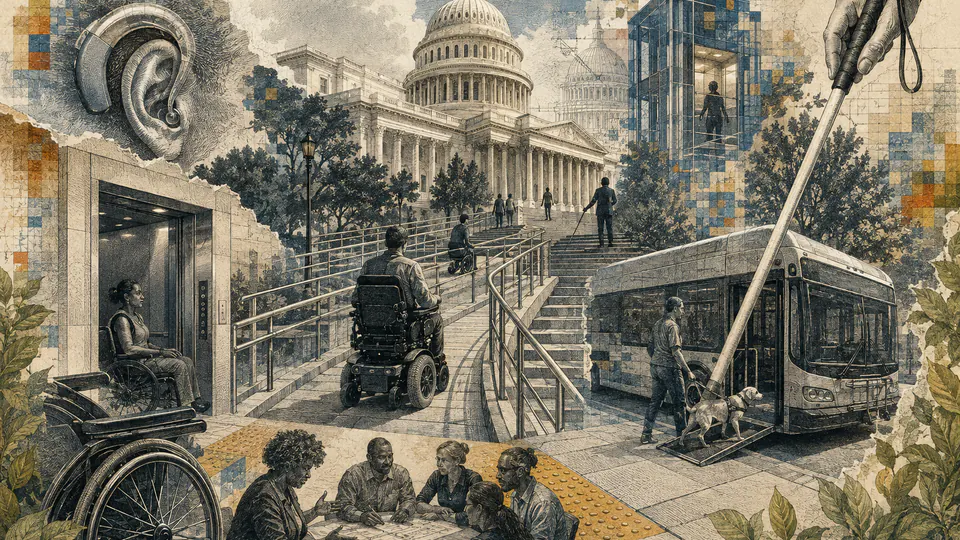
#storyThe familiar version of Americans with Disabilities Act usually begins at the moment cameras, police, or a national audience arrived. That makes a clean story and a bad explanation. The coalition, compromises, Capitol action, and enforcement record behind the ADA. To understand that claim, the organizing before the famous scene and the institutions after it have to remain in view.
The ADA resulted from decades of organizing that translated access into enforceable duties for employers, governments, transport, and public businesses. That is the article’s measure of success. It asks who gained the power to make a decision, which rule changed, who remained outside it, and whether the gain lasted after attention moved elsewhere.
The conditions came before the headline
1973: Section 504 establishes a federal disability-discrimination rule for funded programs. 1986: The National Council on Disability proposes a broad federal civil-rights statute. Those events established the field on which later choices were made. People did not enter it with equal money, legal standing, mobility, safety, or access to the press. An order that looked ordinary to those who administered it could feel like a permanent emergency to those made to live under it.
This context does not turn participants into passengers of large forces. It identifies the constraints they learned to use. A workplace schedule could become a contact list. A church, apartment, union hall, campus, newspaper, or neighborhood association could become an office. A court case could collect evidence for a campaign, while a campaign could make judges and officials understand that a case would not disappear without resistance.
Organization made the public moment possible
1988: A first Americans with Disabilities Act bill is introduced in Congress. March 12, 1990: Disabled protesters climb or gather at the Capitol steps during a day of lobbying and direct action. Neither development moved by reputation alone. Organizers needed places to meet, ways to settle disputes, trusted people who could carry information, money for food and transport, and plans for arrest, dismissal, or retaliation. That daily work determined who could remain involved when the first burst of attention ended.
Coalition added reach and friction. Participants could share a target while disagreeing about tactics, leadership, parties, weapons, negotiation, or the desired settlement. Those arguments were evidence of real stakes. Unity imposed from above would have hidden differences without resolving them. Durable cooperation required rules for making decisions and a distribution of risk that people considered fair enough to continue.
The link to civil-rights organizing is practical. Rights become usable through registration, representation, hearings, contracts, budgets, and enforcement. Moral language can name an injury. Organization identifies the person or institution able to stop it and creates a cost for refusal.
Conflict exposed where authority sat
July 1990: Congress passes a revised bill covering employment, government, public accommodations, transport, and telecommunications. July 26, 1990: President George H. W. Bush signs the ADA. At that point, opponents did more than offer a different opinion. They used the authority available to them: ownership, police, courts, party rules, licensing, hiring, firing, surveillance, or control of public information. The response reveals which interests a supposedly neutral system was prepared to protect.
Organizers also made choices under pressure. A dramatic tactic could bring attention while exhausting money. A legal compromise could protect people immediately while leaving a larger demand unanswered. Central leadership could coordinate action while silencing local knowledge. The right question is not whether every decision looks pure in hindsight. It is what alternatives existed, who bore their risks, and what the participants knew at the time.
This is where labor organizing enters the story. Work, housing, public space, education, policing, and voting were connected even when law placed them in separate boxes. A person blocked in one institution arrived at the next with fewer resources. Organizing across those boundaries could create power, but it also required more time and broader accountability.
A result is larger than a victory label
1999: Olmstead v. L.C. holds that unjustified institutional isolation can violate the ADA. 2008: Congress broadens the statutory definition of disability after restrictive court decisions. These later events prevent a simple ending. A campaign may lose its immediate demand and still train leaders, expose a system, or leave a tactic others can use. It may win a law whose exclusions reproduce part of the old order. It may build an organization that protects members while becoming less willing to take the risks that built it.
Coverage, exemptions, complaint-driven enforcement, inaccessible design, and the cost of litigation leave a gap between a formal right and daily access. Naming that limit does not cancel the achievement. It identifies the next conflict and gives credit to people who challenged the movement from within. Race, gender, class, citizenship, occupation, sexuality, and disability affected who was heard and who could survive retaliation. These were contemporary disputes, not standards invented after the fact.
The economic questions also continued. economic justice concerns who controls the resources needed to act: wages, time, transport, care, land, credit, and public services. Formal access without those resources can leave a right unusable. Material gains without a protected voice can disappear when management or government changes direction.
The archive has interests too
No source type sees the whole event. Government files document what an agency counted, feared, or prosecuted, often in the agency’s own language. Organizational minutes show plans and votes but may omit informal labor. Newspapers capture public claims while repeating the prejudices of owners, editors, police, or advertisers. Oral histories restore texture and motive, though memory recorded later can compress dates and settle old arguments too neatly.
The responsible method is comparison. When several independent records agree, a claim grows stronger. When they conflict, the disagreement belongs in the story. A missing name can show who lacked formal authority, but absence from minutes does not prove absence from the work. A famous quotation should be traced to a recording, transcript, letter, or contemporary report before it carries an argument.
What this history leaves us
Americans with Disabilities Act matters because power was made visible in use. Participants learned which office could delay, which employer could punish, which law could be enforced, and which alliance could outlast a news cycle. Their answers were incomplete because all political answers are made under conditions they do not fully control.
The useful inheritance is therefore neither worship nor dismissal. Keep the organizing methods, measure the result, name the exclusions, and follow the institution after the celebration. That approach preserves drama without turning history into a poster. It also preserves the people whose patient work made the remembered moment possible.
Strategy can be measured in resources
The ADA resulted from decades of organizing that translated access into enforceable duties for employers, governments, transport, and public businesses. The sentence becomes more concrete when translated into resources. Who controlled the meeting room, membership list, printing bill, defense fund, car, telephone, childcare, food, medical help, or legal filing? Who could miss a shift, and who lost rent money by doing so? Those questions explain why an idea that sounded popular might remain weak and why a smaller group with trusted organization could alter an institution.
Opponents performed the same calculation. Delay could drain a strike fund or outlast public attention. Selective concessions could separate a coalition. Arrest or firing could remove a local leader without answering the demand. A hearing could collect testimony while postponing enforcement. A sympathetic statement could preserve an official’s reputation at lower cost than changing a budget or rule. Strategy meant recognizing those moves early enough to answer them.
Coverage, exemptions, complaint-driven enforcement, inaccessible design, and the cost of litigation leave a gap between a formal right and daily access. The limit belongs inside the account because it affected the available strategy. People excluded from leadership often saw danger first. They knew which promise could not be enforced, which compromise shifted costs downward, and which supporter would leave after the photograph. Their criticism was organizational knowledge, even when officers treated it as disloyalty.
Three measures help separate durable change from ceremony. Capacity asks whether more people could act together after the campaign. Distribution asks who received money, time, safety, standing, or control. Enforcement asks what happened when an employer, agency, or leader ignored the new rule. A result can score well on one measure and poorly on another. That mixed finding is more informative than forcing the story into triumph or failure.
It also keeps the history alive without pretending the present is identical. The names of agencies, industries, and organizations change. The work of building trust, sharing risk, recording decisions, testing a promise, and preparing for retaliation remains recognizable. Americans with Disabilities Act offers evidence about that work, including evidence of what could not be solved in one campaign or one lifetime.
What people get wrong
#wrong- The myth
The ADA covers every business, no matter how small. - The record
Title I's employment provisions apply to employers with 15 or more employees. Title III's public accommodations rules apply regardless of a business's size, but religious organizations are exempt from Title III entirely, subject only to employment provisions and local building codes.
- The myth
Churches and other houses of worship automatically follow ADA accessibility rules like any public business. - The record
ADA.gov states plainly that religious organizations are exempt from Title III's public accommodations requirements, though they can still be bound by employment provisions and by state or local building codes that require access.
- The myth
Passing the ADA in 1990 settled who counts as disabled under the law. - The record
Two Supreme Court rulings, Sutton v. United Air Lines (1999) and Toyota Motor Manufacturing v. Williams (2002), narrowed coverage by requiring courts to weigh mitigating measures like medication when judging disability. Congress reversed that narrowing with the ADA Amendments Act of 2008, instructing courts to interpret disability in favor of broad coverage.
- The myth
ADA protection is mainly for people who use wheelchairs or have other visible disabilities. - The record
The statutory definition, as clarified in 2008, covers impairments affecting major life activities that include immune, digestive, neurological, and respiratory function alongside learning, concentrating, and communicating, so conditions with no visible marker can qualify for coverage.
The dates that matter
#dates- 1973 Section 504 establishes a federal disability-discrimination rule for funded programs.
- 1986 The National Council on Disability proposes a broad federal civil-rights statute.
- 1988 A first Americans with Disabilities Act bill is introduced in Congress.
- March 12, 1990 Disabled protesters climb or gather at the Capitol steps during a day of lobbying and direct action.
- July 1990 Congress passes a revised bill covering employment, government, public accommodations, transport, and telecommunications.
- July 26, 1990 President George H. W. Bush signs the ADA.
- 1999 Olmstead v. L.C. holds that unjustified institutional isolation can violate the ADA.
- 2008 Congress broadens the statutory definition of disability after restrictive court decisions.
Questions people ask
#faqsWhat was Americans with Disabilities Act known for?
The coalition, compromises, Capitol action, and enforcement record behind the ADA
Why does Americans with Disabilities Act matter?
The ADA resulted from decades of organizing that translated access into enforceable duties for employers, governments, transport, and public businesses.
What is often left out of this history?
Coverage, exemptions, complaint-driven enforcement, inaccessible design, and the cost of litigation leave a gap between a formal right and daily access.
How should the evidence be read?
Compare official records with movement papers, contemporary reporting, and participant accounts, because each preserves different actions and interests.
The bookshelf
#bookshelfWhere to go next. Buy from an independent bookstore, or find it at your library for nothing.
-
Being Heumann: An Unrepentant Memoir of a Disability Rights Activist Judith Heumann with Kristen Joiner, 2020 primary
A leader of the 504 sit-in and the ADA fight, in her own account of both.
-
No Pity: People with Disabilities Forging a New Civil Rights Movement Joseph P. Shapiro, 1993 secondary
The journalist's account, written just after the ADA passed, of the movement that forced it.
-
Enabling Acts: The Hidden Story of How the Americans with Disabilities Act Gave the Largest US Minority Its Rights Lennard J. Davis, 2015 secondary
The legislative and coalition history behind the bill's passage in Congress.
Wear it: Americans with Disabilities Act
#merchEvery design here links back to this page.
Sources
#sourcesPrimary sources
The documents themselves: laws, court opinions, speeches, letters, and the numbers from the agencies that count them.
Secondary sources
Written afterward, about the story.