Published
Pullman Strike
The Pullman Strike: When the Company Cut Wages but Kept the Rent
The 1894 Pullman strike became a national rail boycott, drew federal troops and an injunction, and sent Eugene Debs to jail.
The story
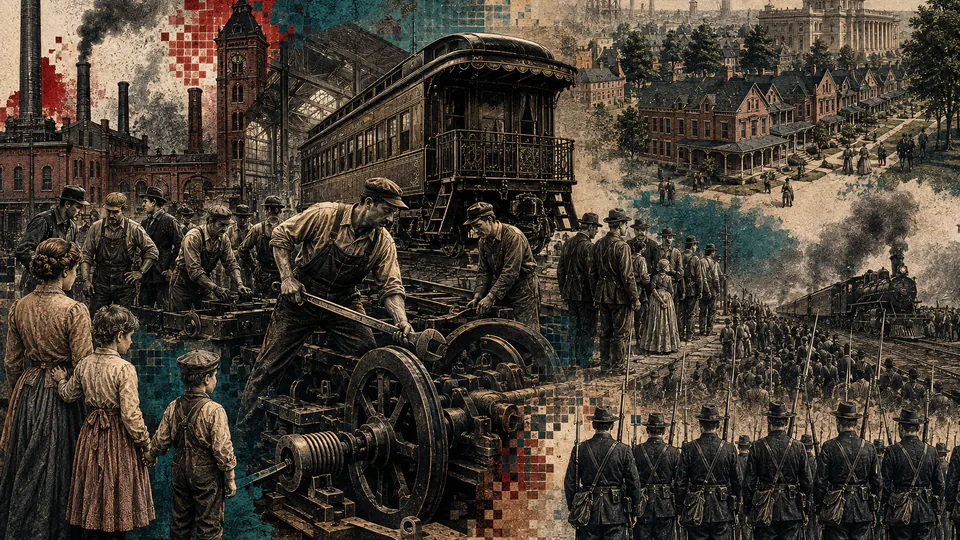
#storyPullman workers lived inside their employer’s balance sheet. The company owned the railcar factory south of Chicago, the houses around it, and much of the town’s public life. During the depression of 1893, Pullman cut jobs and wages while rents stayed high. A worker could take home a nearly empty envelope and still owe the company for the roof over it.
On May 11, 1894, workers struck. George Pullman refused arbitration. The dispute then left the town aboard the rail network his sleeping cars had made famous.
The ARU turned a strike into a boycott
Eugene Debs had founded the American Railway Union in 1893 as an industrial union open across railroad crafts, though its constitution excluded Black workers. Pullman employees joined and appealed to the union’s June 1894 convention. Delegates voted to stop handling Pullman cars unless the company agreed to arbitration.
The boycott began June 26 and spread across western railroads. Managers attached Pullman cars to mail trains and coordinated through the General Managers’ Association. That arrangement made interruption of the mail a federal weapon.
Injunction first, soldiers next
Attorney General Richard Olney, a former railroad lawyer, obtained a broad injunction on July 2 under federal commerce and antitrust theories. President Grover Cleveland ordered troops to Chicago over Governor John Peter Altgeld’s protest. Violence and property destruction increased amid the confrontation. People were killed in Chicago and elsewhere as troops and marshals moved against crowds.
Union officers were arrested, replacement workers ran trains, and the boycott broke. Debs served six months for contempt after violating the injunction. In jail he read socialist writing and reconsidered the power of craft and electoral politics.
The company won and lost
Workers returned without winning their demands. The ARU collapsed. Federal courts had demonstrated how an injunction could turn a labor dispute into contempt charges before a jury heard the underlying conflict.
Pullman kept its factory, but the company town’s moral advertising was ruined. A presidential commission criticized the company’s control and refusal to lower rents. In 1898 the Illinois Supreme Court ordered Pullman to sell its nonindustrial property.
The strike became part of the road toward broader industrial unionism and later limits on labor injunctions. Its central fact remains plain enough: a boss who controlled both sides of a worker’s pay envelope cut one side and protected the other, then called the federal government when the workers objected.
The sequence changes the argument
Accounts often compress the Pullman Strike into a clash between one railroad company and its employees. The chronology makes a larger claim. Pullman cut wages during the depression of 1893 while rents in its company town did not fall in step. Workers who presented grievances found that paternal promises offered no independent way to compel an answer. Neither fact is background decoration. Together they explain why the conflict took the form it did and why participants did not treat patience as a serious answer.
The American Railway Union voted to support the Pullman workers by refusing to handle trains carrying Pullman cars. That boycott spread because rail labor was interconnected, and it also gave railroad managers and federal officials a national target. The work depended on meetings, transportation, money, printed material, trusted messengers, and people willing to absorb retaliation. Public memory usually preserves the microphone or the confrontation. Organization lived in the less photogenic decisions that made a crowd, vote, strike, or policy demand possible.
Power worked through institutions
The central dispute concerned who could set the terms of industrial life when housing, wages, transport, courts, and troops reinforced one another. That question could not be settled by a good argument alone. Employers, public officials, courts, parties, unions, churches, and newspapers controlled different resources. Organizers had to identify which body could change a rule, which ally could move it, and what pressure could make delay more expensive than action.
The federal government obtained an injunction and sent troops to Chicago on the ground that the strike obstructed the mails and interstate commerce. Violence and property destruction followed, while union leaders disputed the claim that soldiers were needed to restore order. Those outcomes belong in the same account. A movement can gain public sympathy and still lose an immediate demand. It can win a statute while leaving people outside its coverage. It can build an institution that later becomes cautious. Calling one moment a victory or defeat without naming the measure hides more than it explains.
The limits were part of the result
Debs was jailed for defying the injunction, and the Supreme Court later upheld broad federal authority in the dispute. A federal commission criticized Pullman’s labor relations even though the strike ended in defeat for the workers. These limits were not footnotes added by later critics. Participants argued about them at the time, often from unequal positions. Race, gender, citizenship, occupation, geography, and access to money affected who took the greatest risk and who received authority after a campaign became respectable.
This is why coalition should be treated as work rather than a photograph. Groups can share an opponent while wanting different remedies. They can cooperate on a march and disagree about a contract, a party, a war, or the pace of change. The useful question concerns the rules that allowed people to decide together, what resources they shared, and whose objections were easier to ignore.
What the record lets us say
The source trail matters because later retellings reward drama and erase maintenance. Government records show what officials claimed and enforced. Organizational papers show plans, budgets, arguments, and revisions. Oral histories recover work that formal minutes often omit, though memory recorded years later has its own limits. Newspapers capture public language while reflecting the interests and racial habits of editors. Reading those records against one another makes uncertainty visible instead of filling it with a convenient quotation.
The durable lesson of the Pullman Strike is practical. Rights need procedures, money, institutions, and people able to enforce them after attention moves elsewhere. A law can change the field without ending the contest. A lost campaign can train organizers, expose an alliance, or leave a demand that later movements can use. History becomes more useful when it preserves both the achievement and the bill that remained unpaid.
What people get wrong
#wrong- The myth
Debs was criminally convicted for organizing the strike. - The record
Debs and other ARU officers were indicted for contempt of the federal injunction, not tried and convicted of a crime for striking. The Supreme Court's In re Debs decision upheld the government's authority to use that injunction, and it was the contempt citation, not a jury verdict, that sent him to prison for six months.
- The myth
Illinois asked Washington to send federal troops to Chicago. - The record
President Cleveland ordered thousands of U.S. Marshals and Army troops into Chicago over the head of Illinois Governor John Peter Altgeld, not at his request.
- The myth
The Pullman strike stayed a local dispute at one factory. - The record
The American Railway Union, with roughly 150,000 members across the country, voted at its June 1894 convention to boycott the handling of Pullman cars nationwide, which turned a factory dispute south of Chicago into a strike that reached western railroads across the country.
The dates that matter
#dates- 1893 A national depression cuts orders and employment at Pullman.
- May 11, 1894 Pullman factory workers strike after failed negotiations.
- June 26, 1894 The American Railway Union begins its boycott of Pullman cars.
- July 2, 1894 A federal court issues a sweeping injunction against the boycott.
- July 3, 1894 President Cleveland orders federal troops toward Chicago.
- July 1894 The boycott collapses under military force, injunctions, and replacement labor.
- 1895 Eugene Debs serves six months for contempt of the injunction.
- October 1898 The Illinois Supreme Court orders Pullman to sell its nonindustrial town property.
Questions people ask
#faqsWhy did Pullman workers strike?
The company cut wages during the depression while leaving rents in its company town largely unchanged, then refused meaningful negotiation with a worker committee.
What did Eugene Debs do in the Pullman strike?
Debs led the American Railway Union, which voted to boycott trains carrying Pullman cars. He urged restraint at points but backed the boycott and was jailed for defying a federal injunction.
Why did federal troops enter the Pullman strike?
The Cleveland administration argued that the boycott obstructed interstate commerce and the mail. It obtained an injunction and sent troops over Illinois governor John Peter Altgeld's objection.
Did the Pullman strike succeed?
No. The boycott was broken, workers returned without their demands, and the American Railway Union collapsed. The conflict exposed company-town control and expanded federal use of injunctions against labor.
The bookshelf
#bookshelfWhere to go next. Buy from an independent bookstore, or find it at your library for nothing.
-
Debs: His Life, Writings and Speeches Eugene V. Debs and Stephen Marion Reynolds, 1908 primary
Debs's own account of the strike and the prison term that turned him toward socialism, in his own words.
-
The Bending Cross: A Biography of Eugene Victor Debs Ray Ginger, 1949 secondary
The standard Debs biography, with the Pullman injunction as its turning chapter.
-
The Pullman Strike: The Story of a Unique Experiment and of a Great Labor Upheaval Almont Lindsey, 1942 secondary
The full academic history of the company town, the boycott, and the injunction that broke it.
Wear it: Pullman Strike
#merchEvery design here links back to this page.
Sources
#sourcesSecondary sources
Written afterward, about the story.