Published
Housing Justice
Housing Justice Asks Who Gets a Home and Who Gets an Asset
Housing-justice movements confront segregation, eviction, rent, displacement, homelessness, unsafe conditions, and the treatment of shelter as an investment vehicle.

The story
#storyHousing is where several systems send the bill. Wages determine what rent is possible. Land-use rules determine what can be built. Credit decides who can buy. Transit shapes which jobs are reachable. Policing, disability access, schools, insurance, and taxes all enter through the address.
The federal government did not merely fail to prevent segregation. New Deal mortgage programs helped create a mass homeownership system that favored white borrowers and new segregated suburbs. Redlining maps and underwriting rules denied many Black neighborhoods conventional credit. Racial covenants and local zoning reinforced the division.
The same policy can create shelter and displacement
Postwar urban renewal cleared neighborhoods labeled blighted, often moving Black and Latino residents for highways, offices, and institutions. Public housing provided homes and was also segregated, isolated, and starved of funds. The Fair Housing Act of 1968 outlawed major forms of discrimination but did not restore property, cheap credit, or accumulated wealth.
Tenant organizing works from a fact landlords already understand: renters in the same building share an economic relationship. Acting together can win repairs, resist evictions, bargain over rent, and prevent retaliation from remaining an individual problem. Rent regulation, vouchers, public and social housing, community land trusts, and zoning reform address different pieces and can conflict when designed around different beneficiaries.
The 2007-2010 foreclosure crisis again showed how extraction follows older maps. Predatory loans were concentrated in Black and Latino communities, and lost homes meant lost savings and inheritance. Housing justice therefore asks two linked questions: can people remain safely housed now, and who owns the land and wealth their payments create?
Policy tools answer different parts of that problem. Rent limits can slow displacement for current tenants but do not build a unit. Vouchers help pay private rent but can raise questions about landlord participation and public subsidy. Public and social housing can remove homes from speculative pricing if funding and tenant authority hold. Community land trusts separate land ownership from the building to preserve affordability across sales. Tenant right-to-counsel programs change the balance in eviction court. Housing justice depends on matching the instrument to the people who need protection, then checking who receives the subsidy and the appreciation.
Segregation was built through public and private rules
Racial housing inequality did not result only from individual prejudice. Local zoning, federal mortgage policy, real-estate practice, violence, restrictive covenants, and discriminatory lending worked together. Redlining maps classified many Black neighborhoods as poor credit risks, restricting affordable finance while public money supported suburban ownership elsewhere.
The Supreme Court barred judicial enforcement of racial covenants in Shelley v. Kraemer in 1948, but agents, lenders, sellers, and neighbors kept enforcing separation through other means. A legal barrier could fall while accumulated equity, school boundaries, and property access preserved its effects.
Public housing carried investment and control
Public housing supplied stable homes and addressed conditions private landlords had failed to remedy. Programs were also segregated, placed on isolated sites, and subject to rules that gave officials extensive authority over tenants.
Later demolition is often described as correction of a failed model. Federal funding cuts, concentrated poverty, poor maintenance, discriminatory placement, and job loss helped produce that failure. Redevelopment replaced some distressed buildings but did not always replace every deeply affordable home or guarantee residents a return.
Tenant organization changed public housing from a service administered to residents into a site of political power. Councils and rent strikes could demand repairs, contest rules, and insist that the people living in a development participate in decisions about its future.
Fair housing law needed an enforcement system
The 1968 Fair Housing Act prohibited discrimination in sale, rental, and financing on specified grounds. Congress passed it after years of organizing and days after the assassination of Martin Luther King Jr., who had faced violent opposition during the Chicago housing campaign.
Prohibition did not make discrimination easy to prove. Paired testing, complaint investigation, data, and legal representation reveal treatment an individual applicant may only suspect. Enforcement budgets determine whether a right can move faster than an eviction or lost purchase.
The law also requires attention to policies with discriminatory effects and to the public duty to advance fair housing. Those obligations become politically contested because genuine integration can require changing zoning, investment, and regional distribution of subsidized homes.
Rent converts scarcity into unequal bargaining power
Tenants need housing continuously, while a landlord with many units can spread risk. In a shortage, that imbalance supports rising rent, weak maintenance, fees, and retaliation. Eviction court can process cases faster than tenants can obtain counsel or emergency assistance.
Tenant unions, rent strikes, right-to-counsel programs, just-cause rules, rent stabilization, and code enforcement act on different parts of the relationship. No single policy supplies enough homes. New construction alone also fails if the homes are priced beyond those most likely to be displaced.
People without legal immigration status, disabled tenants, domestic-violence survivors, and people with criminal records can face distinct barriers. Housing justice must measure who actually gets through an application and remains housed, not only how many units receive permits.
Homelessness is a housing condition before it is a character judgment
People lose housing through rent increases, eviction, disability, family conflict, domestic violence, low wages, institutional discharge, and a shortage of affordable homes. Shelters may prevent immediate exposure while imposing curfews, separation, surveillance, or rules that exclude partners, pets, possessions, and people with particular needs.
Criminalizing sleeping, sitting, or camping moves people without producing a home. Fines and arrest can create new barriers to work and leasing. Supportive housing and rapid placement address the housing condition directly while services should remain available without turning every tenancy into a test of personal compliance.
Ownership models decide where appreciation goes
Homeownership has built wealth for many households while tax benefits and federal credit historically favored white buyers. Expanding access can repair part of that divide, but a high-cost loan or purchase in a declining market can transfer risk rather than wealth.
Community land trusts separate ownership of land from a home and limit resale prices to preserve affordability. Cooperatives give residents shared control. Social housing can keep units outside speculative markets. Each model makes a different bargain among individual equity, public subsidy, and long-term community benefit.
Housing justice is finally a question of power over place. A home must be safe and affordable today, and residents need a voice in what happens when a neighborhood becomes valuable tomorrow. Otherwise, public improvement can arrive as the notice that the people who waited for it can no longer afford to stay.
Argue it
#argue4 claims about Housing Justice you can make out loud, the best case against each one, and the answer. Every number links to where it came from.
-
Claim 1
Rent stabilization keeps people in their homes. That part is not in dispute.
The evidence
San Francisco's 1994 expansion of rent control cut displacement by raising the odds a covered tenant stayed at the same address by nearly 20 percent, exactly the mechanism the policy is built for, according to a quasi-experimental study of the city's own records published in the American Economic Review in 2019.
Their best case
Cato Institute economists Ryan Bourne and Vanessa Brown Calder cite the same San Francisco study for the other side of the ledger: landlords facing rent control converted units to owner-occupied condos and other exempt uses, cutting the rental housing supply covered by the law by 15 percent, and the lost supply pushed market rents citywide up by more than 5 percent.
The answer
Diamond, McQuade, and Qian ran one study and reported both effects, so the honest tally is that rent control worked for the tenants it covered and shrank the market for everyone else over time. That is an argument for building alongside the protection, not for leaving tenants exposed while supply catches up on its own: the hourly wage a full-time worker needs to afford a two-bedroom apartment nationally, $34.73 in 2026 per the National Low Income Housing Coalition, sits $9.89 above what the average renter actually earns, a gap the private market has not closed in the decades economists have spent debating rent control.
-
Claim 2
Public housing collapsed because Congress refused to fund it, not because the idea failed.
The evidence
Congress barred housing agencies from growing the public housing stock at all in the 1998 Quality Housing and Work Responsibility Act, the Faircloth Amendment, then let the program's repair account run dry: the national capital backlog HUD counted at $25.6 billion in 2010 had grown to roughly $70 billion within a decade, and agencies lose more than 10,000 apartments a year to disrepair, over 139,000 units gone to demolition or disposition since 2000.
Their best case
Howard Husock of the Manhattan Institute, writing about the New York City Housing Authority, calls public housing 'a failed 1930s-era experiment in socialist housing' and points to a documented $18 to $26 billion NYCHA capital backlog, more than 300,000 tenants who went without heat or hot water one winter, and inspectors who falsified lead paint records, which he calls 'not only incompetence but malice.'
The answer
The falsified inspections are real and indefensible on their own terms. But NYCHA's collapse is the national pattern, not an exception to it: Congress has barred every housing authority in the country from building a single net new public housing unit since 1998, then underfunded the repair account for the stock that already exists by tens of billions of dollars. A landlord forbidden by law from expanding and left without money for the roof produces exactly what NYCHA produced, a story about Congress more than about the model itself.
-
Claim 3
Clearing an encampment does not end a person's homelessness. It moves where they sleep.
The evidence
HUD's own January 2025 count found 745,652 people homeless nationwide on a single night, 266,320 of them unsheltered, published May 29, 2026. The same year, the National Low Income Housing Coalition found only one in four eligible households receives any federal housing assistance at all, because Congress has never funded the programs to reach everyone who qualifies.
Their best case
The Cicero Institute, which wrote the model encampment-ban legislation now law in Texas, Missouri, and several other states, argues permanent supportive housing 'doesn't address homelessness, it creates demand for more homelessness and supports cronyism,' and that it takes 'between eight and 20 units of Permanent Supportive Housing to get one chronically homeless person off the street,' which it calls 'untenable as a solution.'
The answer
Building enough supportive housing to reach everyone is genuinely slow and underfunded, and that is the same funding gap the point-in-time count keeps measuring. But the National Alliance to End Homelessness's own tracked data shows permanent supportive housing keeps 98 percent of residents housed a full year after move-in, and one tracked Housing First program cut emergency-service spending by $31,545 per person over two years. A sanctioned encampment or a jail cell does not build a single unit and does not show up in that retention number at all.
-
Claim 4
Vouchers do not trap families in dependency. They buy children a better zip code, and it shows up in their paychecks decades later.
The evidence
Housing choice vouchers reach barely a quarter of eligible households, per the National Low Income Housing Coalition, because Congress has never funded the program to serve everyone who qualifies. Where a voucher pairs with a move to a lower-poverty neighborhood, the Moving to Opportunity experiment found children who moved before age 13 earned $3,477, 31 percent, more a year in their mid-twenties than children in the control group, and attended college at higher rates.
Their best case
Howard Husock argues vouchers pin a 30-percent-of-income rent share on recipients, so 'any increase in a recipient's wages above that amount leads to a steep rent increase,' which he says creates a strong disincentive to earn more, and that the benefit is 'open-ended,' with no exit built in, unlike reformed cash welfare.
The answer
The 30-percent design is a real marginal-cost problem inside the program and a fair target for reform. But Chetty, Hendren, and Katz tracked outcomes through tax records rather than survey answers and found the opposite of a dependency trap: children who used a voucher to leave a high-poverty neighborhood young grew up to earn measurably more and attend college more often, a return the authors calculated was large enough that the program could pay for itself in higher future tax revenue. Dependency is a risk worth designing against. It is not what the best data on outcomes shows.
What people get wrong
#wrong- The myth
Redlining was banks acting on their own bias. Washington was not involved. - The record
The federal Home Owners' Loan Corporation drew the original redlining maps in the 1930s, and the Federal Housing Administration then used that same grading system to decide which neighborhoods qualified for the mortgage insurance that built mass homeownership, a policy documented block by block in the University of Richmond's Mapping Inequality project. The government did not fail to stop private discrimination. It drew the map private lenders then followed.
- The myth
The 1968 Fair Housing Act ended housing discrimination. - The record
Fair housing organizations, HUD, and the Justice Department together logged 34,150 housing discrimination complaints in 2023 alone, up from 33,007 the year before, more than half of them over disability, according to the National Fair Housing Alliance's 2024 trends report. A law that bans an act and an act that has stopped happening are different facts.
- The myth
Homelessness is mainly a story about drug addiction, mental illness, or how generous a city's services are. - The record
Gregg Colburn and Clayton Page Aldern tested exactly those explanations against city-by-city and state-by-state data in Homelessness Is a Housing Problem (2022) and found none of them explained the regional variation in homelessness rates. The cost and availability of rental housing did.
The dates that matter
#dates- 1934 The Federal Housing Administration expands mortgage finance while underwriting racial segregation.
- 1930s Federal maps grade neighborhoods for lending risk and mark many Black communities in red.
- 1948 Shelley v. Kraemer bars courts from enforcing racially restrictive covenants.
- 1949-1970s Urban-renewal and highway projects displace many low-income Black and Latino communities.
- April 11, 1968 The Fair Housing Act prohibits specified forms of housing discrimination.
- 1977 The Community Reinvestment Act addresses discriminatory credit practices in underserved neighborhoods.
- 2007-2010 Foreclosure crisis strips wealth from communities targeted with predatory loans.
Questions people ask
#faqsWhat is housing justice?
It is the demand that everyone have safe, stable, accessible, affordable housing and meaningful control over the policies and markets that shape where they live.
What was redlining?
Government-backed maps and lending practices classified many Black and immigrant neighborhoods as hazardous credit risks, restricting mortgage access and reinforcing segregation.
What do tenant unions do?
Tenant unions organize renters to negotiate with landlords, resist eviction, improve conditions, limit rent increases, and press for changes in housing law.
How should Housing Justice be evaluated?
Separate the immediate result from the institutions, tactics, exclusions, and enforcement record that followed it.
The bookshelf
#bookshelfWhere to go next. Buy from an independent bookstore, or find it at your library for nothing.
-
Evicted: Poverty and Profit in the American City Matthew Desmond, 2016 secondary
Eight Milwaukee families and the eviction machinery that runs under them.
-
The Color of Law: A Forgotten History of How Our Government Segregated America Richard Rothstein, 2017 secondary
The government built segregation by statute and map, not by looking away.
-
Race for Profit: How Banks and the Real Estate Industry Undermined Black Homeownership Keeanga-Yamahtta Taylor, 2019 secondary
What happened after redlining officially ended and lenders found a new angle.
-
Homelessness Is a Housing Problem: How Structural Factors Explain U.S. Patterns Gregg Colburn and Clayton Page Aldern, 2022 secondary
The data that rules out addiction and mental illness as the main driver.
Wear it: Housing Justice
#merchEvery design here links back to this page.
 Design proof
 Hazel M. Johnson Engraved Tee
$36.00 Design proof
 Housing Justice Collage Tee
$36.00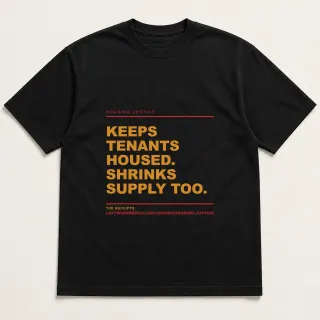 Design proof
 "Keeps tenants housed. Shrinks supply too." Tee
$36.00 Design proof
 "Keeps tenants housed. Shrinks supply too." Sticker
$5.00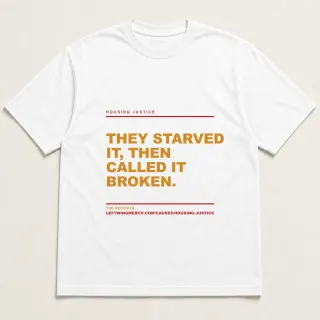 Design proof
 "They starved it, then called it broken." Tee
$36.00 Design proof
 "They starved it, then called it broken." Sticker
$5.00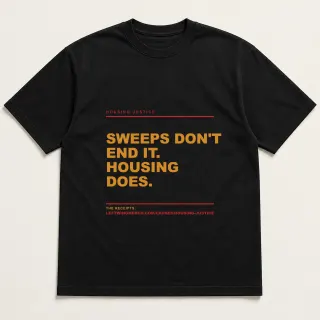 Design proof
 "Sweeps don't end it. Housing does." Tee
$36.00 Design proof
 "Sweeps don't end it. Housing does." Sticker
$5.00 Design proof
 "Vouchers buy a zip code. Paychecks show it." Tee
$36.00 Design proof
 "Vouchers buy a zip code. Paychecks show it." Sticker
$5.00Sources
#sourcesPrimary sources
The documents themselves: laws, court opinions, speeches, letters, and the numbers from the agencies that count them.
- HUD, Department History
- HUD, Fair Housing Act Overview
- Mapping Inequality, Redlining in New Deal America (reproduces the Home Owners' Loan Corporation's original 1930s security maps)
- Library of Congress, Housing
- U.S. Supreme Court, Shelley v. Kraemer
- National Archives, Fair Housing Act
- Census Bureau, housing data
- Rebecca Diamond, Tim McQuade, and Franklin Qian, "The Effects of Rent Control Expansion on Tenants, Landlords, and Inequality: Evidence from San Francisco," American Economic Review 109(9) (September 2019)
- National Low Income Housing Coalition, "Out of Reach 2026: The High Cost of Housing" (July 23, 2026)
- HUD, "New HUD Study: $26 Billion in Major Repairs Needed in Public Housing" (press release, June 24, 2011) (the $25.6 billion figure reflects 2010 data)
- HUD, "HUD Releases 2025 Annual Homelessness Assessment Report to Congress" (press release, May 29, 2026)
- Cicero Institute, homelessness policy statement
- Raj Chetty, Nathaniel Hendren, and Lawrence F. Katz, "The Effects of Exposure to Better Neighborhoods on Children," NBER Working Paper 21156
Secondary sources
Written afterward, about the story.
- Ryan Bourne and Vanessa Brown Calder, "Rent Control: An Old, Bad Idea That Won't Go Away," Governing (October 31, 2018)
- National Low Income Housing Coalition, "Public Housing: Where Do We Stand?"
- Howard Husock, "NYCHA's Failings Prove We Need to Rethink Public Housing," Manhattan Institute
- National Alliance to End Homelessness, "Housing First"
- Howard Husock, "Public Housing and Rental Subsidies," Manhattan Institute
- National Fair Housing Alliance, "2024 Fair Housing Trends Report"
- University of California Press, "Homelessness Is a Housing Problem" (book description)