Published
Selma Voting Rights
Selma: The Local Voting Fight Before and After Bloody Sunday
Selma's 1965 marches grew from years of local voter organizing, state repression, and conflict that forced federal voting law.
The story
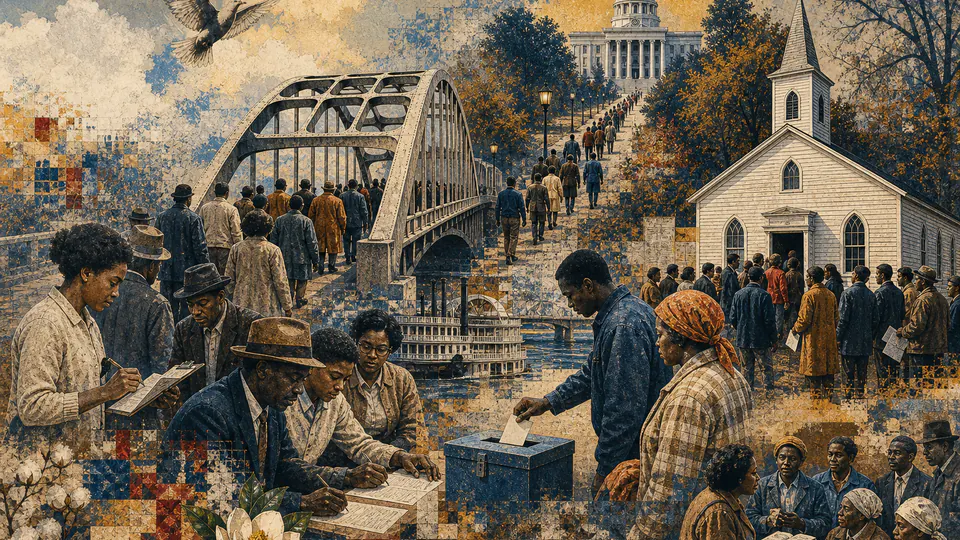
#storyBefore national cameras reached the Edmund Pettus Bridge, Selma’s Black residents had spent decades confronting a registrar built to say no. Amelia and Samuel Boynton and the Dallas County Voters League organized from the 1930s. SNCC workers joined local campaigns in the 1960s. SCLC arrived after a base already existed.
A death turned toward Montgomery
Alabama troopers attacked a February 1965 night march in Marion. Trooper James Fowler shot Jimmie Lee Jackson, who died eight days later. Organizers planned a 54-mile march from Selma to the state capitol.
On March 7, about 600 people crossed the bridge led by John Lewis and Hosea Williams. Troopers ordered them to disperse, then attacked with clubs and tear gas. Television carried the assault nationwide.
Three attempts, one federal law
Martin Luther King Jr. led a second march to the bridge on March 9 and turned around while a federal court considered protection. Judge Frank Johnson authorized the march. Thousands began on March 21, and about 25,000 reached Montgomery on March 25.
President Johnson had introduced voting-rights legislation after Bloody Sunday. He signed the Voting Rights Act on August 6. Federal examiners and preclearance rules attacked the machinery local officials had used for disfranchisement.
Selma became a national symbol because the attack was filmed. It became a campaign because people had been filing applications, holding meetings, and absorbing retaliation long before a camera found the bridge.
National attention rested on local infrastructure
The Dallas County Voters League challenged disfranchisement before national groups made Selma a campaign center. SNCC organizers Bernard and Colia Lafayette worked in the county from 1963, developing local leadership under surveillance and violence. SCLC’s arrival brought press and clergy networks to work already under way, along with a different style and recurring strategic disagreement.
The three marches performed different functions. Bloody Sunday exposed state violence. The second march preserved the coalition while a federal court considered protection. The final march, authorized by Judge Frank Johnson and protected by federalized Guard troops, demonstrated what enforcement could look like. The Voting Rights Act then gave the federal government tools against tests, registrars, and rule changes. The sequence joined community work, public confrontation, judicial action, executive power, and legislation. Removing any one of them makes the victory look easier than it was.
Local organizers worked before Selma became a national symbol
Black residents in Dallas County faced registrars who controlled applications, literacy tests, office hours, and approval. Employment and credit retaliation could follow an attempt to register. Sheriff Jim Clark used arrests and force against people challenging the system.
The Dallas County Voters League had pursued voting rights for years. SNCC organizers, including Bernard and Colia Lafayette, worked locally before SCLC entered the campaign. Their work involved canvassing, meetings, political education, and supporting residents who faced retaliation.
This chronology matters. National organizations could bring staff, money, media, and prominent leadership. Local people held the relationships and remained after attention moved away.
Competing organizations brought different strategic strengths
SNCC emphasized long-term local organizing and leadership from within communities. SCLC used mass meetings, dramatic confrontation, church networks, and King’s national position. The approaches overlapped and also produced conflict over timing, publicity, and control.
Competition did not mean one organization was unnecessary. A campaign could need deep canvassing and a national crisis at the same time. The question was whether outside attention increased local power or replaced it.
Selma’s history is stronger when these differences remain visible. Unity assembled for a march should not be mistaken for identical theories of change.
Jimmie Lee Jackson’s death changed the campaign’s route
During a February 1965 night march in Marion, Alabama state troopers attacked participants. Trooper James Bonard Fowler shot Jimmie Lee Jackson, who died days later. Jackson had been protecting family members from the assault.
Organizers proposed a march from Selma to the state capital in Montgomery. The route would carry the demand from local registration offices to Governor George Wallace and make state responsibility visible.
Jackson’s death was an act of state violence with a named victim, family, officer, and delayed legal accounting.
Bloody Sunday exposed enforcement by television
On March 7, 1965, about six hundred marchers crossed the Edmund Pettus Bridge. State troopers and local officers ordered them to disperse, then attacked with clubs, tear gas, and mounted force. John Lewis and many others were injured.
Broadcast images reached a national audience. Their impact depended on the campaign’s discipline and clear demand. Viewers saw citizens seeking access to voting confronted by armed government on a public highway.
Media attention did not create the injustice or guarantee action. It raised the political price for federal officials who could no longer describe the conflict as a misunderstanding at a county office.
Turnaround Tuesday remains a strategic dispute
King led a second march on March 9 after a federal judge issued a temporary order against proceeding to Montgomery. At the bridge, marchers prayed and turned back. Some organizers felt betrayed or believed a private assurance with officials had shaped the decision.
That evening, white minister James Reeb was attacked in Selma; he died two days later. His death received far more national coverage than the death of Jimmie Lee Jackson, revealing racial inequality in public attention even within the same campaign.
The turn protected participants from another possible assault while creating conflict over transparency and momentum. Strategic caution and movement trust both carried real stakes.
Court and executive power opened the final road
Federal Judge Frank Johnson ruled that marchers had a right to proceed. President Johnson federalized the Alabama National Guard and provided protection. The final march left Selma on March 21 and reached Montgomery on March 25.
Thousands joined the last stage. Viola Liuzzo, a white volunteer transporting marchers, was murdered by Ku Klux Klan members after the event. Federal protection of the route did not erase terror around it.
The march demonstrated why freedom of assembly and voting rights required enforcement against state officials rather than deference to them.
The Voting Rights Act changed the machinery
President Johnson introduced voting-rights legislation during the campaign and invoked the movement’s demand in a national address. Congress passed the Voting Rights Act, which he signed on August 6, 1965.
The law suspended literacy tests and authorized federal oversight and examiners in covered jurisdictions. Registration increased because local gatekeepers no longer held the same unchecked authority.
Later court decisions and legislation changed the Act’s reach, and new voting rules continue to produce conflict over discrimination and federal review. Selma’s lesson is institutional: a ballot right depends on who writes the form, sets the district, opens the office, reviews a change, and supplies a remedy before an election has passed.
What people get wrong
#wrong- The myth
Martin Luther King Jr. personally led the marchers across the Edmund Pettus Bridge on Bloody Sunday. - The record
King was in Atlanta on March 7, 1965. Hosea Williams and John Lewis led the roughly 600 marchers whom troopers and a mounted posse attacked at the bridge. King led the second, symbolic march two days later, on March 9, the day organizers call Turnaround Tuesday.
- The myth
The Selma voting rights campaign started with the 1965 marches. - The record
Amelia and Samuel Boynton organized voter registration in Dallas County from the 1930s, and SNCC organizers Bernard and Colia Lafayette built a local base there starting in 1963, two years before Bloody Sunday. The march used infrastructure that already existed.
- The myth
The Voting Rights Act of 1965 permanently ended the kind of voting discrimination Selma fought. - The record
In 2013, in Shelby County v. Holder, the Supreme Court struck down the Act's coverage formula for federal preclearance, ending the automatic federal oversight of the states and counties that included Selma's own Dallas County. States covered by the old formula changed voting rules afterward without that federal check.
The dates that matter
#dates- 1930s Amelia and Samuel Boynton organize voting rights in Dallas County.
- 1963 SNCC organizers help restart a public mass campaign in Selma.
- February 26, 1965 Jimmie Lee Jackson dies after being shot by an Alabama trooper.
- March 7, 1965 Troopers attack about 600 marchers on Bloody Sunday.
- March 21-25, 1965 The protected march reaches Montgomery.
- August 6, 1965 President Johnson signs the Voting Rights Act.
Questions people ask
#faqsWhat happened on Bloody Sunday?
On March 7, 1965, Alabama troopers and a mounted posse attacked nonviolent marchers after they crossed the Edmund Pettus Bridge.
Who led the Selma march?
Hosea Williams and John Lewis led Bloody Sunday. Local groups, SNCC, SCLC, the Dallas County Voters League, churches, and many named and unnamed organizers built the campaign.
How did Selma lead to the Voting Rights Act?
Televised state violence increased national pressure, and Johnson introduced voting-rights legislation eight days after Bloody Sunday. Congress passed it that summer.
How should Selma Voting Rights be evaluated?
Separate the immediate result from the institutions, tactics, exclusions, and enforcement record that followed it.
The bookshelf
#bookshelfWhere to go next. Buy from an independent bookstore, or find it at your library for nothing.
-
Bridge Across Jordan Amelia Platts Boynton, 1979 primary
The organizer who built the Dallas County campaign for three decades before the cameras arrived, in her own words.
-
Walking with the Wind: A Memoir of the Movement John Lewis with Michael D'Orso, 1998 primary
The man who led marchers across the bridge on Bloody Sunday, on what it cost.
-
Selma 1965: The March That Changed the South Charles Fager, 1974 secondary
A reporter who covered the campaign on the ground, on the organizing behind the three marches.
Wear it: Selma Voting Rights
#merchEvery design here links back to this page.
Sources
#sourcesPrimary sources
The documents themselves: laws, court opinions, speeches, letters, and the numbers from the agencies that count them.
Secondary sources
Written afterward, about the story.
- National Park Service, Selma to Montgomery History
- National Park Service, Bloody Sunday
- National Park Service, Tabernacle Baptist Church
- National Park Service, Selma to Montgomery Voting Rights March
- SNCC Digital Gateway, Selma voting rights (catalog search)
- King Institute, Selma to Montgomery March