Published
Homestead Strike
The Homestead Strike: Carnegie's Mill, Frick's Fence, and 300 Pinkertons
In 1892 Carnegie Steel locked out its union, sent Pinkertons up the Monongahela, and used state militia to retake the Homestead mill.
The story
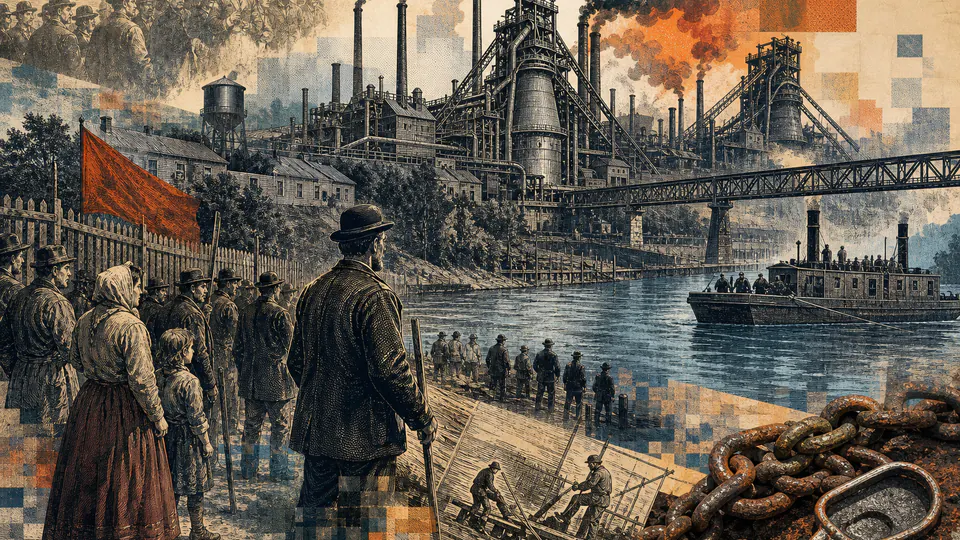
#storyThree hundred Pinkerton agents traveled up the Monongahela River on barges before dawn on July 6, 1892. Henry Clay Frick had hired them to take Carnegie Steel’s Homestead mill from locked-out workers and protect replacements. Workers and their families were waiting on the riverbank.
Gunfire lasted for hours. By the time the Pinkertons surrendered, workers and agents were dead. The union controlled the mill for a few more days. Then Pennsylvania sent 8,500 militia troops, which tells you whose control the state intended to restore.
A contract Carnegie wanted gone
The Amalgamated Association of Iron and Steel Workers represented skilled workers at Homestead and had won a three-year agreement in 1889. As its expiration approached, Carnegie and Frick sought lower wage scales and an end to the union’s control over work rules. The plant was profitable. Cost was part of the fight; authority was the larger part.
Frick built a high fence topped with barbed wire, advertised for replacement workers, and ended negotiations. The company locked workers out on June 30. Homestead residents organized patrols and watched the river.
Private force met a town
The Pinkertons tried to land at the mill. Accounts differ on who fired first, but the result does not: an armed battle between a private force and thousands of workers and townspeople. The agents eventually surrendered and were beaten while being marched through town. Death counts vary among institutional accounts; the National Park Service theme study reports nine workers and seven Pinkertons killed, while other summaries count seven workers and three agents. The sources do agree that the river landing became a lethal battle.
Governor Robert Pattison ordered militia to Homestead. Troops arrived July 12, took the works, and let the company bring in replacement labor. The strike continued but its physical control was gone.
An assassination attempt hurt the union
On July 23, anarchist Alexander Berkman entered Frick’s Pittsburgh office, shot him, and stabbed him. Frick survived. Berkman was not acting for the union, and union leaders condemned the attack. It still shifted sympathy toward management and let Carnegie Steel frame labor resistance through one man’s violence.
The Amalgamated ended the strike in November. Union membership collapsed, and steel remained difficult to organize for decades. The Wagner Act and the CIO era eventually opened another route, but Homestead workers did not get to borrow those later protections.
Carnegie built libraries with the fortune the mills produced. At Homestead, his company used a fence, a private army, and state troops to decide who controlled the work. The libraries kept his name. The riverbank kept the rest of the record.
The sequence changes the argument
Accounts often compress the Homestead Strike into a violent day beside a steel mill. The chronology makes a larger claim. Carnegie Steel sought to break the Amalgamated Association at Homestead while Andrew Carnegie remained in Scotland and Henry Clay Frick directed the confrontation. Workers fortified the town and maintained an elected advisory committee after the company locked them out. Neither fact is background decoration. Together they explain why the conflict took the form it did and why participants did not treat patience as a serious answer.
Frick hired Pinkerton agents who approached by barge before dawn on July 6, 1892. A gun battle killed men on both sides, and the Pinkertons surrendered after hours of fighting. The work depended on meetings, transportation, money, printed material, trusted messengers, and people willing to absorb retaliation. Public memory usually preserves the microphone or the confrontation. Organization lived in the less photogenic decisions that made a crowd, vote, strike, or policy demand possible.
Power worked through institutions
The central dispute concerned whether skilled industrial workers could control their union and conditions against a corporation prepared for a siege. That question could not be settled by a good argument alone. Employers, public officials, courts, parties, unions, churches, and newspapers controlled different resources. Organizers had to identify which body could change a rule, which ally could move it, and what pressure could make delay more expensive than action.
Pennsylvania militia occupied Homestead, allowing the company to bring replacement workers into the plant. Alexander Berkman’s attempt to assassinate Frick was not authorized by the union but damaged public support for the strikers. Those outcomes belong in the same account. A movement can gain public sympathy and still lose an immediate demand. It can win a statute while leaving people outside its coverage. It can build an institution that later becomes cautious. Calling one moment a victory or defeat without naming the measure hides more than it explains.
The limits were part of the result
The company defeated the strike and dismantled organized labor at the works for decades. The battle showed that technical skill alone could not preserve bargaining power when a firm commanded capital, private force, and state protection. These limits were not footnotes added by later critics. Participants argued about them at the time, often from unequal positions. Race, gender, citizenship, occupation, geography, and access to money affected who took the greatest risk and who received authority after a campaign became respectable.
This is why coalition should be treated as work rather than a photograph. Groups can share an opponent while wanting different remedies. They can cooperate on a march and disagree about a contract, a party, a war, or the pace of change. The useful question concerns the rules that allowed people to decide together, what resources they shared, and whose objections were easier to ignore.
What the record lets us say
The source trail matters because later retellings reward drama and erase maintenance. Government records show what officials claimed and enforced. Organizational papers show plans, budgets, arguments, and revisions. Oral histories recover work that formal minutes often omit, though memory recorded years later has its own limits. Newspapers capture public language while reflecting the interests and racial habits of editors. Reading those records against one another makes uncertainty visible instead of filling it with a convenient quotation.
The durable lesson of the Homestead Strike is practical. Rights need procedures, money, institutions, and people able to enforce them after attention moves elsewhere. A law can change the field without ending the contest. A lost campaign can train organizers, expose an alliance, or leave a demand that later movements can use. History becomes more useful when it preserves both the achievement and the bill that remained unpaid.
What people get wrong
#wrong- The myth
Carnegie was uninvolved in the decision to break the union because he was in Scotland when it happened. - The record
Carnegie wrote to Frick before the lockout that "the Firm has decided that the minority must give way to the majority. These works, therefore, will be necessarily non-union after the expiration of the present agreement," and had ordered the plant's inventory built up in advance so it could withstand a strike.
- The myth
The death toll from the July 6 battle is a single agreed-upon number. - The record
Sources disagree. The most common figures put striker deaths at seven with eleven injured, while Pinkerton deaths range from three to eight depending on the source: William Pinkerton testified only three agents died, while the agents' own report claimed seven.
- The myth
Alexander Berkman's attack on Frick was carried out for, or with, the Amalgamated Association. - The record
Berkman had no connection to steel or organized labor. He was a New York anarchist who planned the attack independently with Emma Goldman, and the attempt undermined public support for the union rather than helping it.
- The myth
Homestead's defeat wiped out the Amalgamated Association overnight. - The record
The union's membership fell in stages: from more than 24,000 in 1891 to 10,000 by 1894, 8,000 the year after that, and 6,300 by 1909. By 1900, no Pennsylvania steel plant remained unionized.
The dates that matter
#dates- 1889 The Amalgamated Association wins a three-year contract at Homestead.
- June 30, 1892 Carnegie Steel locks union workers out of the mill.
- July 6, 1892 Pinkerton agents arrive by barge and fight workers and townspeople.
- July 12, 1892 Pennsylvania militia occupies Homestead and secures the plant.
- July 23, 1892 Alexander Berkman shoots and stabs Henry Clay Frick, who survives.
- November 1892 The union ends the strike in defeat.
- 1893 Congress publishes an investigation of Pinkerton employment at Homestead.
Questions people ask
#faqsWhy did the Homestead strike happen?
Carnegie Steel sought wage cuts and an end to the Amalgamated Association's power when its contract expired in 1892. Henry Clay Frick locked workers out and prepared to reopen without the union.
Who were the Pinkertons at Homestead?
They were 300 armed agents hired by Carnegie Steel to secure the mill and protect replacement workers. They arrived on barges before dawn on July 6.
Who won the Homestead strike?
Carnegie Steel won. Pennsylvania militia occupied the town, replacement workers entered the plant, and the union surrendered in November.
Was Andrew Carnegie involved?
Yes. Carnegie was in Scotland, but correspondence and company preparations show that he supported breaking the union and left Frick to carry out the plan.
The bookshelf
#bookshelfWhere to go next. Buy from an independent bookstore, or find it at your library for nothing.
-
Living My Life Emma Goldman, 1931 primary
Goldman's own account of plotting the Frick attack with Berkman, and the union's reaction to it.
-
The Battle for Homestead, 1880-1892: Politics, Culture, and Steel Paul Krause, 1992 secondary
The standard academic history, strongest on the years of tension before the lockout.
-
Meet You in Hell: Andrew Carnegie, Henry Clay Frick, and the Bitter Partnership That Transformed America Les Standiford, 2005 secondary
The Carnegie-Frick relationship, before and after it broke the union and then them.
Wear it: Homestead Strike
#merchEvery design here links back to this page.

Sources
#sourcesPrimary sources
The documents themselves: laws, court opinions, speeches, letters, and the numbers from the agencies that count them.
- Library of Congress, Employment of Pinkerton Detectives (the 1893 congressional investigation record)
- Historic Pittsburgh, Battle of Homestead
Secondary sources
Written afterward, about the story.
- Library of Congress, 1892 Homestead Strike
- National Park Service, 200 Years of Labor History
- AFL-CIO, 1892 Homestead Strike
- National Park Service, Henry Clay Frick
- Library of Congress, Homestead Strike
- Wikipedia, "Homestead strike" (Carnegie's correspondence, disputed death toll, Berkman's independence from the union, membership decline)